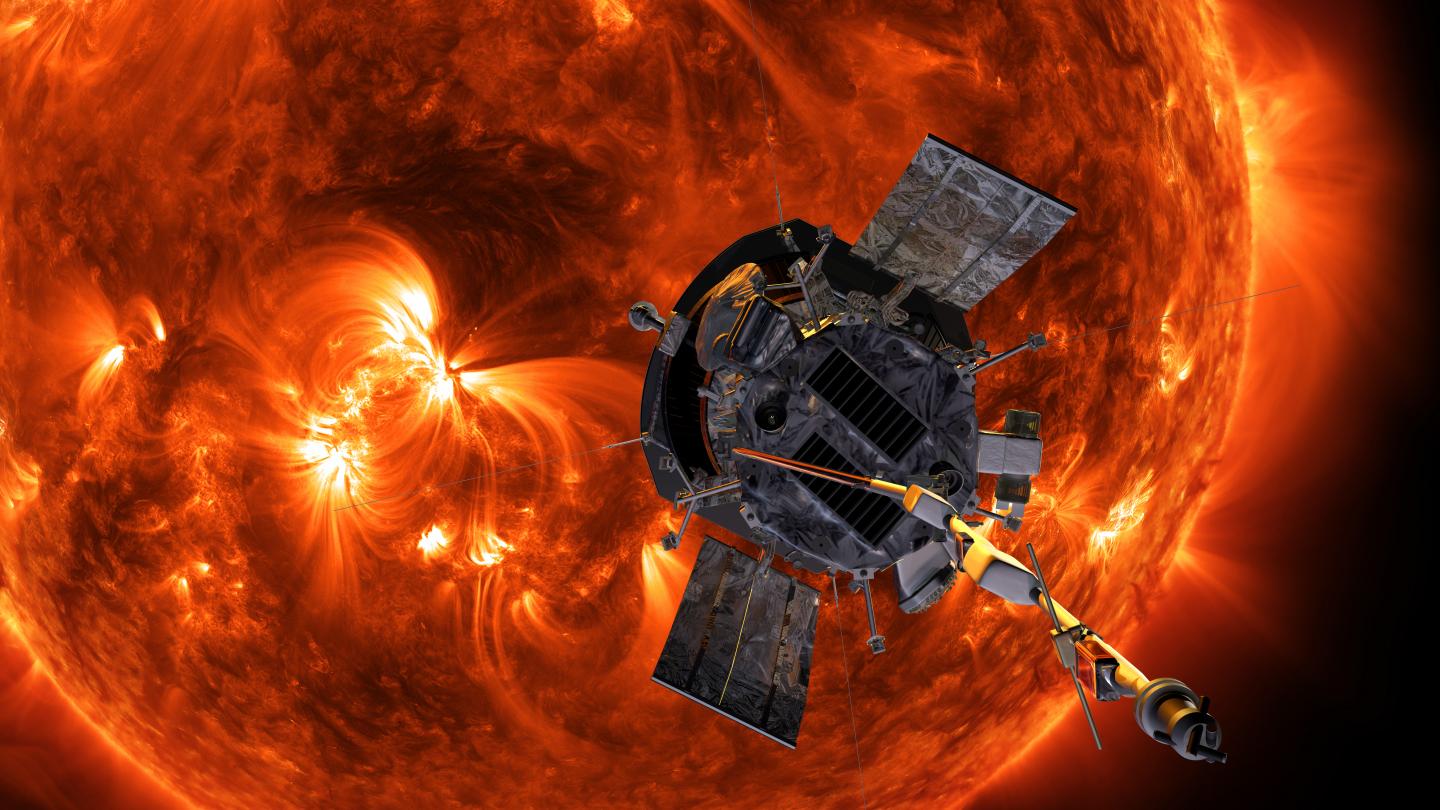
Credit: NASA
DURHAM, N.H.– Scientists at the University of New Hampshire have unlocked one of the mysteries of how particles from flares on the sun accumulate at early stages in the energization of hazardous radiation that is harmful to astronauts, satellites and electronic equipment in space. Using data obtained by NASA’s Parker Solar Probe (PSP), researchers observed one of the largest events so far during the mission. These observations show how plasma that is released after a solar flare–a sudden flash of increased brightness–can accelerate and pile up energetic particles generating dangerous radiation conditions.
“We’re getting some of the earliest observations from this mission to the sun on how the coronal mass ejection–the sun’s release of plasma and energy–builds up particles released after solar flare events,” said Nathan Schwadron, professor of physics in UNH’s Space Science Center. “Because energetic particles are accelerated near the sun, by flying closer and getting a better look we are able to observe the beginning of the energization process and see them actually start to pile up like snow that piles up in front of a snowplow. Instead of an actual snowplow, it is the coronal mass ejections released from the sun that cause the buildup of this material in space.”
In the study, recently published in The Astrophysical Journal Supplement Series, the researchers observed solar energetic particle events from April 18, 2019 to April 24, 2019. when two active regions near the sun’s equator became highly unstable, releasing a number of flares followed by coronal mass injections (CMEs). Scientists saw the complex interplay between the flares, particle populations and CMEs causing the pre-accelerated particles that are created by these solar events to get trapped and pile up. The study highlights a new phase of the energization process that is critical for the formation of radiation hazards.
“We have known that these high-energy particles are energized in this region, but the missing link was how these particles buildup in the fronts of coronal mass ejections,” said Schwadron. “It’s like imagining a room filled with bouncing tennis balls and asking how did they get there? The particles become so highly energized that they move at almost the speed of light and, as a result, can pose hazards in the form of harmful radiation that cause health issues for astronauts and damage electronic equipment in space.”
The PSP, which was launched by NASA in 2018, is on a seven-year mission to learn more about the sun, the solar wind and the origin of the energetic particles that can pose radiation hazards. The probe will fly to within 4 million miles of the sun’s surface, closer than any previous spacecraft has flown, and will face formidable heat in the corona–the sun’s atmosphere–to help scientists improve the forecasts for space weather that affect life on Earth. Onboard PSP, the Integrated Science Investigation of the Sun instrument suite is specially designed to measure the near-sun energetic particle environment and includes two instruments which were designed based on previous missions with which UNH was involved.
The University of New Hampshire inspires innovation and transforms lives in our state, nation, and world. More than 16,000 students from all 50 states and 71 countries engage with an award-winning faculty in top-ranked programs in business, engineering, law, health and human services, liberal arts and the sciences across more than 200 programs of study. As one of the nation’s highest-performing research universities, UNH partners with NASA, NOAA, NSF and NIH, and receives more than $110 million in competitive external funding every year to further explore and define the frontiers of land, sea and space.
###
Media Contact
Robbin Ray
[email protected]
603-862-4864
Original Source
https:/
Related Journal Article
http://dx.