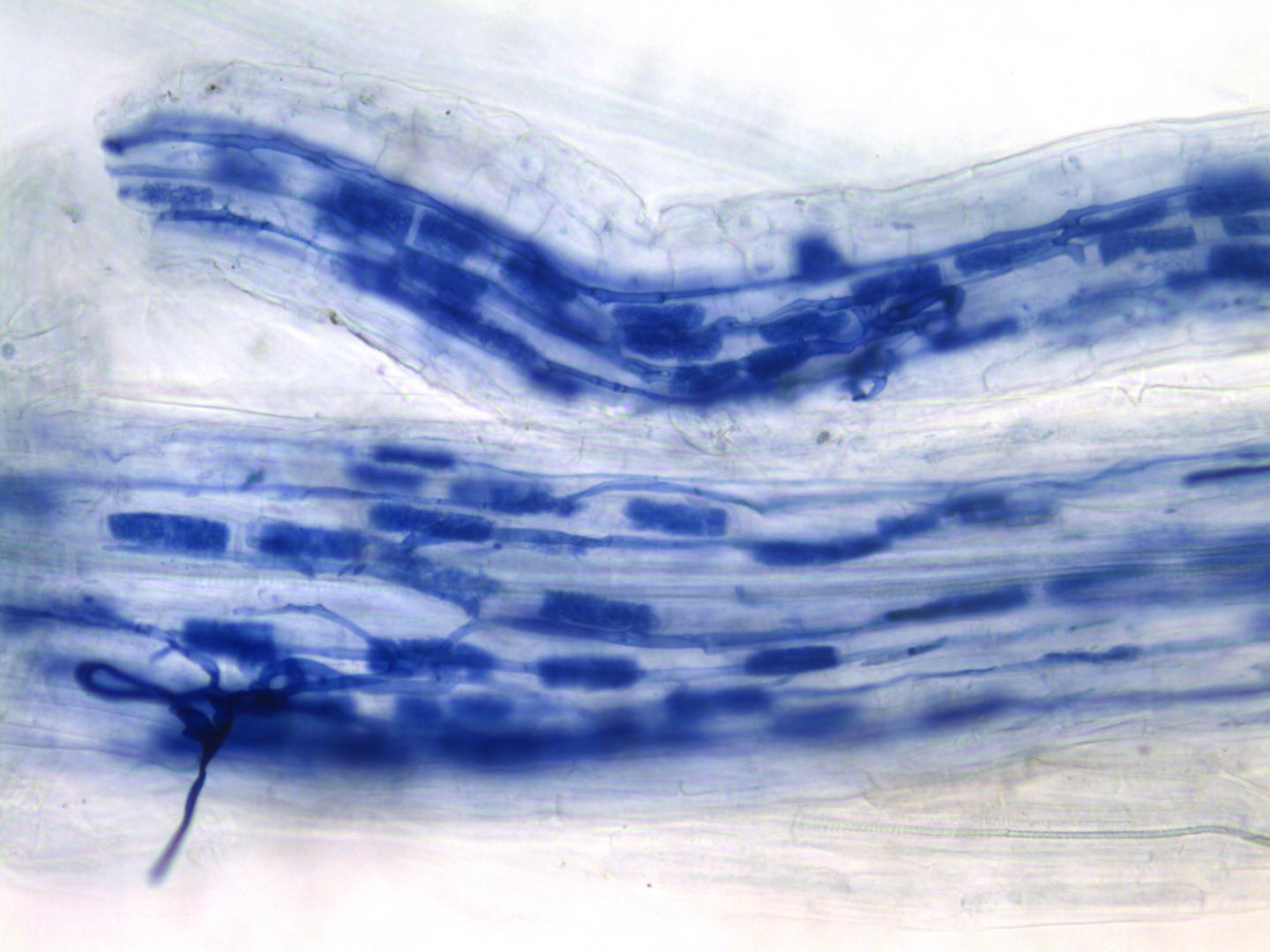
Credit: Photo by Ashley Finnestad, T.E. Cheeke Lab, WSU.
Tiny, symbiotic fungi play an outsized role in helping plants survive stresses like drought and extreme temperatures, which could help feed a planet experiencing climate change, report scientists at Washington State University.
Recently published in the journal Functional Ecology, the discovery by plant-microbe biologist Stephanie Porter and plant pathologist Maren Friesen sheds light on how microbe partners can help sustainably grow a wide variety of crops.
Tiny partners in plant survival
While some microscopic fungi and bacteria cause disease, others live in harmony with plants, collecting water and nutrients in exchange for carbohydrates, or changing plants’ internal and external environment in ways that help plants grow.
These benefits help plants tolerate stresses that come from their environment. Dubbed abiotic stresses, challenges such as drought, extreme temperatures, and poor, toxic, or saline soils are among the leading causes of crop loss and decreasing farm productivity.
“Plants’ abilities to tolerate stress are impacted by the bacteria and fungi that live on or inside them and make up the plant microbiome,” said Porter, assistant professor in the School of Biological Sciences. “Just like how microbes in our digestive system help keep us healthy, microbes play an incredibly important role in plant health.”
Setting out to measure how beneficial microbes affect plants under both normal conditions and stress, Porter and Friesen reviewed 89 research experiments ranging from common Northwest food crops to wild species.
Working with colleagues at Michigan State University and WSU, they compared five different classes of symbiotic bacteria and fungi that live on, in, and around plant roots, under stresses that included fungal diseases, grazing by animals and microscopic worms, heavy metal contamination, and drought, cold, and saline soils. Then, they tallied the effect on plant growth, biomass and yield.
Results showed that while beneficial bacteria are more helpful in normal conditions, symbiotic fungi provide added benefits during crises.
“Stress makes these fungi even more important to plants, which we think is really interesting,” said Friesen, assistant professor in the Department of Plant Pathology.
Particularly beneficial were arbuscular mycorrhizal fungi, which colonize plant roots, provide water, and enhance uptake of nitrogen, phosphorus, and other micronutrients in the soil.
“Should growers want to foster the plant microbiome for stress resistance, our study suggests they should really focus on fungi,” Porter said. “These beneficial microbes could be the key to helping us grow more food in the coming decades.”
A greener solution to stress
With earth’s population predicted to top 9 billion by 2050, scientists predict that current crop yields will need to double.
“As we expand where we grow crops, we’re using marginal areas that are more stressful for plants,” Porter said. “And as our climate changes, that creates stress for plants.
“Maren and I wanted to be forward-looking,” she added. “We wanted to find evidence of how we can best use beneficial microbes to mitigate the stresses that we know are coming.”
Microbes offer a more sustainable tool for stress tolerance than applying hormones or chemicals, noted Friesen.
“Farmers are now having challenges with pathogens no longer responding to chemical treatments,” she said. “There’s already a lot of interest in scientific and industry circles in identifying and harnessing microbial solutions to agricultural problems. This study gives us ideas about where to look.”
###
Media Contact
Stephanie Porter
[email protected]
360-546-9478
Original Source
https:/
Related Journal Article
http://dx.