The new study, in the February issue of Plastic and Reconstructive Surgery, suggests that hyaluronic acid dermal filler treatment can restore a more youthful pattern of facial expressiveness
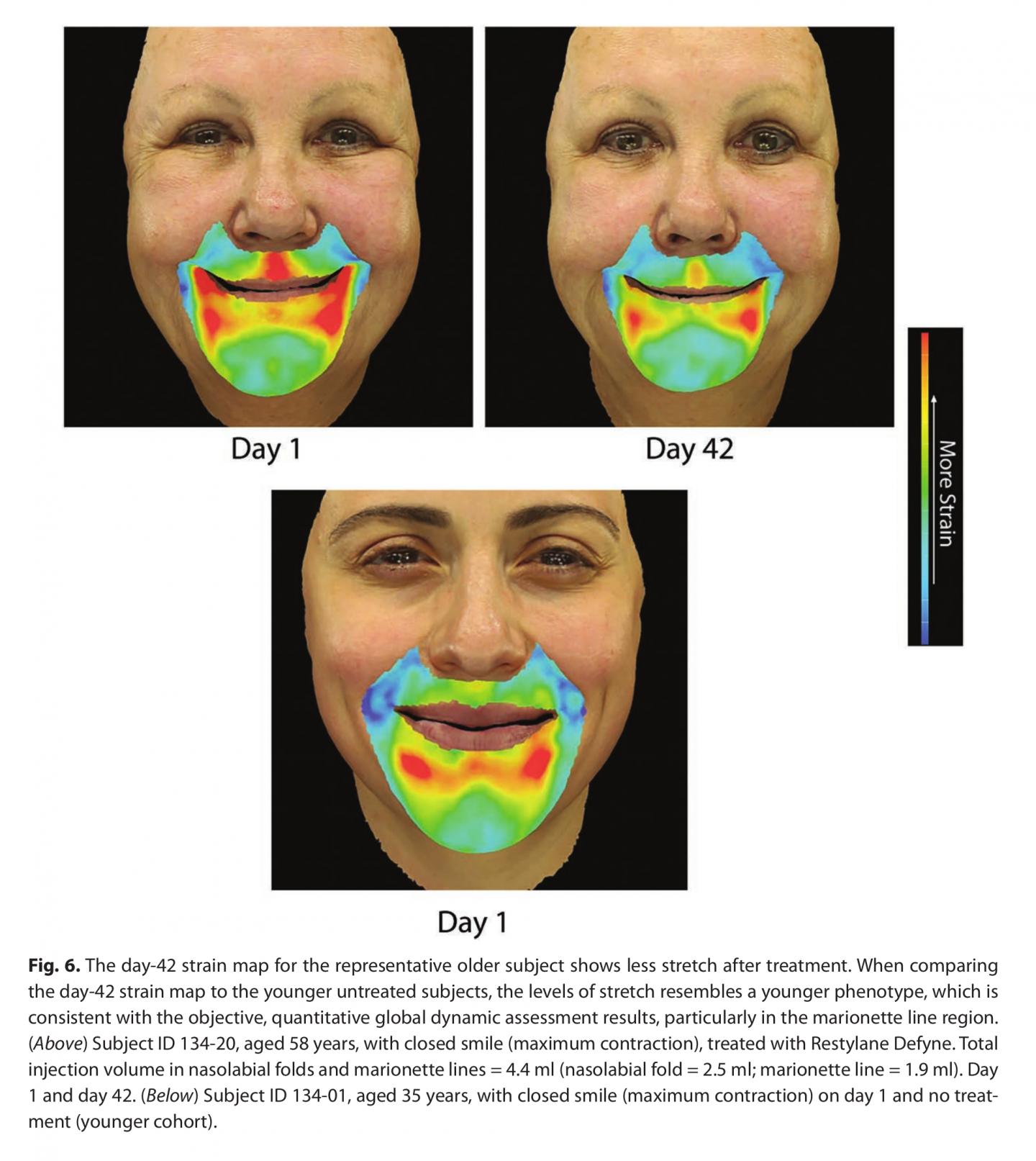
Credit: Plastic and Reconstructive Surgery
January 29, 2020 – Used for facial rejuvenation, dermal fillers do more than just fill in wrinkles. According to a new study in the February issue of Plastic and Reconstructive Surgery®, the official medical journal of the American Society of Plastic Surgeons (ASPS), they also restore a more youthful pattern of facial movement and expressiveness.
Using 3D digital stereophotogrammetry, the study suggests that hyaluronic acid (HA) dermal filler treatment can restore a more youthful pattern of facial expressiveness. “The strain reduction following filler treatment objectively conveys a dermal tightening effect, likely secondary to the volumization of treated areas,” writes ASPS member Ivona Percec, MD, PhD, of University of Pennsylvania, Philadelphia, who led the study.
With further analysis, Dr. Percec and co-authors believe that quantitative dynamic strain analysis could aid in planning and optimizing the outcomes of facial rejuvenation treatments.
Injectable dermal fillers provide a minimally invasive approach to reduce facial lines and wrinkles while restoring volume and fullness in the face. Nearly 2.7 million dermal filler injection procedures were performed in 2018, according to the most recent ASPS statistics.
To be truly effective though, these treatments must do more than just fill out facial lines and sagging – they must also produce a more youthful-appearing pattern of facial movements. “Facial expressions convey emotions as well as signal characteristics such as age and quality of life,” Dr. Percec and colleagues write.
How do dermal fillers affect the face in motion? Using a technique called 3D digital stereophotogrammetry, Dr. Percec and colleagues obtained precise measurements of facial stretch and compression in 30 women, aged 41 to 65 years. All patients were to undergo HA dermal filler treatment for facial lines and wrinkles in the lower face.
Specifically, the women were treated for moderate to severe nasolabial folds (NLF), the lines running from the corners of the nose to the corners of the mouth; and “marionette lines” (ML), running from to mouth to the chin. The scans were performed first before HA filler treatment, then repeated six weeks later.
The facial dynamic strain results were compared with those in a group of 20 younger (aged 25 to 35), untreated women. In scans performed before dermal filler treatment, heat maps showed significantly higher “stretch profiles” in the NLF and ML areas in the older women, compared to the younger women.
In the follow-up scans after HA treatment, the older women had significant reductions in stretch and strain, across the full range of facial expressions. “That finding provides objective evidence that HA dermal filler treatment of facial lines in middle-aged women results in stretch levels more like those of younger women, in areas prone to the effects of facial aging,” said Dr. Percec.
Facial movement reflects the complex interplay of the skin and underlying soft tissue, skeletal volume, and muscle activity. “Facial dynamics should be central to the evaluation of rejuvenation treatments to produce natural-looking results,” according to the authors. Assessment of facial movement is especially important in the area around the mouth, which is especially mobile and prone to facial lines and volume loss.
Click here to read “An objective, quantitative dynamic assessment of hyaluronic acid fillers that adapt to facial movement.”
DOI: 10.1097/PRS.0000000000006461
###
Plastic and Reconstructive Surgery® is published in the Lippincott portfolio by Wolters Kluwer.
About Plastic and Reconstructive Surgery
For more than 70 years, Plastic and Reconstructive Surgery® (http://www.
About ASPS
The American Society of Plastic Surgeons is the largest organization of board-certified plastic surgeons in the world. Representing more than 7,000 physician members, the society is recognized as a leading authority and information source on cosmetic and reconstructive plastic surgery. ASPS comprises more than 94 percent of all board-certified plastic surgeons in the United States. Founded in 1931, the society represents physicians certified by The American Board of Plastic Surgery or The Royal College of Physicians and Surgeons of Canada.
About Wolters Kluwer
Wolters Kluwer (WKL) is a global leader in professional information, software solutions, and services for the clinicians, nurses, accountants, lawyers, and tax, finance, audit, risk, compliance, and regulatory sectors. We help our customers make critical decisions every day by providing expert solutions that combine deep domain knowledge with advanced technology and services.
Wolters Kluwer reported 2018 annual revenues of €4.3 billion. The group serves customers in over 180 countries, maintains operations in over 40 countries, and employs approximately 18,600 people worldwide. The company is headquartered in Alphen aan den Rijn, the Netherlands.
Wolters Kluwer provides trusted clinical technology and evidence-based solutions that engage clinicians, patients, researchers and students with advanced clinical decision support, learning and research and clinical intelligence. For more information about our solutions, visit http://healthclarity.wolterskluwer.com and follow us on LinkedIn and Twitter @WKHealth.
For more information, visit http://www.
Media Contact
Connie Hughes
[email protected]
646-674-6348
Related Journal Article
http://dx.