• HOME
  • NEWS
  • EXPLORE
    • CAREER
      • Companies
      • Jobs
    • EVENTS
    • iGEM
      • News
      • Team
    • PHOTOS
    • VIDEO
    • WIKI
  • BLOG
  • COMMUNITY
    • FACEBOOK
    • INSTAGRAM
    • TWITTER
Saturday, February 7, 2026
BIOENGINEER.ORG
No Result
View All Result
  • Login
  • HOME
  • NEWS
  • EXPLORE
    • CAREER
      • Companies
      • Jobs
        • Lecturer
        • PhD Studentship
        • Postdoc
        • Research Assistant
    • EVENTS
    • iGEM
      • News
      • Team
    • PHOTOS
    • VIDEO
    • WIKI
  • BLOG
  • COMMUNITY
    • FACEBOOK
    • INSTAGRAM
    • TWITTER
  • HOME
  • NEWS
  • EXPLORE
    • CAREER
      • Companies
      • Jobs
        • Lecturer
        • PhD Studentship
        • Postdoc
        • Research Assistant
    • EVENTS
    • iGEM
      • News
      • Team
    • PHOTOS
    • VIDEO
    • WIKI
  • BLOG
  • COMMUNITY
    • FACEBOOK
    • INSTAGRAM
    • TWITTER
No Result
View All Result
Bioengineer.org
No Result
View All Result
Home NEWS Science News Chemistry

It’s closeness that counts: how proximity affects the resistance of graphene

Bioengineer by Bioengineer
January 29, 2020
in Chemistry
Reading Time: 2 mins read
0
IMAGE
Share on FacebookShare on TwitterShare on LinkedinShare on RedditShare on Telegram

Research team led by the University of Göttingen observes greater variation than expected
IMAGE

Credit: Georg A Traeger/Anna Sinterhauf – University of Göttingen


Graphene is often seen as the wonder material of the future. Scientists can now grow perfect graphene layers on square centimetre-sized crystals. A research team from the University of Göttingen, together with the Chemnitz University of Technology and the Physikalisch-Technische Bundesanstalt Braunschweig, has investigated the influence of the underlying crystal on the electrical resistance of graphene. Contrary to previous assumptions, the new results show that the process known as the ‘proximity effect’ varies considerably at a nanometre scale. The results have been published in Nature Communications.

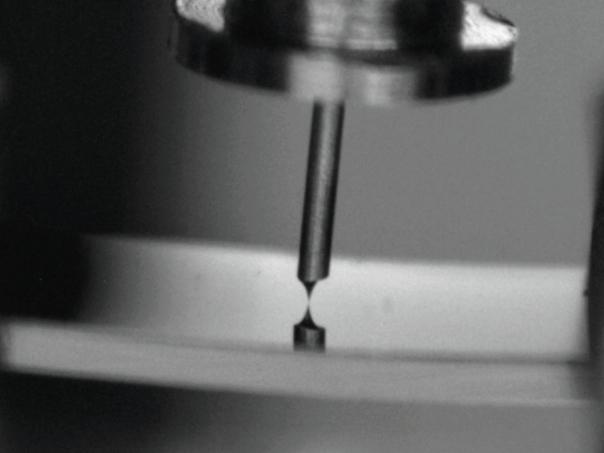
The composition of graphene is very simple. It is a single atomic layer of carbon atoms arranged in a honeycomb structure. The three-dimensional form is already an integral part of our everyday lives: we see it in the lead of an ordinary pencil for instance. However, the two-dimensional material graphene was not synthesized in the laboratory until 2004. To determine the electrical resistance of graphene at the smallest scale possible, the physicists used a “scanning tunnelling microscope”. This can make atomic structures visible by scanning the surface with a fine metal tip. The team also used the tip of the scanning tunnelling microscope to measure the voltage drop and thus the electrical resistance of the tiny graphene sample.

Depending on the distance that they measured, the researchers determined very different values for the electrical resistance. They cite the proximity effect as the reason for this. “The spatially varying interaction between graphene and the underlying crystal means that we measure different electrical resistances depending on the exact position,” explains Anna Sinterhauf, first author and doctoral student at the Faculty of Physics at the University of Göttingen.

At low temperatures of 8 Kelvin, which is around minus 265 degrees Centigrade, the team found variations in local resistance of up to 270 percent. “This result suggests that the electrical resistance of graphene layers epitaxially grown on a crystal surface cannot simply be worked out from an average taken from values measured at a larger scale,” explains Dr Martin Wenderoth, head of the working group. The team assumes that the proximity effect might also play an important role for other two-dimensional materials.

###

Original publication: Anna Sinterhauf et al. Substrate induced nanoscale resistance variation in epitaxial graphene. Nature Communications (2020). DOI: 10.1038/s41467-019-14192-0

Contact:

Dr Martin Wenderoth

University of Göttingen

Faculty of Physics – IV Physical Institute

Friedrich-Hund-Platz 1, 37077 Göttingen, Germany

Tel: +49 (0) 551 39-29367

Email: [email protected]

http://www.uni-goettingen.de/en/500611.html

Media Contact
Melissa Sollich
[email protected]
49-055-139-26228

Original Source

https://www.uni-goettingen.de/en/3240.html?id=5796

Related Journal Article

http://dx.doi.org/10.1038/s41467-019-14192-0

Tags: Chemistry/Physics/Materials SciencesMaterialsNanotechnology/Micromachines
Share12Tweet8Share2ShareShareShare2

Related Posts

blank

Breakthrough in Environmental Cleanup: Scientists Develop Solar-Activated Biochar for Faster Remediation

February 7, 2026
blank

Cutting Costs: Making Hydrogen Fuel Cells More Affordable

February 6, 2026

Scientists Develop Hand-Held “Levitating” Time Crystals

February 6, 2026

Observing a Key Green-Energy Catalyst Dissolve Atom by Atom

February 6, 2026
Please login to join discussion

POPULAR NEWS

  • Robotic Ureteral Reconstruction: A Novel Approach

    Robotic Ureteral Reconstruction: A Novel Approach

    82 shares
    Share 33 Tweet 21
  • Digital Privacy: Health Data Control in Incarceration

    63 shares
    Share 25 Tweet 16
  • Study Reveals Lipid Accumulation in ME/CFS Cells

    57 shares
    Share 23 Tweet 14
  • Breakthrough in RNA Research Accelerates Medical Innovations Timeline

    53 shares
    Share 21 Tweet 13

About

We bring you the latest biotechnology news from best research centers and universities around the world. Check our website.

Follow us

Recent News

Inflammasome Protein ASC Drives Pancreatic Cancer Metabolism

Phage-Antibiotic Combo Beats Resistant Peritoneal Infection

Boosting Remote Healthcare: Stepped-Wedge Trial Insights

Subscribe to Blog via Email

Enter your email address to subscribe to this blog and receive notifications of new posts by email.

Join 73 other subscribers
  • Contact Us

Bioengineer.org © Copyright 2023 All Rights Reserved.

Welcome Back!

Login to your account below

Forgotten Password?

Retrieve your password

Please enter your username or email address to reset your password.

Log In
No Result
View All Result
  • Homepages
    • Home Page 1
    • Home Page 2
  • News
  • National
  • Business
  • Health
  • Lifestyle
  • Science

Bioengineer.org © Copyright 2023 All Rights Reserved.