Researchers led by Osaka University link the well-characterized serine racemase-mediated production of pyruvate from L-serine to colorectal cancer, providing a novel target for therapeutic intervention
Credit: Osaka University
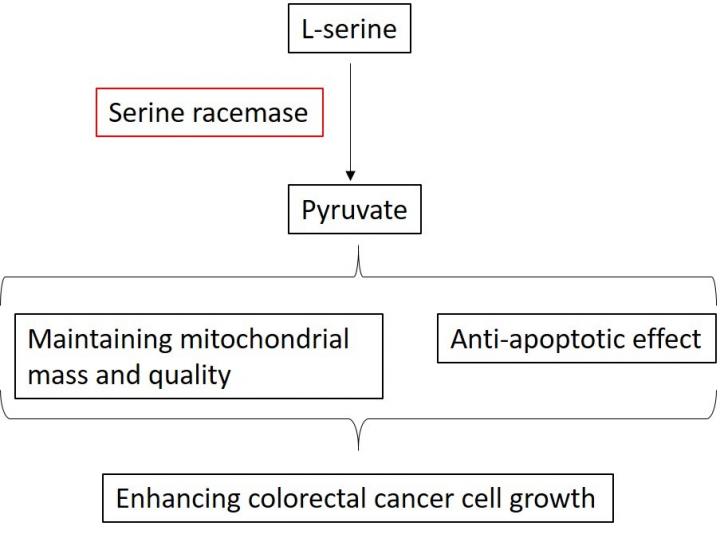
Osaka, Japan – Serine racemase (SRR) is a multifunctional enzyme that carries out several different reactions in human cells, including the conversion of L-serine into pyruvate. Despite already being well characterized, a team of researchers led by Osaka University have discovered an important new role for SRR in cancer metabolism, exposing the metabolic pathway as a viable target for novel anti-cancer therapies.
Researchers have long known that cancer cells display an altered metabolism that favors their growth, survival, and metastasis. Colorectal cancer is one of the most common cancers worldwide but is particularly prevalent in developed countries where it is associated with certain dietary factors and a sedentary lifestyle. One of the hallmarks of colorectal cancer cells is an altered metabolism that is not associated with tumor-causing mutations.
“Pyruvate is known to have an important role in cancer metabolism,” explains lead author of the study Dr Kenji Ohshima. “However, no one had previously studied how pyruvate produced by SRR is involved in cancer metabolism.”
Therefore, the researchers set out to examine what role, if any, SRR plays in the development of colorectal cancer.
In a study published this month in Nature Metabolism, the researchers showed that SRR is much more abundant in colorectal cancer cells than in the surrounding tissues, and that cancer cell lines with higher levels of SRR divide at a much faster rate.
Says Dr Ohshima, “This was a really exciting discovery because it showed that SRR is involved in colorectal cancer cell proliferation. When we then looked more closely at the pathway as a whole, we found that pyruvate levels were decreased in a slow-growing SRR mutant colorectal cancer cell line, suggesting that the pyruvate produced by SRR enhances the proliferation of colorectal cancer cells. This result confirmed that the metabolic pathway is integral to the progression of colorectal cancer.”
Given the obvious importance of SRR, the researchers then decided to test whether disruption of the metabolic pathway could prevent the progression of colorectal cancer. Astonishingly, not only did inhibition of SRR halt the growth of colorectal tumors in mice, it also improved the efficacy of currently available drugs used to treat colorectal cancer, causing a significant reduction in tumor size.
“There is still work to be done to confirm that our results translate into human cancer systems,” explains senior author of the study Dr Eiichi Morii. “However, based on these preliminary results, we expect that future strategies targeting SRR will provide effective new therapies for the treatment of colorectal cancer.”
###
The article, “Serine racemase enhances growth of colorectal cancer by producing pyruvate from serine,” was published in Nature Metabolism at DOI: https:/
About Osaka University
Osaka University was founded in 1931 as one of the seven imperial universities of Japan and now has expanded to one of Japan’s leading comprehensive universities. The University has now embarked on open research revolution from a position as Japan’s most innovative university and among the most innovative institutions in the world according to Reuters 2015 Top 100 Innovative Universities and the Nature Index Innovation 2017. The university’s ability to innovate from the stage of fundamental research through the creation of useful technology with economic impact stems from its broad disciplinary spectrum.
Website: https:/
Media Contact
Saori Obayashi
[email protected]
81-661-055-886
Original Source
https:/
Related Journal Article
http://dx.