• HOME
  • NEWS
  • EXPLORE
    • CAREER
      • Companies
      • Jobs
    • EVENTS
    • iGEM
      • News
      • Team
    • PHOTOS
    • VIDEO
    • WIKI
  • BLOG
  • COMMUNITY
    • FACEBOOK
    • INSTAGRAM
    • TWITTER
Saturday, February 7, 2026
BIOENGINEER.ORG
No Result
View All Result
  • Login
  • HOME
  • NEWS
  • EXPLORE
    • CAREER
      • Companies
      • Jobs
        • Lecturer
        • PhD Studentship
        • Postdoc
        • Research Assistant
    • EVENTS
    • iGEM
      • News
      • Team
    • PHOTOS
    • VIDEO
    • WIKI
  • BLOG
  • COMMUNITY
    • FACEBOOK
    • INSTAGRAM
    • TWITTER
  • HOME
  • NEWS
  • EXPLORE
    • CAREER
      • Companies
      • Jobs
        • Lecturer
        • PhD Studentship
        • Postdoc
        • Research Assistant
    • EVENTS
    • iGEM
      • News
      • Team
    • PHOTOS
    • VIDEO
    • WIKI
  • BLOG
  • COMMUNITY
    • FACEBOOK
    • INSTAGRAM
    • TWITTER
No Result
View All Result
Bioengineer.org
No Result
View All Result
Home NEWS Science News Biology

Second of its kind ‘sharpshooter’ leafhopper from Brazil ‘strikes’ with its colouration

Bioengineer by Bioengineer
January 28, 2020
in Biology
Reading Time: 2 mins read
0
IMAGE
Share on FacebookShare on TwitterShare on LinkedinShare on RedditShare on Telegram

IMAGE

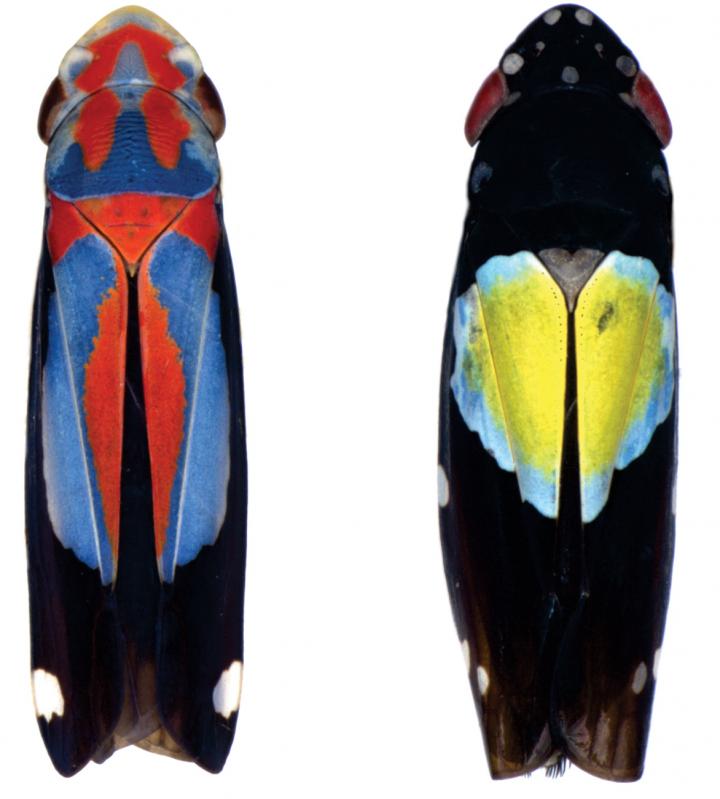
Credit: Gabriel Mejdalani


When, in 2014, Brazilian researchers stumbled across a never-before-seen red-eyed leafhopper feeding inside the rosettes of bromeliads, growing in the restingas of southeastern Brazil, they were certain it was a one-of-a-kind discovery. Described as new-to-science species, as well as genus (Cavichiana bromelicola) and added to the sharpshooter tribe Cicadellini, it became the first known case of a leafhopper feeding on otherwise nutrition-poor bromeliads in their natural habitat.

Several years later, however, a team of entomologists from Universidade Federal do Rio de Janeiro carried out fieldwork in a mountainous area of southeastern Brazil and, as a result, another bromelicolous leafhopper species of the genus was discovered: Cavichiana alpina. Only, the new one appeared even more spectacular.

The new species, described and illustrated in the open-access journal Zoologia, is known from Itatiaia National Park (state of Minas Gerais, southeastern Brazil), where it can be found at altitudes above 1,800 m a.s.l. In fact, its characteristic mountainous habitat came to determine its species name (alpina). In contrast, its relative was originally described exclusively from sea level regions, even though the latest field trips have recorded it from a site located at 1,250 m a.s.l.

Slightly larger than the previously known C. bromelicola and similarly red-eyed, what most remarkably sets apart the newly-described species is its colouration. Rather than a single large yellow blotch contrasting against the dark-brown to black back of the insect, this sharpshooter sports a motley amalgam of red and blue covering most of its upper side.

In conclusion, the researchers explain that the peculiarity of the two known Cavichiana species is best attributed to a putative common ancestor that had likely once been widely distributed in southeastern and southern Brazil. Later, they speculate, a vicariant event, such as the uplift of the southeastern Brazilian mountain ranges during the latest Eocene and Oligocene, might have caused its diversification into two separate species.

###

Original source:

Quintas V, Takiya DM, CĂ´rte I, Mejdalani G (2020) A remarkable new species of Cavichiana (Hemiptera: Cicadellidae: Cicadellinae) from southeastern Brazil. Zoologia 37: 1-8. https://doi.org/10.3897/zoologia.37.e38783

Media Contact
Gabriel Mejdalani
[email protected]

Related Journal Article

http://dx.doi.org/10.3897/zoologia.37.e38783

Tags: BiodiversityBiologyEcology/EnvironmentEntomologyEvolutionPopulation BiologyZoology/Veterinary Science
Share12Tweet8Share2ShareShareShare2

Related Posts

Florida Cane Toad: Complex Spread and Selective Evolution

Florida Cane Toad: Complex Spread and Selective Evolution

February 7, 2026
New Study Uncovers Mechanism Behind Burn Pit Particulate Matter–Induced Lung Inflammation

New Study Uncovers Mechanism Behind Burn Pit Particulate Matter–Induced Lung Inflammation

February 6, 2026

DeepBlastoid: Advancing Automated and Efficient Evaluation of Human Blastoids with Deep Learning

February 6, 2026

Navigating the Gut: The Role of Formic Acid in the Microbiome

February 6, 2026
Please login to join discussion

POPULAR NEWS

  • Robotic Ureteral Reconstruction: A Novel Approach

    Robotic Ureteral Reconstruction: A Novel Approach

    82 shares
    Share 33 Tweet 21
  • Digital Privacy: Health Data Control in Incarceration

    63 shares
    Share 25 Tweet 16
  • Study Reveals Lipid Accumulation in ME/CFS Cells

    57 shares
    Share 23 Tweet 14
  • Breakthrough in RNA Research Accelerates Medical Innovations Timeline

    53 shares
    Share 21 Tweet 13

About

We bring you the latest biotechnology news from best research centers and universities around the world. Check our website.

Follow us

Recent News

Barriers and Boosters of Seniors’ Physical Activity in Karachi

Evaluating Pediatric Emergency Care Quality in Ethiopia

TPMT Expression Predictions Linked to Azathioprine Side Effects

Subscribe to Blog via Email

Enter your email address to subscribe to this blog and receive notifications of new posts by email.

Join 73 other subscribers
  • Contact Us

Bioengineer.org © Copyright 2023 All Rights Reserved.

Welcome Back!

Login to your account below

Forgotten Password?

Retrieve your password

Please enter your username or email address to reset your password.

Log In
No Result
View All Result
  • Homepages
    • Home Page 1
    • Home Page 2
  • News
  • National
  • Business
  • Health
  • Lifestyle
  • Science

Bioengineer.org © Copyright 2023 All Rights Reserved.