Finding ways to faster flight
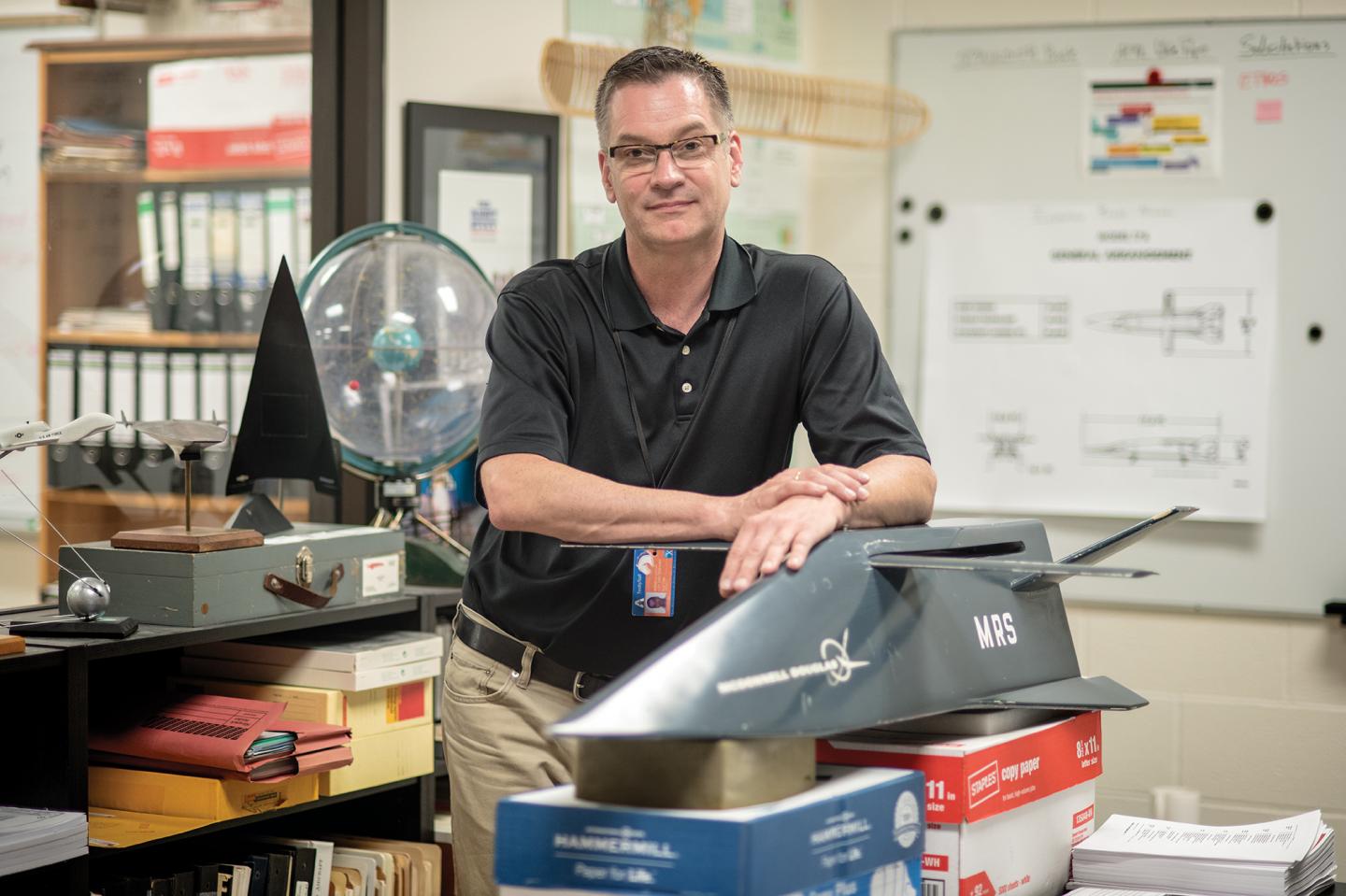
Credit: UT Arlington
The idea of speeding through the atmosphere at many times the speed of sound carries great appeal for commercial aircraft carriers. The technology needed to build such hypersonic passenger or cargo transport vehicles, however, does not yet exist.
Bernd Chudoba, associate professor of mechanical and aerospace engineering at The University of Texas at Arlington, is working with NASA on a feasibility study to determine how current technology could make hypersonic travel a reality sooner and at less cost.
The objective: to explore the feasibility, practicality and affordability of commercial hypersonic transports. The results could directly support NASA’s Hypersonic Technology Project, with the intent of identifying knowledge gaps guiding future NASA hypersonic research investments.
The study, funded through a contract with the National Institute of Aerospace (NIA) in Hampton, Virginia, also explores mission-vehicle-technology solution space mapping for future hypersonic civil aircraft. These hypersonic vehicle design tasks will enable designers to define and justify feasible missions, baseline vehicle configurations and relevant technologies.
“This project will produce a model of the solutions that are pragmatically out there, primarily based on industry capability we already have on the shelf,” Chudoba said. “Rather than searching for all new ideas that stretch beyond the current state of the art, we’ll first focus on available industry capability that will define the currently available solution-space topography for hypersonic vehicles.
“In a second step, we will initiate technology forecasting with the aim of matching the available industry capability and the minimum required technology capability to successfully comply with the mission specification for future hypersonic corporate or commercial transport aircraft.”
Much of the current work on hypersonic aircraft is being done for the military, but Chudoba says that passengers and businesses will pay for speed, such as quicker flights from the United States to Europe, Asia or other long-haul commercial routes.
Chudoba will consider promising technology areas such as engine cycles capable of propelling the aircraft from standstill to hypersonic speeds, nanotechnology, artificial intelligence design approaches and others, with an overall goal of exploring how strategic technology investments could improve the return on investment when implemented into a hypersonic aircraft.
“Hypersonic vehicles are an exciting frontier in aerospace engineering, and Dr. Chudoba continues to make unique contributions to the knowledge base in this challenging field,” said Erian Armanios, chair of UTA’s Mechanical and Aerospace Engineering Department. “This contract is an opportunity to further cement Dr. Chudoba’s legacy and UTA’s leadership in capitalizing on historical concepts to forge cost-effective strategies that meet mission requirements for future hypersonic commercial aircraft.”
Chudoba is an expert in aerospace vehicle design. His Aerospace Vehicle Design Laboratory has previously provided recommendations for technology investments that would enable astronauts to perform on-orbit servicing of satellites. He is also the author of two books that explore the design of hypersonic aircraft and long-range space vehicles.
In 2018, his laboratory earned a grant from the Air Force Research Laboratory to develop parameters for a forecasting methodology that will allow strategic planners to identify science and technology gaps related to space transportation issues like hypersonic speed, space launch/return and in-space operation. Chudoba has worked with NASA, the Defense Advanced Research Projects Agency, the Air Force Research Laboratory and various private industries on numerous subsonic to hypersonic and reusable space access transportation activities that involved technology and strategic forecasting.
###
— Written by Jeremy Agor, College of Engineering
Media Contact
Herb Booth
[email protected]
817-272-7075
Original Source
https:/