• HOME
  • NEWS
  • EXPLORE
    • CAREER
      • Companies
      • Jobs
    • EVENTS
    • iGEM
      • News
      • Team
    • PHOTOS
    • VIDEO
    • WIKI
  • BLOG
  • COMMUNITY
    • FACEBOOK
    • INSTAGRAM
    • TWITTER
Saturday, February 7, 2026
BIOENGINEER.ORG
No Result
View All Result
  • Login
  • HOME
  • NEWS
  • EXPLORE
    • CAREER
      • Companies
      • Jobs
        • Lecturer
        • PhD Studentship
        • Postdoc
        • Research Assistant
    • EVENTS
    • iGEM
      • News
      • Team
    • PHOTOS
    • VIDEO
    • WIKI
  • BLOG
  • COMMUNITY
    • FACEBOOK
    • INSTAGRAM
    • TWITTER
  • HOME
  • NEWS
  • EXPLORE
    • CAREER
      • Companies
      • Jobs
        • Lecturer
        • PhD Studentship
        • Postdoc
        • Research Assistant
    • EVENTS
    • iGEM
      • News
      • Team
    • PHOTOS
    • VIDEO
    • WIKI
  • BLOG
  • COMMUNITY
    • FACEBOOK
    • INSTAGRAM
    • TWITTER
No Result
View All Result
Bioengineer.org
No Result
View All Result
Home NEWS Science News

Stressed-out dust is sharing antibiotic resistance genes

Bioengineer by Bioengineer
January 23, 2020
in Science News
Reading Time: 2 mins read
0
IMAGE
Share on FacebookShare on TwitterShare on LinkedinShare on RedditShare on Telegram

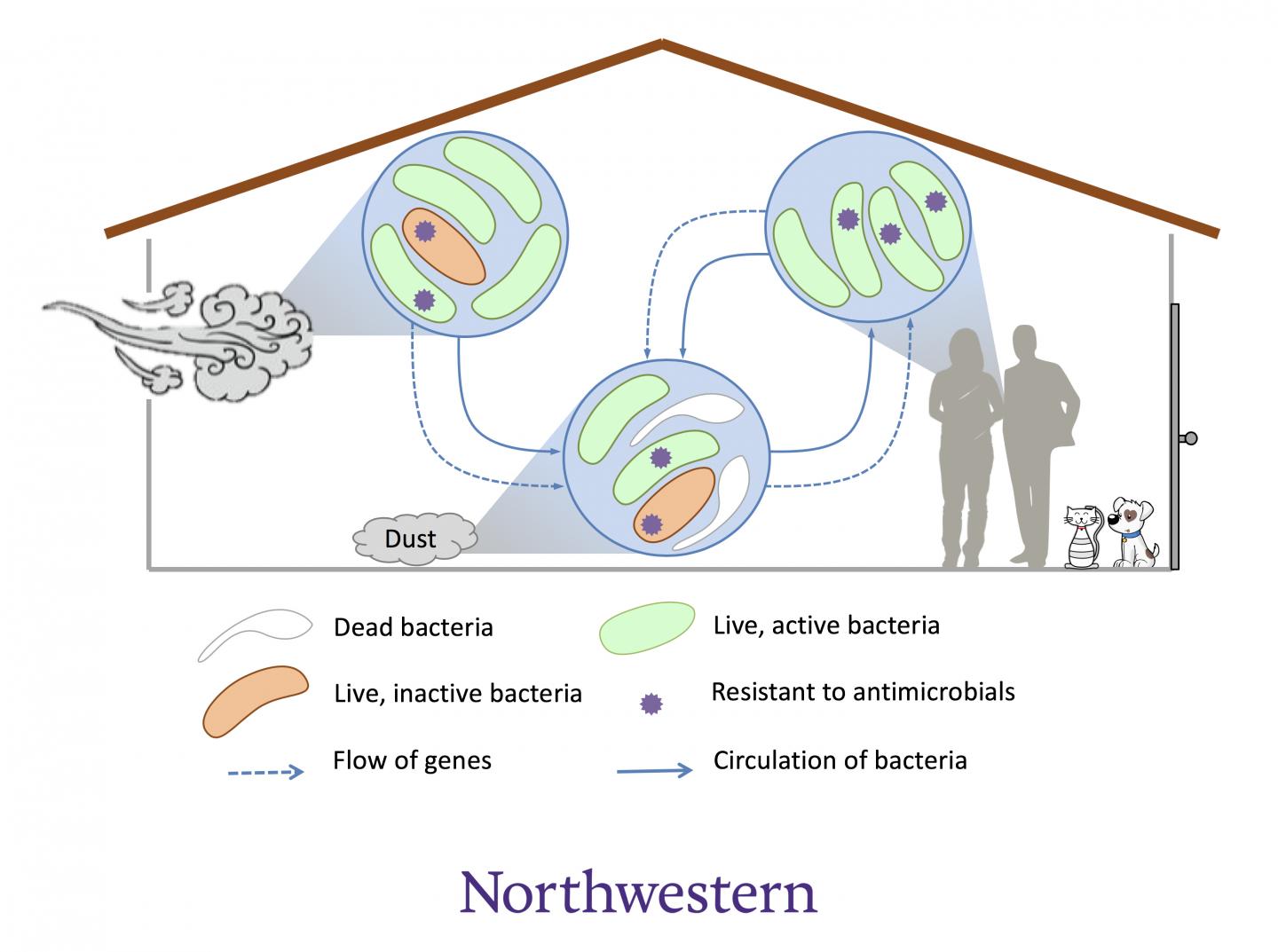
First study to show indoor dust bacteria have transferrable antibiotic resistance genes
IMAGE

Credit: Northwestern University


  • Bacteria can swap their genes with neighboring bacteria
  • Study finds that antibiotic resistance genes can be transferred
  • Nonpathogens could give antibiotic resistance genes to pathogens

EVANSTON, Ill. — Indoor dust is evolving — and not in a good way.

A new Northwestern University study is the first to find that bacteria living in household dust can spread antibiotic resistance genes. Although most bacteria are harmless, the researchers believe these genes could potentially spread to pathogens, making infections more difficult to treat.

“This evidence, in and of itself, doesn’t mean that antibiotic resistance is getting worse,” said Northwestern’s Erica Hartmann, who led the study. “It’s just one more risk factor. It’s one more thing that we need to be careful about.”

The study will be published on Jan. 23 in the journal PLOS Pathogens. Hartmann is an assistant professor of environmental engineering in Northwestern’s McCormick School of Engineering.

A bacterium can share its genes by using either of two methods: dividing, which is the equivalent to having a baby, or horizontal gene transfer. The primary method for spreading antibiotic resistance genes among species, horizontal gene transfer occurs when a bacterium makes a copy of its genes and swaps them with a neighbor.

Bacteria can share many different types of genes — as long as the genes have mobile segments of DNA. Hartmann and her team were the first to find that antibiotic resistance genes in dust microbes have mobile capabilities.

“We observed living bacteria have transferrable antibiotic resistance genes,” Hartmann said. “People thought this might be the case, but no one had actually shown that microbes in dust contain these transferrable genes.”

Although it is rare for pathogens to live in indoor dust, they can hitchhike into homes and mingle with existing bacteria.

“A nonpathogen can use horizontal gene transfer to give antibiotic resistance genes to a pathogen,” Hartmann explained. “Then the pathogen becomes antibiotic resistant.”

Why do bacteria share genes? Hartmann says they can’t handle the stress of being indoors. The indoor environment might be too dry and cold without enough food, for example, or it might be occasionally spritzed with antimicrobial solutions. (Hartmann, by the way, recommends dusting with a damp cloth instead of using antimicrobial solutions, which can make bacteria more resistant to antibiotics.)

“Microbes share genes when they get stressed out,” Hartmann said. “They aren’t equipped to handle the stress, so they share genetic elements with a microbe that might be better equipped.”

###

The study, “Mobilization antibiotic resistance genes are present in dust microbial communities,” was supported by the Alfred P. Sloan Foundation and the Biology & the Built Environment Center at the University of Oregon.

More news at Northwestern Now

Find experts on our Faculty Experts Hub

Follow @NUSources for expert perspectives

Media Contact
Amanda Morris
[email protected]
847-467-6790

Tags: BacteriologyBiologyBiomedical/Environmental/Chemical EngineeringEvolutionInfectious/Emerging DiseasesMicrobiology
Share12Tweet8Share2ShareShareShare2

Related Posts

Evaluating Pediatric Emergency Care Quality in Ethiopia

February 7, 2026

TPMT Expression Predictions Linked to Azathioprine Side Effects

February 7, 2026

Improving Dementia Care with Enhanced Activity Kits

February 7, 2026

Decoding Prostate Cancer Origins via snFLARE-seq, mxFRIZNGRND

February 7, 2026
Please login to join discussion

POPULAR NEWS

  • Robotic Ureteral Reconstruction: A Novel Approach

    Robotic Ureteral Reconstruction: A Novel Approach

    82 shares
    Share 33 Tweet 21
  • Digital Privacy: Health Data Control in Incarceration

    63 shares
    Share 25 Tweet 16
  • Study Reveals Lipid Accumulation in ME/CFS Cells

    57 shares
    Share 23 Tweet 14
  • Breakthrough in RNA Research Accelerates Medical Innovations Timeline

    53 shares
    Share 21 Tweet 13

About

We bring you the latest biotechnology news from best research centers and universities around the world. Check our website.

Follow us

Recent News

Evaluating Pediatric Emergency Care Quality in Ethiopia

TPMT Expression Predictions Linked to Azathioprine Side Effects

Improving Dementia Care with Enhanced Activity Kits

Subscribe to Blog via Email

Success! An email was just sent to confirm your subscription. Please find the email now and click 'Confirm' to start subscribing.

Join 73 other subscribers
  • Contact Us

Bioengineer.org © Copyright 2023 All Rights Reserved.

Welcome Back!

Login to your account below

Forgotten Password?

Retrieve your password

Please enter your username or email address to reset your password.

Log In
No Result
View All Result
  • Homepages
    • Home Page 1
    • Home Page 2
  • News
  • National
  • Business
  • Health
  • Lifestyle
  • Science

Bioengineer.org © Copyright 2023 All Rights Reserved.