• HOME
  • NEWS
  • EXPLORE
    • CAREER
      • Companies
      • Jobs
    • EVENTS
    • iGEM
      • News
      • Team
    • PHOTOS
    • VIDEO
    • WIKI
  • BLOG
  • COMMUNITY
    • FACEBOOK
    • INSTAGRAM
    • TWITTER
Saturday, December 27, 2025
BIOENGINEER.ORG
No Result
View All Result
  • Login
  • HOME
  • NEWS
  • EXPLORE
    • CAREER
      • Companies
      • Jobs
        • Lecturer
        • PhD Studentship
        • Postdoc
        • Research Assistant
    • EVENTS
    • iGEM
      • News
      • Team
    • PHOTOS
    • VIDEO
    • WIKI
  • BLOG
  • COMMUNITY
    • FACEBOOK
    • INSTAGRAM
    • TWITTER
  • HOME
  • NEWS
  • EXPLORE
    • CAREER
      • Companies
      • Jobs
        • Lecturer
        • PhD Studentship
        • Postdoc
        • Research Assistant
    • EVENTS
    • iGEM
      • News
      • Team
    • PHOTOS
    • VIDEO
    • WIKI
  • BLOG
  • COMMUNITY
    • FACEBOOK
    • INSTAGRAM
    • TWITTER
No Result
View All Result
Bioengineer.org
No Result
View All Result
Home NEWS Science News Biology

Predicting the degradation behavior of advanced medical devices

Bioengineer by Bioengineer
January 23, 2020
in Biology
Reading Time: 2 mins read
0
IMAGE
Share on FacebookShare on TwitterShare on LinkedinShare on RedditShare on Telegram

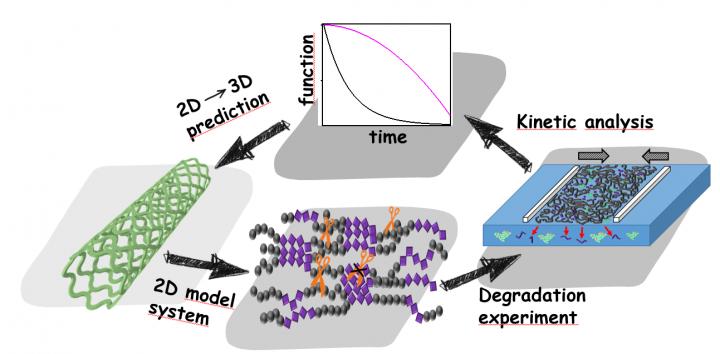
Thin film studies are suggested as a fast and reliable method to determine the degradation of complex biomacromolecules
IMAGE

Credit: Copyright: HZG/Institute of Biomaterial Science

The results have been reported today in the first issue of the journal Cell Reports Physical Science. With the so-called Langmuir technique, the authors transfer the material into a 2D system, and thereby circumvent the complex transport processes that influence the degradation of three-dimensional objects. They created analytical models describing different polymer architectures that are of particular interest for the design of multifunctional implants and determined the kinetic parameters that describe the degradation of these materials. In the next step, the scientists want to use these data to carry out computer simulations of the decomposition of therapeutic polymer devices. Regulatory authorities already prescribe computer simulations of the performance of such devices, for example for some stents. The insights gained by the 2D degradation studies are certain to improve these simulations. By introducing a method to quickly understand and predict the degradation of polymer materials, the HZG researchers are contributing substantially to establishing innovative, multifunctional polymers for regenerative medicine.

Background – Multifunctional Biomaterials

An implementation of degradability can be especially helpful for implants such as sutures or staples. These objects are only needed temporarily as a mechanical support. Future medical implants are expected to perform much more complex tasks. These degradable devices will for example be able to be programmed in a compressed shape and in this way implantable by minimally invasive techniques, release a drug that supports the healing process, recruit the right cells to its surface and report back on the progress of the recovery. Here degradation is only one out of several functions that are integrated in the materials. Yet, degradation is highly critical, because it changes the material on a molecular level. In order to implement multiple functions into a material, its molecular structure is designed in a distinct, often complex way. Understanding how degradation affects this molecular architecture is key to ensuring that all the functions are executed as intended. The thin layer method presented in the study can have a transformative role for designing such degradable polymers.

###

Media Contact
Andreas Lendlein
[email protected]
49-033-283-52450

Original Source

https://hzg.de/public_relations_media/news/084179/index.php.en

Related Journal Article

http://dx.doi.org/10.1016/j.xcrp.2019.100009

Tags: Biomechanics/BiophysicsChemistry/Physics/Materials SciencesMaterialsMolecular Biology
Share12Tweet8Share2ShareShareShare2

Related Posts

blank

Drought Stress: PHD Gene Expression in Alfalfa

December 26, 2025
Temperature and Heat Penetration in Canned vs. Pouched Whelk

Temperature and Heat Penetration in Canned vs. Pouched Whelk

December 26, 2025

Unveiling Genetic Factors Affecting Milk Fat in Holsteins

December 26, 2025

Halophilic Bacteria: Combatting Salt Stress with EPS and IAA

December 26, 2025
Please login to join discussion

POPULAR NEWS

  • Robotic Waist Tether for Research Into Metabolic Cost of Walking

    NSF funds machine-learning research at UNO and UNL to study energy requirements of walking in older adults

    71 shares
    Share 28 Tweet 18
  • Nurses’ Views on Online Learning: Effects on Performance

    70 shares
    Share 28 Tweet 18
  • Exploring Audiology Accessibility in Johannesburg, South Africa

    51 shares
    Share 20 Tweet 13
  • Unraveling Levofloxacin’s Impact on Brain Function

    54 shares
    Share 22 Tweet 14

About

We bring you the latest biotechnology news from best research centers and universities around the world. Check our website.

Follow us

Recent News

Baby Oil Eases Itch and Sleep in Uremic Patients

Impact of Vegan Diet and Resistance Exercise on Muscle Volume

Long Non-Coding RNAs: Key Players in NSCLC Immunity

Subscribe to Blog via Email

Enter your email address to subscribe to this blog and receive notifications of new posts by email.

Join 71 other subscribers
  • Contact Us

Bioengineer.org © Copyright 2023 All Rights Reserved.

Welcome Back!

Login to your account below

Forgotten Password?

Retrieve your password

Please enter your username or email address to reset your password.

Log In
No Result
View All Result
  • Homepages
    • Home Page 1
    • Home Page 2
  • News
  • National
  • Business
  • Health
  • Lifestyle
  • Science

Bioengineer.org © Copyright 2023 All Rights Reserved.