Credit: ©Science China Press
Micromotors are artificial microscale devices which can achieve autonomous movement by converting supplied fuels or externally provided energy into kinetic energy. Since the concept of micromotors was proposed, great scientific interest has been attracted, as a consequence, impressive progress has been made in exploiting various kinds of micromotors. Major efforts have revealed that micromotors present copious values in fields of biomedical engineering, environmental science, and so on. In particular, there is considerable interest in the use of micromotors in biosensing. Compared with traditional methods, these micromotors based strategies are able to greatly enhance the sensitivity while largely reducing the assay time of biomolecules since the continuous movement of micromotors can increase the possibility of target-receptor contacts. Although with many progresses in this aspect, recently available micromotors employed in biosensors can only carry out with single target screening and cannot meet the requirement of multiplex and high-throughput analyses, which is usually necessary to guide diagnosis. Therefore, functional micromotors with the multiplexing capabilities are still anticipated in the biomedical areas.
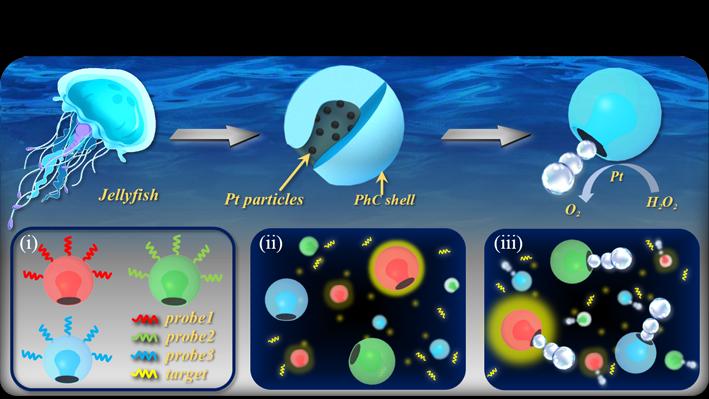
In a new research article published in National Science Review, scientists at Southeast University present a novel kind of micrototors with stable structural color for multiplex assays. They formed particles of colloidal crystal clusters with stomatocyte morphology by rapid extracting solvent and assembling monodispersed nanoparticles in droplets. These stomatocyte particles could not only show striking structural colors and characteristic reflection peaks due to their ordered nanoparticles arrangement, but also provide effective cavities for the integration of functional elements. Thus, by using the platinum (Pt) and ferric oxide (Fe3O4) dispersed hydrogel to fill and duplicate the stomatocyte colloidal crystal particles, the barcode micromotors with catalyst or magnetic elements in their cavities, as well as with corresponding structural color coding, could be achieved. When these micromotors were exposed to a solution with hydrogen peroxide (H2O2) additive, the Pt-dispersed hydrogel in their cavities could propel the micromotors by expelling catalytic bubbles, while the present Fe3O4 could impart magnetic guidance for the micromotors. It was demonstrated that the self-movement of these structural color barcode micromotors could efficiently accelerate the mixing speed of the detection sample and greatly increase the probe-target interactions towards faster and more sensitive detection, and the magnetism of these barcode micromotors enable the flexible collection of the micromotors, which could facilitate the detection processes. Based on the specific identification feature of the stable structural color coding, the barcode micromotors could also perform an unprecedented simultaneous multiplexing capability for DNA detection. These results indicate that the structural color barcode micromotors will provide an ideal platform for ultrasensitive multiplex assays in different fields.
###
This research received fundings from the National Natural Science Foundation of China (grants 51522302 and 21473029), the NSAF Foundation of China (grant U1530260).
See the article:
Li-Jun Cai, Huan Wang, Yun-Ru Yu, Fei-Ka Bian, Yu Wang, Ke-Qing Shi, Fang-Fu Ye, Yuan-Jin Zhao
Stomatocyte structural color barcode micromotors for multiplex assays
Natl Sci Rev nwz185
https:/
The National Science Review is the first comprehensive scholarly journal released in English in China that is aimed at linking the country’s rapidly advancing community of scientists with the global frontiers of science and technology. The journal also aims to shine a worldwide spotlight on scientific research advances across China.
Media Contact
Yuan-Jin Zhao
[email protected]
Related Journal Article
http://dx.