High-precision plasma bubble observation from the initial generation by installation at the magnetic equator
Credit: National Institute of Information and Communications Technology
[Abstract]
The National Institute of Information and Communications Technology (NICT, President: Hideyuki Tokuda, Ph.D.), in collaboration with King Mongkut’s Institute of Technology Ladkrabang (KMITL, President: Prof. Dr. Suchatvee Suwansawat), starts operation of a radar installed at KMITL Chumphon campus in Thailand to observe plasma bubbles that cause radio propagation disturbances. Chumphon is close to the magnetic equator where plasma bubbles are expected to be generated, and is the best place to observe plasma bubbles from their initial generation stage. In the vicinity of the plasma bubble, radio propagations are disturbed, which may degrade satellite-based navigation and communications. For this reason, continuous observation and forecast of plasma bubbles have been strongly desired in recent years. Routine observation of plasma bubbles by this radar is expected to be a major advancement in expanding the use of precise satellite-based navigation in the field of agriculture, construction, etc.
[Background]
NICT has been conducting research and development related to monitoring and forecasting of space weather including ionospheric and solar activities for the purpose of providing the information on forecasts and warnings about radio propagation conditions. NICT has been delivering the “Space Weather Forecast” every day since 1988. In recent years, the need for space weather information has increased in various fields. In particular, in the aviation industry, the Global Space Weather Center of International Civil Aviation Organization (ICAO) has started providing space weather information services on November 7, 2019. NICT also provides information on communications, satellite-based navigation, and radiation exposure as a member of the center.
One of the most significant effects of space weather on our social life is the degradation of satellite-based navigation, such as GPS, due to ionospheric disturbances. One of the intense ionospheric disturbances is “plasma bubbles” that occur around the magnetic equator, which is the equator of the Earth’s magnetic field. In the vicinity of the plasma bubble, the radio propagations are disturbed, which may reduce the accuracy of satellite-based navigation or disable them in the worst case.
Recently, advanced satellite-based navigation technology, such as unmanned auto-driving system in the field of agriculture and construction, has been available, and is already an indispensable infrastructure in our society. Since plasma bubbles cause degradation of satellite-based navigation not only at low latitudes near the magnetic equator, but also at mid-latitudes such as Japan, continuous observation and forecast of plasma bubbles have been strongly desired in recent years.
[Achievements]
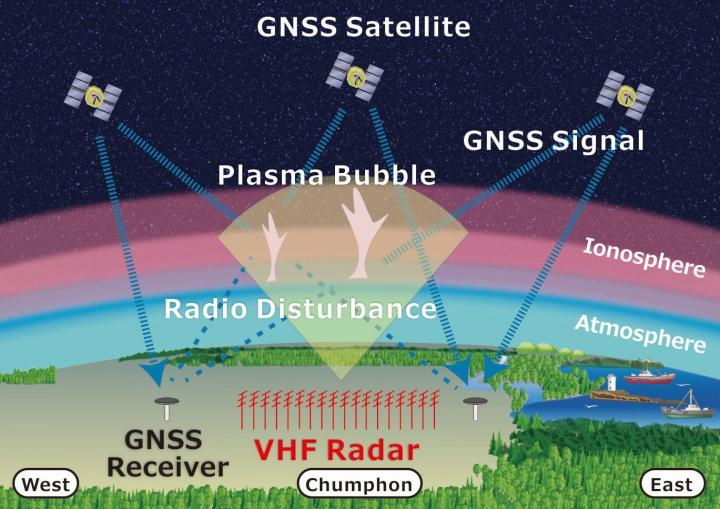
NICT and KMITL collaboratively have installed a radar system for observation of plasma bubbles in the KMITL Chumphon campus and start operation on January 17, 2020 (see Figure 1). Chumphon is close to the magnetic equator where plasma bubbles are expected to be generated, and is the best place to observe plasma bubbles immediately after their generation (see Figure 2).
The radar system consists of 18 antennas equidistantly installed in the east-west direction at spacing of about 5m, using radio waves in the VHF band (39.65 MHz). The radio waves transmitted from the radar are reflected by the plasma irregularity caused by plasma bubbles in the ionosphere. By observing the reflected radio waves, the location and velocity of the plasma bubbles can be monitored (see Figure 3).
Plasma bubbles generally travel eastward after their generation and sometimes develop to mid-latitudes, causing radio propagation disturbances in the southern part of Japan. The radar will enable routine observation of plasma bubbles, which will lead to a significant progress in expanding the use of high-accuracy satellite-based navigation in the fields of agriculture, construction, etc. in Japan and Southeast Asia.
[Future Prospects]
For future work, using GPS receiver networks in Japan and Thailand in addition to this radar system, we will investigate the effects of plasma bubbles on various satellite-based navigation methods and conduct research to reduce the effects. These results will be provided as one of the space weather forecast services.
###
Media Contact
Sachiko Hirota
[email protected]
Original Source
https:/