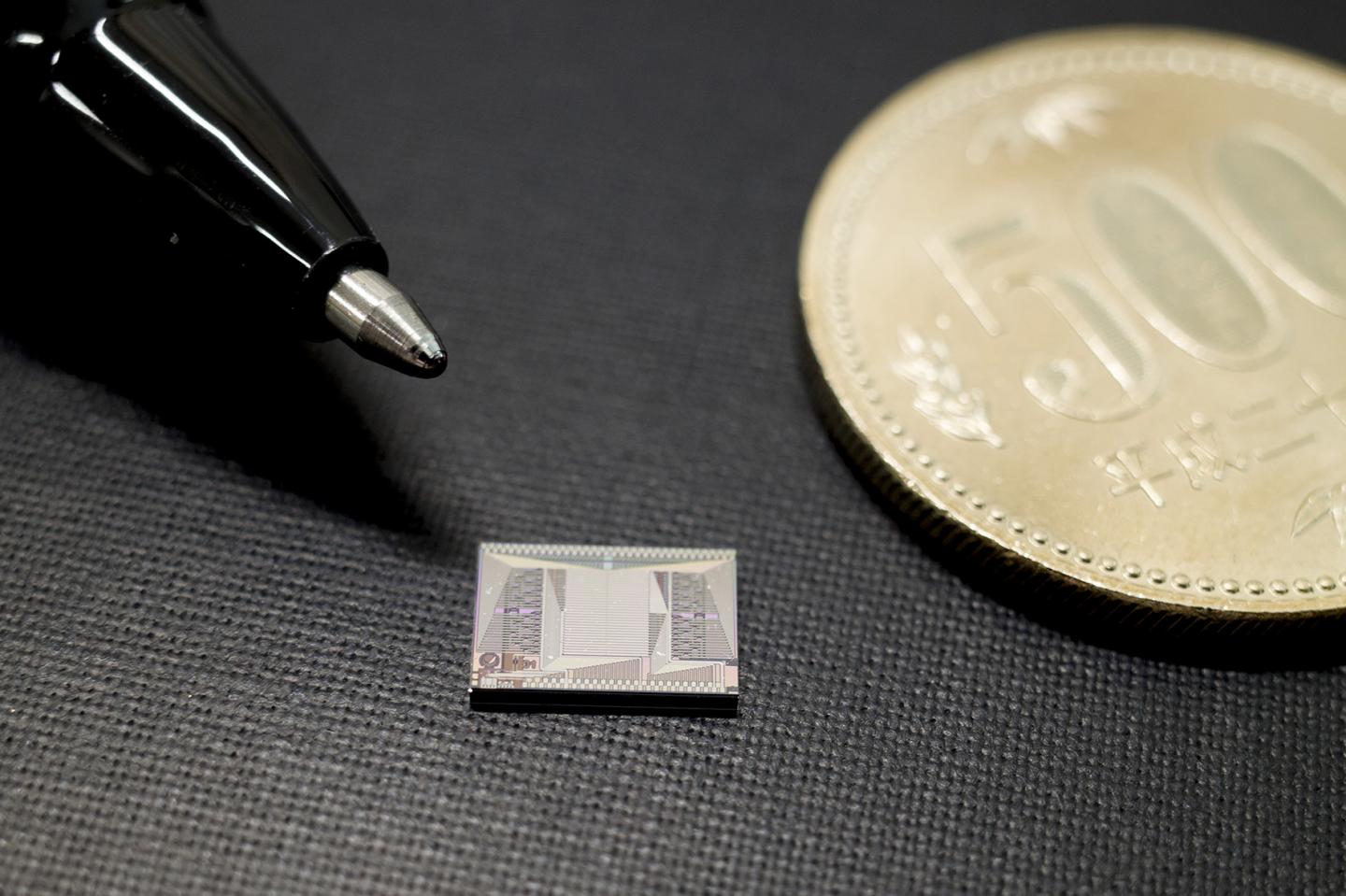
Credit: Yokohama National University
Quicker is not always better, especially when it comes to a 3D sensor in advanced technology. With applications in autonomous vehicles, robots and drones, security systems and more, researchers are striving for a 3D sensor that is compact and easy to use.
A team from Yokohama National University in Japan believes they have developed a method to obtain such a sensor by taking advantage of slow light, an unexpected move in a field where speed is often valued above other variables.
They publish their results on January 20 in the Optica, a journal published by The Optical Society.
Light detection and ranging also called LiDAR sensors can map the distance between distant objects and more using laser light. In modern LiDAR sensors, many of the systems are composed of a laser source; a photodetector, which converts light into current; and an optical beam steering device, which directs the light into the proper location.
“Currently existing optical beam steering devices all use some kind of mechanics, such as rotary mirrors,” said Toshihiko Baba, paper author and professor in the Department of Electrical and Computer Engineering at Yokohama National University. “This makes the device large and heavy, with limited overall speed and a high cost. It all becomes unstable, particularly in mobile devices, hampering the wide range of applications.”
In recent years, according to Baba, more engineers have turned toward optical phased arrays, which direct the optical beam without mechanical parts. But, Baba warned, such an approach can become complicated due to the sheer number of optical antennae required, as well as the time and precision needed to calibrate each piece.
“In our study, we employed another approach — what we call ‘slow light,'” Baba said.
Baba and his team used a special waveguide “photonic crystal,” aimed through a silicon-etched medium. Light is slowed down and emitted to the free space when forced to interact with the photonic crystal. The researchers engaged a prism lens to then direct the beam in the desired direction.
“The non-mechanical steering is thought to be crucial for LiDAR sensors,” Baba said.
The resulting method and device are small-sized, free of moving mechanics, setting the stage for a solid-state LiDAR. Such a device is considered smaller, cheaper to make and more resilient, especially in mobile applications such as autonomous vehicles.
Next, Baba and his team plan to more fully demonstrate the potential of a solid-state LiDAR, as well as work on improving its performance with the ultimate goal of commercializing the device.
###
Other contributors from Yokohama National University’s Department of Electrical and Computer Engineering include Hiroyuki Ito, Yuma Kusunoki, Jun Maeda, Daichi Akiyama, Naoya Kodama, Hiroshi Abe and Ryo Tetsuya.
This research was supported by the Accelerated Innovation Research Initiative Turning Top Science and Ideas into High-Impact Values and the Japan Science and Technology Agency.
Yokohama National University (YNU or Yokokoku) is a Japanese national university founded in 1949. YNU provides students with a practical education utilizing the wide expertise of its faculty and facilitates engagement with the global community. YNU’s strength in the academic research of practical application sciences leads to high-impact publications and contributes to international scientific research and the global society. For more information, please see: https:/
Media Contact
Akiko Tsumura
[email protected]
Related Journal Article
http://dx.