• HOME
  • NEWS
  • EXPLORE
    • CAREER
      • Companies
      • Jobs
    • EVENTS
    • iGEM
      • News
      • Team
    • PHOTOS
    • VIDEO
    • WIKI
  • BLOG
  • COMMUNITY
    • FACEBOOK
    • INSTAGRAM
    • TWITTER
Saturday, February 7, 2026
BIOENGINEER.ORG
No Result
View All Result
  • Login
  • HOME
  • NEWS
  • EXPLORE
    • CAREER
      • Companies
      • Jobs
        • Lecturer
        • PhD Studentship
        • Postdoc
        • Research Assistant
    • EVENTS
    • iGEM
      • News
      • Team
    • PHOTOS
    • VIDEO
    • WIKI
  • BLOG
  • COMMUNITY
    • FACEBOOK
    • INSTAGRAM
    • TWITTER
  • HOME
  • NEWS
  • EXPLORE
    • CAREER
      • Companies
      • Jobs
        • Lecturer
        • PhD Studentship
        • Postdoc
        • Research Assistant
    • EVENTS
    • iGEM
      • News
      • Team
    • PHOTOS
    • VIDEO
    • WIKI
  • BLOG
  • COMMUNITY
    • FACEBOOK
    • INSTAGRAM
    • TWITTER
No Result
View All Result
Bioengineer.org
No Result
View All Result
Home NEWS Science News

A breath of fresh air for longer-running batteries

Bioengineer by Bioengineer
January 9, 2020
in Science News
Reading Time: 3 mins read
0
IMAGE
Share on FacebookShare on TwitterShare on LinkedinShare on RedditShare on Telegram

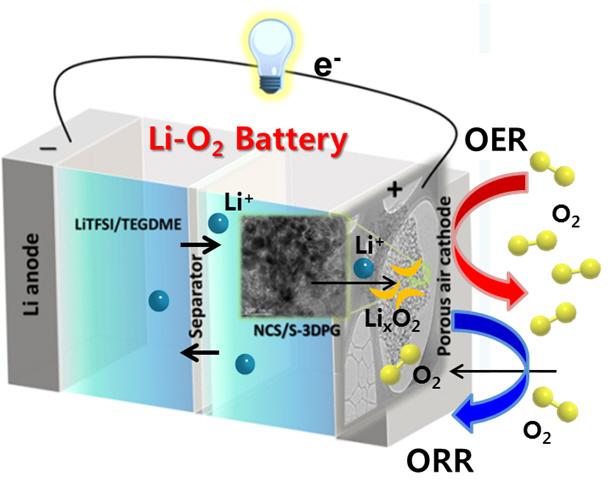
A low-cost catalyst on a sulfur-doped, porous, carbon nanostructure improves the performance of lithium batteries that run on air
IMAGE

Credit: DGIST


DGIST researchers are improving the performance of lithium-air batteries, bringing us closer to electric cars that can use oxygen to run longer before they need to recharge. In their latest study, published in the journal Applied Catalysis B: Environmental, they describe how they fabricated an electrode using nickel cobalt sulphide nanoflakes on a sulphur-doped graphene, leading to a long-life battery with high discharge capacity.

“The driving distance of electric cars running on lithium-ion batteries is about 300 kilometers,” says chemist Sangaraju Shanmugam of Korea’s Daegu Gyeongbuk Institute of Science & Technology (DGIST). “This means it’s difficult to make a round trip between Seoul and Busan on these batteries. This has led to research on lithium-air batteries, due to their ability so store more energy and thus provide longer mileage.”

But lithium-air batteries face many challenges before they can be commercialized. For example, they don’t discharge energy as fast as lithium-ion batteries, meaning an electric car with a lithium-air battery might travel further without needing to recharge, but you’d have to drive very slowly. These batteries are also less stable and would need to be replaced more often.

Shanmugam and his colleagues focused their research on improving the capacity of lithium-air batteries to catalyse the reactions between lithium ions and oxygen, which facilitate energy release and the recharging process.

Batteries have two electrodes, an anode and a cathode. The reactions between lithium ions and oxygen happen at the cathode in a lithium-air battery. Shanmugam and his team developed a cathode made from nickel cobalt sulphide nanoflakes placed on a porous graphene that was doped with sulphur.

Their battery demonstrated a high discharge capacity while at the same time maintaining its battery performance for over two months without the capacity waning.

The success of the battery is due to several factors. The different-sized pores in the graphene provided a large amount of space for the chemical reactions to occur. Similarly, the nickel cobalt sulphide catalyst flakes posses abundant active sites for these reactions. The flakes also form a protective layer that makes for a more robust electrode. Finally, doping the graphene with sulphur and the interconnectivity of its pores improves the transportation of electrical charges in the battery.

The team next plans to work on improving other aspects of the lithium-air battery by conducting research on understanding the discharge/charge behaviours of the electrodes and its surface characteristics. “Once we’ve secured the core technologies of all parts of the battery and combined them, it will be possible to start manufacturing prototypes,” says Shanmugam.

###

Media Contact
Sangaraju Shanmugam
[email protected]
82-537-856-413

Original Source

https://www.dgist.ac.kr/en/html/sub06/060202.html?mode=V&no=71ade6410f01f0503457b8e6395ff7b8

Related Journal Article

http://dx.doi.org/10.1016/j.apcatb.2019.118283

Tags: Chemistry/Physics/Materials SciencesElectrical Engineering/ElectronicsElectromagneticsEnergy/Fuel (non-petroleum)Technology/Engineering/Computer Science
Share12Tweet8Share2ShareShareShare2

Related Posts

Phage-Antibiotic Combo Beats Resistant Peritoneal Infection

February 7, 2026

Boosting Remote Healthcare: Stepped-Wedge Trial Insights

February 7, 2026

Barriers and Boosters of Seniors’ Physical Activity in Karachi

February 7, 2026

Evaluating Pediatric Emergency Care Quality in Ethiopia

February 7, 2026
Please login to join discussion

POPULAR NEWS

  • Robotic Ureteral Reconstruction: A Novel Approach

    Robotic Ureteral Reconstruction: A Novel Approach

    82 shares
    Share 33 Tweet 21
  • Digital Privacy: Health Data Control in Incarceration

    63 shares
    Share 25 Tweet 16
  • Study Reveals Lipid Accumulation in ME/CFS Cells

    57 shares
    Share 23 Tweet 14
  • Breakthrough in RNA Research Accelerates Medical Innovations Timeline

    53 shares
    Share 21 Tweet 13

About

We bring you the latest biotechnology news from best research centers and universities around the world. Check our website.

Follow us

Recent News

Phage-Antibiotic Combo Beats Resistant Peritoneal Infection

Boosting Remote Healthcare: Stepped-Wedge Trial Insights

Barriers and Boosters of Seniors’ Physical Activity in Karachi

Subscribe to Blog via Email

Enter your email address to subscribe to this blog and receive notifications of new posts by email.

Join 73 other subscribers
  • Contact Us

Bioengineer.org © Copyright 2023 All Rights Reserved.

Welcome Back!

Login to your account below

Forgotten Password?

Retrieve your password

Please enter your username or email address to reset your password.

Log In
No Result
View All Result
  • Homepages
    • Home Page 1
    • Home Page 2
  • News
  • National
  • Business
  • Health
  • Lifestyle
  • Science

Bioengineer.org © Copyright 2023 All Rights Reserved.