• HOME
  • NEWS
  • EXPLORE
    • CAREER
      • Companies
      • Jobs
    • EVENTS
    • iGEM
      • News
      • Team
    • PHOTOS
    • VIDEO
    • WIKI
  • BLOG
  • COMMUNITY
    • FACEBOOK
    • INSTAGRAM
    • TWITTER
Wednesday, December 17, 2025
BIOENGINEER.ORG
No Result
View All Result
  • Login
  • HOME
  • NEWS
  • EXPLORE
    • CAREER
      • Companies
      • Jobs
        • Lecturer
        • PhD Studentship
        • Postdoc
        • Research Assistant
    • EVENTS
    • iGEM
      • News
      • Team
    • PHOTOS
    • VIDEO
    • WIKI
  • BLOG
  • COMMUNITY
    • FACEBOOK
    • INSTAGRAM
    • TWITTER
  • HOME
  • NEWS
  • EXPLORE
    • CAREER
      • Companies
      • Jobs
        • Lecturer
        • PhD Studentship
        • Postdoc
        • Research Assistant
    • EVENTS
    • iGEM
      • News
      • Team
    • PHOTOS
    • VIDEO
    • WIKI
  • BLOG
  • COMMUNITY
    • FACEBOOK
    • INSTAGRAM
    • TWITTER
No Result
View All Result
Bioengineer.org
No Result
View All Result
Home NEWS Science News

Improved functioning of diverse landscape mosaics

Bioengineer by Bioengineer
January 9, 2020
in Science News
Reading Time: 3 mins read
0
IMAGE
Share on FacebookShare on TwitterShare on LinkedinShare on RedditShare on Telegram

IMAGE

Credit: University of Zurich


To date, biodiversity research primarily focused on the number of plant species present in ecosystems. “Most studies so far have used small, artificially established study plots. However, real-world landscapes are much more complex, and, in addition to natural areas, also contain human-dominated elements such as arable land and urban areas”, says Pascal Niklaus, professor at the Department of Evolutionary Biology and Environmental Studies at the University of Zurich (UZH).

5,000 Swiss landscapes analyzed

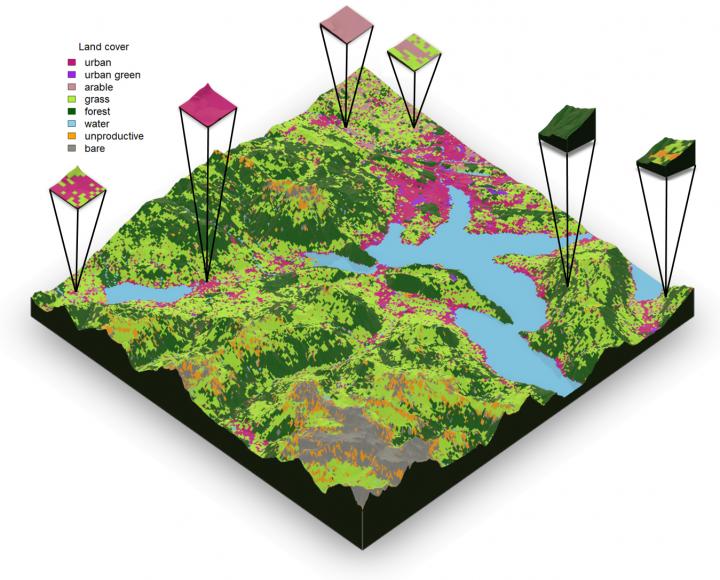
A research team led by Niklaus and part of the Research Priority Program “Global Change and Biodiversity” investigated how different land-cover areas affect vegetation growth in large landscapes. Using aerial imagery, they assessed land-cover in 4,974 landscape plots from all regions in Switzerland. In addition to green areas such as grassland and forest they also considered human-dominated areas including arable fields and settlements. In parallel, they used satellite data to determine plant productivity in these landscapes over a period of 17 years.

Land-cover mixtures are more productive and stable

“We found that landscapes consisting of a mosaic of different land uses were more productive than the average landscape with uniform use”, Niklaus summarizes. This positive effect of land-use diversity and productivity held over many regions, climatic conditions and altitude ranges. Landscape mosaics also showed a temporally more stable productivity. In other words, more diverse landscapes are able to mitigate effects of inter-annual climate variation.

Different mechanisms are at play

The positive effects of land-use diversity were unrelated to the number of plant species present in these landscapes. This indicates that areas with different land uses interact and improve the functioning of the entire landscape, similar to the way in which plant species interact in a small patch of vegetation and thereby improve the functioning of the plant community. “In such large landscapes, novel mechanisms must be at play that do not operate in the small study plots traditionally examined in biodiversity experiments”, Jacqueline Oehri, first author of the study, says. The specific nature of these mechanisms is the subject of further investigations. The authors speculate that, for example, urban areas and water bodies affect climatic conditions in their surroundings, and that this might improve the productivity of vegetation in these areas.

Strategies for regional planning and landscape management

The way in which different land uses are spatially interwoven thus promotes the functioning of landscapes, in addition to the established beneficial effects of high species diversity. The study’s novel approach enables landscapes to be analyzed on a scale that is relevant for regional planning and conservation policies. However, Niklaus emphasizes that “the fact that mixed landscapes function better should not be understood to mean that natural areas should be fragmented by expanding urban settlements”.

###

Media Contact
Pascal A. Niklaus
[email protected]
41-446-353-413

Original Source

https://www.media.uzh.ch/en/Press-Releases/2020/Landscape-Richness.html

Related Journal Article

http://dx.doi.org/10.1038/s41467-019-14002-7

Tags: BiologyClimate ChangeEarth ScienceEcology/EnvironmentPlant SciencesUrbanization
Share12Tweet8Share2ShareShareShare2

Related Posts

Skink’s Sex Chromosome Compensation Unaffected by Sex Phenotype

Skink’s Sex Chromosome Compensation Unaffected by Sex Phenotype

December 17, 2025

Digital Health Literacy’s Influence on Nursing Students’ Engagement

December 17, 2025

nSOFA Scores Forecast Extended Ventilation in Neonates

December 17, 2025

Unrecognized Lean MASLD in U.S. Adults Revealed

December 17, 2025
Please login to join discussion

POPULAR NEWS

  • Nurses’ Views on Online Learning: Effects on Performance

    Nurses’ Views on Online Learning: Effects on Performance

    70 shares
    Share 28 Tweet 18
  • NSF funds machine-learning research at UNO and UNL to study energy requirements of walking in older adults

    70 shares
    Share 28 Tweet 18
  • MoCK2 Kinase Shapes Mitochondrial Dynamics in Rice Fungal Pathogen

    72 shares
    Share 29 Tweet 18
  • Unraveling Levofloxacin’s Impact on Brain Function

    52 shares
    Share 21 Tweet 13

About

We bring you the latest biotechnology news from best research centers and universities around the world. Check our website.

Follow us

Recent News

Skink’s Sex Chromosome Compensation Unaffected by Sex Phenotype

Digital Health Literacy’s Influence on Nursing Students’ Engagement

nSOFA Scores Forecast Extended Ventilation in Neonates

Subscribe to Blog via Email

Enter your email address to subscribe to this blog and receive notifications of new posts by email.

Join 70 other subscribers
  • Contact Us

Bioengineer.org © Copyright 2023 All Rights Reserved.

Welcome Back!

Login to your account below

Forgotten Password?

Retrieve your password

Please enter your username or email address to reset your password.

Log In
No Result
View All Result
  • Homepages
    • Home Page 1
    • Home Page 2
  • News
  • National
  • Business
  • Health
  • Lifestyle
  • Science

Bioengineer.org © Copyright 2023 All Rights Reserved.