• HOME
  • NEWS
  • EXPLORE
    • CAREER
      • Companies
      • Jobs
    • EVENTS
    • iGEM
      • News
      • Team
    • PHOTOS
    • VIDEO
    • WIKI
  • BLOG
  • COMMUNITY
    • FACEBOOK
    • INSTAGRAM
    • TWITTER
Monday, October 5, 2026
BIOENGINEER.ORG
No Result
View All Result
  • Login
  • HOME
  • NEWS
  • EXPLORE
    • CAREER
      • Companies
      • Jobs
        • Lecturer
        • PhD Studentship
        • Postdoc
        • Research Assistant
    • EVENTS
    • iGEM
      • News
      • Team
    • PHOTOS
    • VIDEO
    • WIKI
  • BLOG
  • COMMUNITY
    • FACEBOOK
    • INSTAGRAM
    • TWITTER
No Result
View All Result
Bioengineer.org
No Result
View All Result
Home NEWS Science News Biology

Greening at high latitudes may inhibit the expansion of midlatitude deserts

Bioengineer by Bioengineer
January 9, 2020
in Biology
Reading Time: 2 mins read
0
IMAGE
Share on FacebookShare on TwitterShare on LinkedinShare on RedditShare on Telegram

IMAGE

Credit: Yongli He

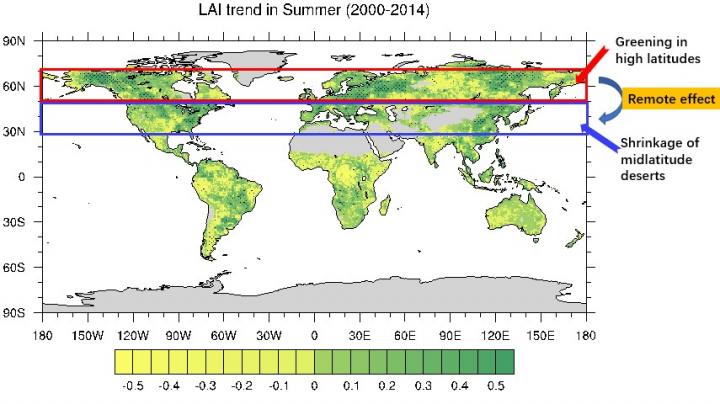
Desertification has always been a serious challenge for human beings, especially in arid and semi-arid regions. Projections from CMIP5 support the expansion of arid and semi-arid regions with increasing greenhouse gas concentrations. Interestingly, besides inducing a stronger greenhouse effect, increasing carbon dioxide is also leading to global vegetation greening, especially in high latitudes, by the fertilization effect. However, it is still unknown whether greening in high latitudes could affect midlatitude deserts.

In a paper recently published in Atmospheric and Oceanic Science Letters, Dr. Yongli He from the department of Atmospheric Science, Lanzhou University, and his coauthors, try to address this question based on their work on the remote effect of greening in high latitudes.

“We investigated the remote effects of greening at high latitudes by using a two-dimensional energy balance model. We decreased the albedo in high latitudes to represent the greening phenomenon, and then investigated the changes in the boundaries of midlatitude deserts. We found that the midlatitude deserts retreated significantly at the southern boundary, while the polar ice belts and low-latitude vegetation belts expanded,” says Dr. He.

According to this study, high-latitude vegetation greening may inhibit the expansion of midlatitude deserts. “However, due to the simplification of the two-dimensional energy balance model, the impact of high-latitude vegetation greening on the climate of midlatitude desert regions still needs further study,” adds Dr. He.

###

Media Contact
Zheng Lin
[email protected]
86-108-299-5053

Original Source

http://159.226.119.58/aosl/EN/news/news29.shtml

Related Journal Article

http://dx.doi.org/10.1080/16742834.2020.1696650

Tags: AgricultureAtmospheric ScienceClimate ChangeEarth ScienceForestryPlant Sciences
Share12Tweet8Share2ShareShareShare2

Related Posts

Filariasis Cases Cluster Near Mosquito Breeding Grounds on Indonesian Island, Study Finds

Filariasis Cases Cluster Near Mosquito Breeding Grounds on Indonesian Island, Study Finds

October 5, 2026
Embryo-Derived Peptide Signal Orients Endosperm Development in Seeds

Embryo-Derived Peptide Signal Orients Endosperm Development in Seeds

October 5, 2026

Aging Disc Cells Lose a Key Signal That Calls Immune Cells to Heal Injured Spines

October 5, 2026

AI-Powered Molecular Glue Discovery Offers New Route Against Blood Cancers and Autoimmune Disease

October 5, 2026
Please login to join discussion

POPULAR NEWS

  • Alloys That Shrink Their Own Grains: New PIX Mechanism Refines Metals With Heat Alone

    Alloys That Shrink Their Own Grains: New PIX Mechanism Refines Metals With Heat Alone

    29 shares
    Share 12 Tweet 7
  • Endurance Exercise Reshapes the Liver in Males and Females Through Distinct Molecular Routes

    29 shares
    Share 12 Tweet 7
  • Single Transcription Factor PU.1 Rapidly Converts Fibroblasts into Macrophage-Lineage Cells

    29 shares
    Share 12 Tweet 7
  • New Scale Measures How Ready Nurse Educators Really Are for the AI Era

    29 shares
    Share 12 Tweet 7

About

We bring you the latest biotechnology news from best research centers and universities around the world. Check our website.

Follow us

Recent News

Alloys That Shrink Their Own Grains: New PIX Mechanism Refines Metals With Heat Alone

Endurance Exercise Reshapes the Liver in Males and Females Through Distinct Molecular Routes

Single Transcription Factor PU.1 Rapidly Converts Fibroblasts into Macrophage-Lineage Cells

Subscribe to Blog via Email

Success! An email was just sent to confirm your subscription. Please find the email now and click 'Confirm' to start subscribing.

Join 85 other subscribers
  • Contact Us

Bioengineer.org © Copyright 2023 All Rights Reserved.

Welcome Back!

Login to your account below

Forgotten Password?

Retrieve your password

Please enter your username or email address to reset your password.

Log In
No Result
View All Result
  • Homepages
    • Home Page 1
    • Home Page 2
  • News
  • National
  • Business
  • Health
  • Lifestyle
  • Science

Bioengineer.org © Copyright 2023 All Rights Reserved.