Activating relativistic effects of intense laser light in plasma, researchers at Osaka University test a new method for achieving consistent nuclear fusion, which may lead to cheaper and emission-free energy production
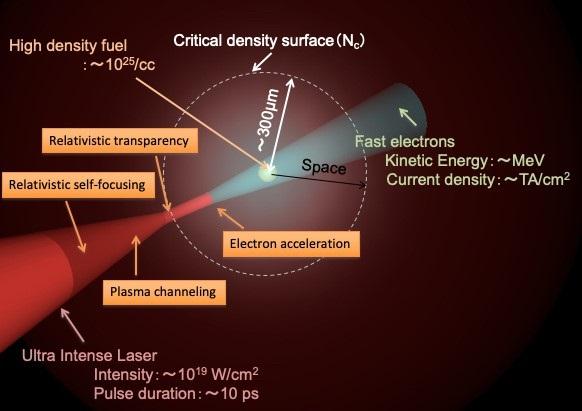
Credit: Osaka University
Osaka, Japan – A team of researchers at Osaka University has investigated a new method for generating nuclear fusion power, showing that the relativistic effect of ultra-intense laser light improves upon current “fast ignition” methods in laser-fusion research to heat the fuel long enough to generate electrical power. These findings could provide a spark for laser fusion, ushering in a new era of carbonless energy production.
Current nuclear power uses the fission of heavy isotopes, such as uranium, into lighter elements to produce power. Yet, this fission power has major concerns, such as spent fuel disposal and the risk of meltdowns. A promising alternative to fission is nuclear fusion. Like all stars, our sun is powered by the fusion of light isotopes, notably hydrogen, into heavier elements. Fusion has many advantages over fission, including the lack of hazardous waste or risk of uncontrolled nuclear reactions.
However, getting more energy out of a fusion reaction than was put into it has remained an elusive goal. This is because hydrogen nuclei strongly repel each other, and fusion requires extreme heat and pressure conditions – like those found in the interior of the sun, for instance – to squeeze them together. One method, called “inertial confinement” uses extremely high-energy laser pulses to heat and compress a fuel pellet before it gets the chance to be blown apart. Unfortunately, this technique requires extremely precise control of the laser’s energy so that the compression shock waves all arrive at the center simultaneously.
Now, a team led by Osaka University has developed a modified method for inertial confinement that can be performed more consistently using a second laser shot. In “super-penetration” fast ignition, the directly irradiated second laser produces fast-moving electrons in dense plasma that heat the core during compression to trigger fusion. “By utilizing the relativistic behavior of the high-intensity laser, the energy can be reliably delivered to fuel in the imploded plasma aiming the ignition,” first author Tao Gong says.
The fuel for this method, which is usually a mix of the hydrogen isotopes deuterium and tritium, is easier to obtain than uranium, and becomes harmless helium after fusion. “This result is an important step towards the realization of laser fusion energy, as well as for other applications of high-energy density physics, including medical treatment,” explains senior author Kazuo Tanaka.
###
The article, “Direct observation of imploded core heating via fast electrons with super-penetration scheme,” was published in Nature Communications at DOI: https:/
About Osaka University
Osaka University was founded in 1931 as one of the seven imperial universities of Japan and now has expanded to one of Japan’s leading comprehensive universities. The University has now embarked on open research revolution from a position as Japan’s most innovative university and among the most innovative institutions in the world according to Reuters 2015 Top 100 Innovative Universities and the Nature Index Innovation 2017. The university’s ability to innovate from the stage of fundamental research through the creation of useful technology with economic impact stems from its broad disciplinary spectrum.
Website: https:/
Media Contact
Saori Obayashi
[email protected]
81-661-055-886
Original Source
https:/
Related Journal Article
http://dx.