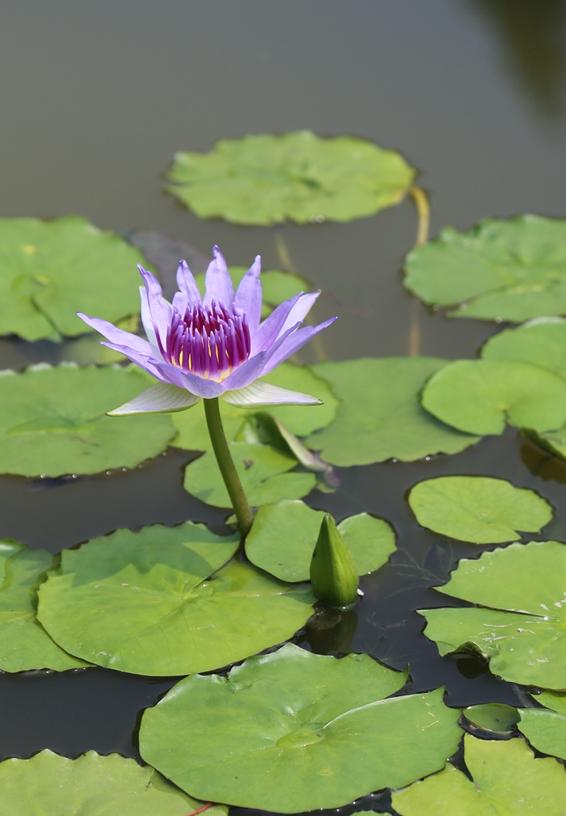
Credit: Liangsheng Zhang
The newly reported genome sequence of a water lily sheds light on the early evolution of angiosperms, the group of all flowering plants. An international team of researchers, including scientists at Penn State, used high-throughput next-generation sequencing technology to read out the water lily’s (Nymphaea colorata) genome and transcriptome–the set of all genes expressed as RNAs.
The unusual high quality and depth of coverage of the sequence allowed the researchers to assemble the vast majority of the genome into 14 chromosomes and identify more than 31 thousand protein-coding genes. A paper describing the sequence and subsequent analysis appears December 18, 2019 in the journal Nature.
“Water lilies have been an inspiration to artists like Claude Monet because of their beauty and important to scientists because of their position near the base of the evolutionary tree of all flowering plants,” said Hong Ma, associate dean for research and innovation, Huck Distinguished Research Professor of Plant Molecular Biology, and professor of biology at Penn State, one of the leaders of the research team. “I previously contributed to the sequencing and analysis of the genome of Amborella, which represents the earliest branch to separate from other flowering plants, but Amborella lacks big showy colorful flowers and attractive floral scent, both of which serve to attract pollinators in most groups of flowering plants. We were interested in the water lily genome to help us understand how these traits evolved.”
Evolutionary comparison of the water lily genome to the genomes of Amborella, other angiosperms, and several gymnosperms–the group of seed-bearing plants that do not produce flowers–confirmed the position of Amborella, which shares some characteristics with the gymnosperms, as the earliest of currently living angiosperms to separate from other flowering plants. Water lilies were the next branch to diverge from a third branch (Austrobaileyales, which includes star anise) and a fourth very large group called the mesangiosperms, which contains over 99% of living flowering plants.
“If we make an analogy to mammalian evolution, Amborella has a similar position to that of the platypus and other egg-laying mammals,” said Ma. “The platypus is a mammal because it feeds its young with milk, but it lays eggs like birds or reptiles. Amborella, like gymnosperms, has separate male and female plants, but the water lily has male and female reproductive parts within a single flower. This makes the water lily more similar to the vast majority of other flowering plants, so having the genomes of both Amborella and water lily can help us to better analyze the evolutionary transition from gymnosperms to angiosperms.”
The researchers used molecular dating to estimate the separation of the family of water lilies (Nymphaeaceae) from other families of related aquatic plants at somewhere between 147 and 185 million years ago, when dinosaurs roamed the earth, with a whole-genome duplication (WGD)/polyploidy event at about the same time. Many of the key genes for flower development retained in this WGD.
The research team also analyzed genes in the water lily genome that are likely important for the generation of molecules for attractive floral scent and color, traits shared with most other angiosperms, but not found in Amborella. They identified a massive expansion in the number of genes involved in the biosynthesis of floral scent in water lilies; these genes seem to have evolved in parallel with the other angiosperms. They also analyzed the expression of genes involved in flower color between two species of water lily, identifying the key proteins responsible for blue petals.
“Having the water lily genome allows us to explore these important traits in flowering plants and especially among horticultural plants,” said Ma. “It’s likely that brightly colored flowers and floral scent evolved through an interaction with pollinators and such flowers are ultimately extremely important for the success of flowering plants. Identification of the key synthetic genes of blue petals has important reference value for breeding blue petal varieties.”
###
In addition to Ma, the research team was led by Liangsheng Zhang and Haibao Tang of the Fujian Agriculture and Forestry University in Fuzhou, China; Fei Chen and Feng Chen of Nanjing Agricultural University in Nanjing, China and the University of Tennessee, Knoxville; and Yves Van de Peer of Ghent University in Belgium, and includes 47 authors from 23 institutions.
Media Contact
Sam Sholtis
[email protected]
814-865-1390
Original Source
http://science.
Related Journal Article
http://dx.