Scientists can’t see underground, but computational models are providing a new way to investigate how root systems might be changing
Credit: Charlotte Grossiord
BUFFALO, N.Y. — As the world warms, a new study is helping scientists understand how cone-bearing trees like pines and junipers may respond to drought.
The research addresses a classic question in the field: When conditions are dry for long periods of time, do trees survive by growing new roots to tap water sources, or by relying on established roots that already go deep?
The answer, at least for some cone-bearing trees, known as conifers, may be the latter, says Scott Mackay, PhD, professor of geography in the University at Buffalo College of Arts and Sciences. Mackay is an expert in ecohydrology and how trees take up water.
In the new study, he led a team that used computational modeling to investigate how pines and junipers access water sources during prolonged dry spells.
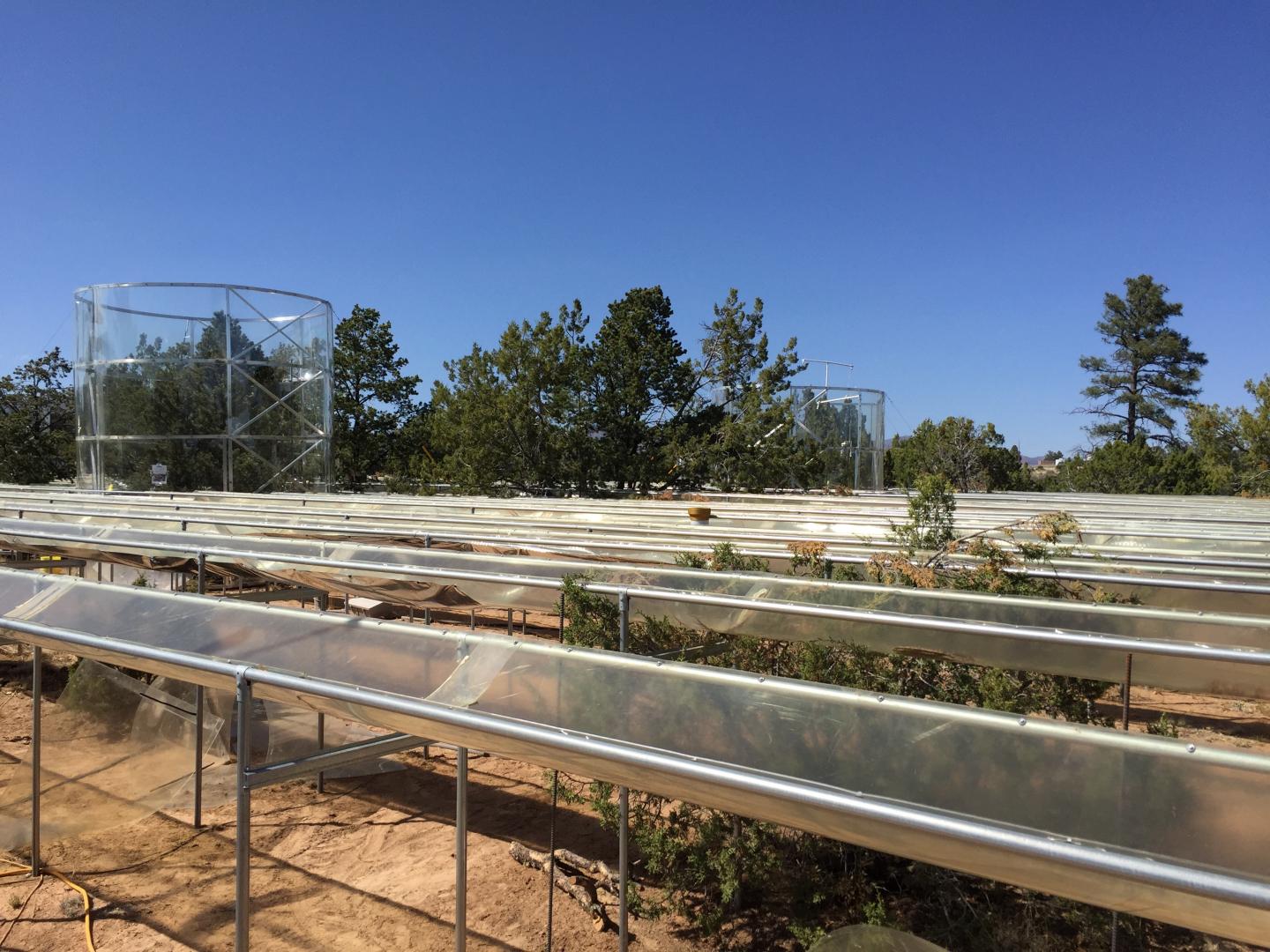
In simulations, trees of both species survived a five-year drought when they entered the dry period with deep roots already reaching into fractured bedrock, where water can be found. These modeled trees also used water in ways that matched well with observations of real trees that successfully weathered drought conditions at the Los Alamos Survival-Mortality (SUMO) experiment site in New Mexico.
“When the model was set up with roots in the groundwater, none of the trees died off,” Mackay says. “When the model required the trees to grow the roots into the bedrock after simulations started, all the trees died off. Growing new roots, which itself requires water, took too long.”
The study was a collaboration between scientists at UB, Duke University, the Swiss Federal Institute for Forest, Snow and Landscape Research (WSL), Pacific Northwest National Laboratory, Oklahoma State University and the University of Utah.
The research, published online in New Phytologist in July 2019, appears in the journal’s January 2020 issue, along with a more recent commentary on the paper’s importance by Louis Santiago, PhD, a professor of botany and plant sciences at the University of California, Riverside.
“Mackay et al. (2020) were able to distinguish between two major hypotheses regarding the dynamics of root function during drought, and essentially establish theory, which can now be validated or refuted in other systems,” Santiago writes in the commentary.
The study’s results could help explain why some pines and junipers are able to survive droughts while other trees around them, including those of the same species, perish.
What’s happening underground?
The inability to see underground — to peer through soil and bedrock — is a topic of frustration for scientists who research trees. Mackay’s research addresses this conundrum, providing a new tool for deducing what might be happening down below.
“It’s very difficult to see what’s happening with a tree’s roots. Digging these trees up is very difficult, and you would kill them in the process,” Mackay says. “The model provides us with an additional lens of seeing below the surface. Below-ground is kind of a frontier, an area of research that’s becoming more and more important.”
The model his team employed in the study simulates the behavior of trees, including how they use water and carbon, both of which are needed to grow new tissue, including roots.
As Mackay explains, “Carbon is obtained through photosynthesis, and it has to be transported down from the canopy of the trees to grow roots. Water is needed as part of this transport process. So if the tree’s roots are in dry soil and they can’t obtain water, this can affect the tree’s ability to move carbon around, which can in turn impair the growth of new roots. Our model captures this feedback.”
By helping scientists understand the traits that set some pines and junipers up to survive droughts, the study could provide insights into how coniferous forests will respond to the pressures of climate change.
“Scientists are trying to forecast what’s going to happen to the world’s biomes under climate change, and models need to be physiologically realistic,” Mackay says. “During past droughts, there’s lots of evidence of what we might think of as hydrologic refugia — pockets of woody species that have survived droughts by tapping into deeper water resources. Some models tend to overestimate tree mortality because they’re not able to capture some of these refugia. If we can learn more about these refugia and how they’re established, we can use that knowledge to create better models.”
###
The study was funded by the U.S. National Science Foundation, with additional support from Laboratory Directed Research & Development funding at Pacific Northwest National Laboratory, and the Swiss National Science Foundation.
Media Contact
Charlotte Hsu
[email protected]
716-645-4655
Original Source
http://www.
Related Journal Article
http://dx.