Immunologists from St. Jude Children’s Research Hospital have revealed 2 independent mechanisms driving self-defense molecules to trigger cell death
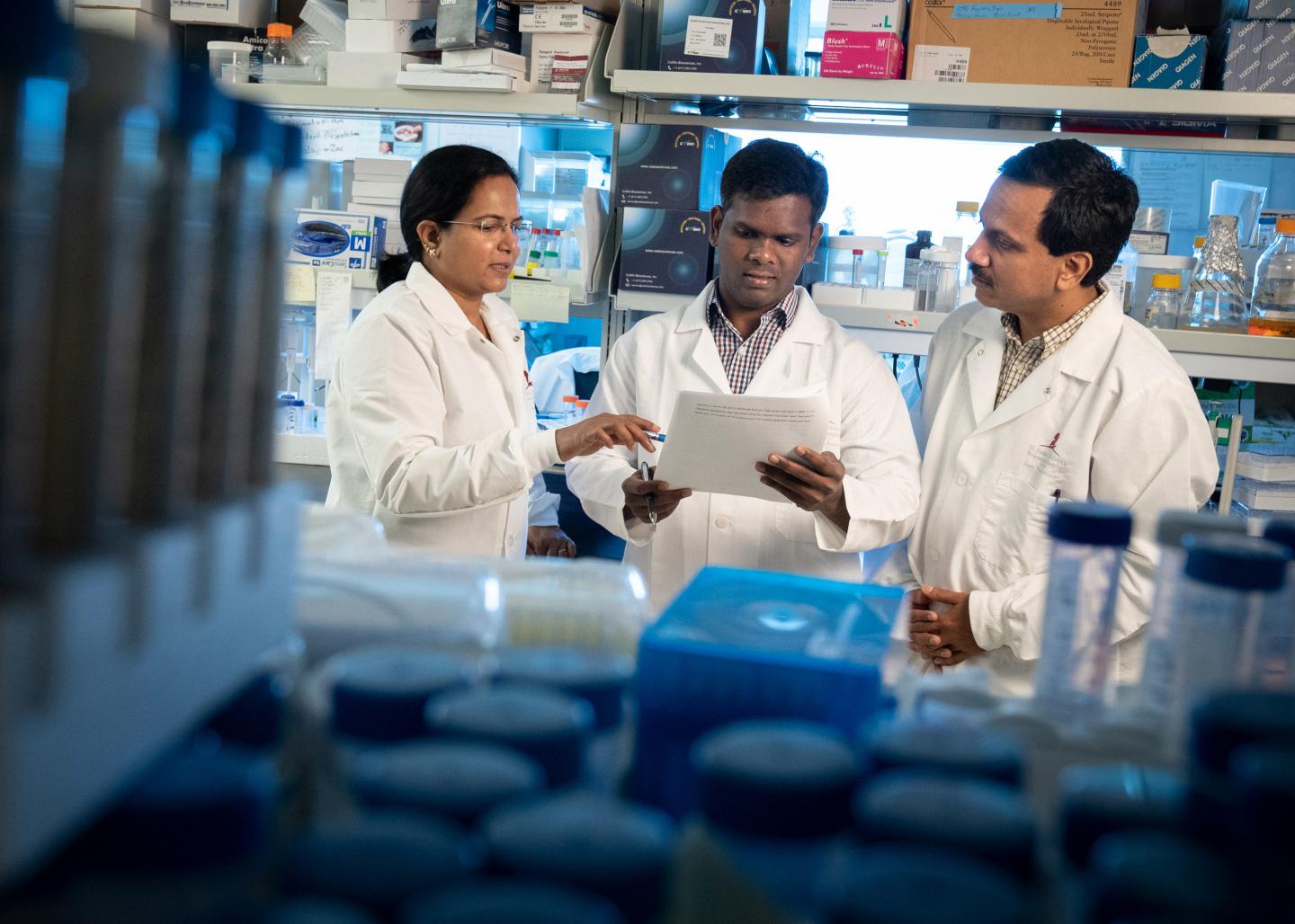
Credit: St. Jude Children’s Research Hospital
Scientists at St. Jude Children’s Research Hospital have discovered a new way that the molecule RIPK1 leads to cell death in infected, damaged or unwanted cells showing that more than one mechanism can trigger the process. The findings appeared online today in the Journal of Experimental Medicine.
“Our findings break the existing dogma that RIPK1 kinase activity is required for cell death,” said Thirumala-Devi Kanneganti, Ph.D., a member in the St. Jude Department of Immunology.
The discovery of the alternate RIPK1 mechanism offers the promise of drug treatments to protect patients from the inflammatory, cell-killing response of septic shock and other inflammatory diseases as well as cancer.
‘Cleaning house’ by triggering cell death
The immune system protects the body and rids itself of unwanted cells in health and disease through three major programmed cell-death mechanisms, called pyroptosis, apoptosis and necroptosis. Kanneganti’s lab has dubbed the processes collectively PANoptosis.
Kanneganti and her colleagues had shown that RIPK1 kinase activity functions as a cell switch to activate PANoptosis. RIPK1 triggers this form of cell death when cell survival molecules such as TAK1 are inhibited. TAK1’s function is central to the body’s protection against a broad range of bacteria, viruses and other agents. Pathogens have evolved to inhibit TAK1 in order to evade the immune response.
Researchers developed a model system to study the phenomenon. The investigators selectively blocked TAK1 and the RIPK1 kinase function in white blood cells called macrophages that were exposed to microbial molecules.
Despite the loss of RIPK1 kinase function, the cells reacted as if the immune system had been activated. TAK1 deletion or inhibition triggered cell death. “The results showed the immune system recognizes loss of TAK1 function as a danger signal,” Kanneganti said. “That drives the robust inflammation and cell death of PANoptosis with the goal of fighting infection.”
But the enhanced inflammation and sensitivity to cell death left mice with altered macrophages at greater susceptibility to septic shock.
Dual mechanisms of action
To the researchers’ surprise, their experiments identified a separate route to RIPK1 activation–in which the molecule acts as a “scaffold” to support a separate molecular mechanism that triggers PANoptosis. Their work demonstrated how PANoptosis can be triggered even when RIPK1’s kinase activity is inactivated.
“We highlight for the first time a kinase-independent role for RIPK1 in promoting a novel and versatile cell death complex which drives PANoptosis, the cell death pathways involved in several inflammatory disorders,” Kanneganti said. “Dysregulation of this complex can lead to severe diseases, including septic shock. Our work underscores the importance of investigating the homeostatic molecular mechanisms of inflammatory cell death in health and disease.”
The findings also offer the potential of drugs that could trigger PANoptotic cell suicide in proliferating cancer cells. Such drug treatments could aid cancer immunotherapy, in which a patient’s own immune system is activated to attack tumors.
###
The paper’s co-first authors are R.K. Subbarao Malireddi, Ph.D., of St. Jude and Prajwal Gurung, Ph.D., of the University of Iowa and formerly a postdoctoral fellow in the Kanneganti lab. The other authors are Sannula Kesavardhana, Parimal Samir, Amanda Burton, Harisankeerth Mummareddy, Peter Vogel and Stephane Pelletier, all of St. Jude; and Sandeepta Burgula of Osmania University, India.
The research was supported in part by the National Institutes of Health (AI101935, AI124346, AR056296, CA163507), the National Institute of Allergy and Infectious Diseases (K22AI127836, NIEHS P30ES005605) and ALSAC, the fundraising and awareness organization of St. Jude.
Read the full text of the article:
“Innate immune priming in the absence of TAK1 drives RIPK1 kinase activity-independent inflammasome activation, pyroptosis, apoptosis, necroptosis, and inflammatory disease.”
Journal of Experimental Medicine. Published December 23, 2019.
Media Contact
Katy Hobgood
[email protected]
901-568-9869
Original Source
https:/
Related Journal Article
http://dx.