• HOME
  • NEWS
  • EXPLORE
    • CAREER
      • Companies
      • Jobs
    • EVENTS
    • iGEM
      • News
      • Team
    • PHOTOS
    • VIDEO
    • WIKI
  • BLOG
  • COMMUNITY
    • FACEBOOK
    • INSTAGRAM
    • TWITTER
Sunday, February 8, 2026
BIOENGINEER.ORG
No Result
View All Result
  • Login
  • HOME
  • NEWS
  • EXPLORE
    • CAREER
      • Companies
      • Jobs
        • Lecturer
        • PhD Studentship
        • Postdoc
        • Research Assistant
    • EVENTS
    • iGEM
      • News
      • Team
    • PHOTOS
    • VIDEO
    • WIKI
  • BLOG
  • COMMUNITY
    • FACEBOOK
    • INSTAGRAM
    • TWITTER
  • HOME
  • NEWS
  • EXPLORE
    • CAREER
      • Companies
      • Jobs
        • Lecturer
        • PhD Studentship
        • Postdoc
        • Research Assistant
    • EVENTS
    • iGEM
      • News
      • Team
    • PHOTOS
    • VIDEO
    • WIKI
  • BLOG
  • COMMUNITY
    • FACEBOOK
    • INSTAGRAM
    • TWITTER
No Result
View All Result
Bioengineer.org
No Result
View All Result
Home NEWS Science News Chemistry

Why are alloy metal nanoparticles better than monometallic ones for CNT growth?

Bioengineer by Bioengineer
December 20, 2019
in Chemistry
Reading Time: 2 mins read
0
IMAGE
Share on FacebookShare on TwitterShare on LinkedinShare on RedditShare on Telegram

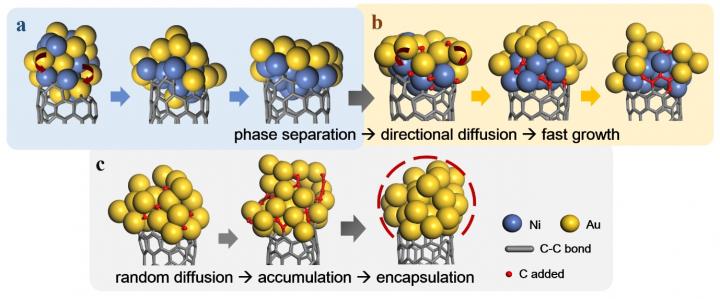
Revealing a long-term mystery of why certain nanoparticles are more efficient in incorporating carbon atoms and achieving a faster carbon nanotube growth
IMAGE

Credit: IBS


Researchers of the Center for Multidimensional Carbon Materials, within the Institute of Basic Science (IBS, South Korea), have presented a theoretical solution to a long-lasting mystery of carbon nanotubes (CNTs) growth. Published in Physical Review Letters, this study explains why nanoparticles made with an alloy of metals help to synthetize longer CNTs compared with conventional monometallic catalysts.

CNTs are tubular nanostructures made of carbon atoms with exciting potential properties that have kept researchers on the lookout for new advances. One of the most common methods to produce CNTs involves catalyst nanoparticles, which have the function of facilitating the addition of carbon atoms from precursor molecules to the walls of the cylinders. It is common knowledge in the field that alloy catalysts, like Ni-Y, Fe-Mo, Cu-Ni, and Co-Mo, outperform other single metal catalysts, but the reason has been unclear.

IBS researchers performed a systematic molecular dynamics simulation to explore the role of alloy catalysts in CNT growth. “In a molecular dynamics simulation, the motion of every atom can be clearly seen and, therefore, the variation of the shape and structure of the catalyst particle during the carbon nanotube growth can be recorded precisely. This allows us to go beyond the capacity of the best experimental methods.” explains Feng Ding, a group leader of the Center and corresponding author of the study.

Through the molecular dynamic simulations, the authors have found that the two metals of the alloy are spatially separated at the rim of the tubes: CNTs tend to attract the more active metal atoms to the open end of the cylinders (growth front), where carbon atoms are inserted into the CNT wall during growth, while the less active metal atoms are pushed above. More simulations show that this is a general phenomenon and can be applied to many types of alloy catalysts.

IBS researchers have also demonstrated that alloy catalysts win over monometallic nanoparticles because the active metal atoms near the rim of the CNT catch the carbon atoms more easily than the less active ones. This will lead to a larger carbon concentration at the vicinal of CNT growth front and a quick addition of the carbon atoms, which contribute to the fast growth of the CNT.

Since the carbon atoms are continuously incorporated to the growing CNTs, the carbon precursors do not accumulate around the alloy nanoparticles. This prevents the formation of a cap made of carbon atoms engulfing the entire nanoparticle.

“This theoretical study addresses a long-term puzzle of the role of the alloy catalysts in carbon nanotube growth. It reveals the advantage of using alloy catalysts in carbon nanotube growth, and the contact-induced phase separation of the alloy catalyst can be considered as a general rule to guide catalyst design for controllable carbon nanotube growth,” says Lu Qiu, the first author of the study.

###

Media Contact
Dahee Carol Kim
[email protected]
82-428-788-133

Related Journal Article

http://dx.doi.org/10.1103/PhysRevLett.123.256101

Tags: Chemistry/Physics/Materials Sciences
Share12Tweet8Share2ShareShareShare2

Related Posts

blank

Breakthrough in Environmental Cleanup: Scientists Develop Solar-Activated Biochar for Faster Remediation

February 7, 2026
blank

Cutting Costs: Making Hydrogen Fuel Cells More Affordable

February 6, 2026

Scientists Develop Hand-Held “Levitating” Time Crystals

February 6, 2026

Observing a Key Green-Energy Catalyst Dissolve Atom by Atom

February 6, 2026
Please login to join discussion

POPULAR NEWS

  • Robotic Ureteral Reconstruction: A Novel Approach

    Robotic Ureteral Reconstruction: A Novel Approach

    82 shares
    Share 33 Tweet 21
  • Digital Privacy: Health Data Control in Incarceration

    63 shares
    Share 25 Tweet 16
  • Breakthrough in RNA Research Accelerates Medical Innovations Timeline

    53 shares
    Share 21 Tweet 13
  • Mapping Tertiary Lymphoid Structures for Kidney Cancer Biomarkers

    50 shares
    Share 20 Tweet 13

About

We bring you the latest biotechnology news from best research centers and universities around the world. Check our website.

Follow us

Recent News

Mapping NYC Foot Traffic: Insights for Urban Planning

Evaluating Digital Diabetes Screening’s B2C Potential in Switzerland

Resilient Together: A Promising Post-Diagnosis Intervention

Subscribe to Blog via Email

Enter your email address to subscribe to this blog and receive notifications of new posts by email.

Join 74 other subscribers
  • Contact Us

Bioengineer.org © Copyright 2023 All Rights Reserved.

Welcome Back!

Login to your account below

Forgotten Password?

Retrieve your password

Please enter your username or email address to reset your password.

Log In
No Result
View All Result
  • Homepages
    • Home Page 1
    • Home Page 2
  • News
  • National
  • Business
  • Health
  • Lifestyle
  • Science

Bioengineer.org © Copyright 2023 All Rights Reserved.