• HOME
  • NEWS
  • EXPLORE
    • CAREER
      • Companies
      • Jobs
    • EVENTS
    • iGEM
      • News
      • Team
    • PHOTOS
    • VIDEO
    • WIKI
  • BLOG
  • COMMUNITY
    • FACEBOOK
    • INSTAGRAM
    • TWITTER
Saturday, February 7, 2026
BIOENGINEER.ORG
No Result
View All Result
  • Login
  • HOME
  • NEWS
  • EXPLORE
    • CAREER
      • Companies
      • Jobs
        • Lecturer
        • PhD Studentship
        • Postdoc
        • Research Assistant
    • EVENTS
    • iGEM
      • News
      • Team
    • PHOTOS
    • VIDEO
    • WIKI
  • BLOG
  • COMMUNITY
    • FACEBOOK
    • INSTAGRAM
    • TWITTER
  • HOME
  • NEWS
  • EXPLORE
    • CAREER
      • Companies
      • Jobs
        • Lecturer
        • PhD Studentship
        • Postdoc
        • Research Assistant
    • EVENTS
    • iGEM
      • News
      • Team
    • PHOTOS
    • VIDEO
    • WIKI
  • BLOG
  • COMMUNITY
    • FACEBOOK
    • INSTAGRAM
    • TWITTER
No Result
View All Result
Bioengineer.org
No Result
View All Result
Home NEWS Science News

Oat pathogen defence discovery marks an important milestone

Bioengineer by Bioengineer
December 2, 2019
in Science News
Reading Time: 2 mins read
0
IMAGE
Share on FacebookShare on TwitterShare on LinkedinShare on RedditShare on Telegram

IMAGE

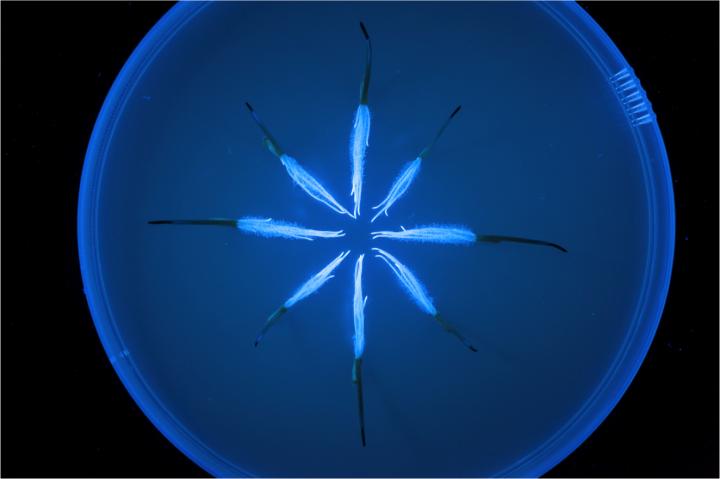
Credit: Andrew Davis


Researchers have identified the critical last pieces of a genetic defence system that gives oats resistance to soil pathogens.

The discovery opens significant opportunities for scientists and breeders to introduce versions of this defence mechanism into other crops.

It is an important milestone in research into avenacins, defensive antimicrobial compounds produced in the roots of oats. These were first identified more than 70 years ago and belong to the triterpene glycoside family of natural products which have diverse industrial and agricultural applications.

Avenacins give oats resistance against soil pathogens including Take-all, a notorious disease that causes major losses in wheat and barley.

Professor Anne Osbourn of the John Innes Centre and an author of the study said: “When we started 20 years ago we didn’t have any of the genetic pieces in this avenacin defence pathway. Now we have found the last critical steps we have the potential to engineer it into other crops.

“Wheat, other cereals and grasses are not good at making antimicrobial compounds. Oat, on the other hand, is a prime example of a super-fit plant that has not been extensively bred and has disease resistance which could benefit more cultivated crops.”

Many plant natural products such as avenacin have sugars attached to them, a process called glycosylation. This is important for the biological activity of natural products, in this case the antifungal activity of avenacin.

In this study, which appears in the journal PNAS, researchers used a range of genomic analysis techniques to identify the enzymes that catalyse this process.

They discovered the final component in this sugar chain was added by an unexpected class of enzyme. Furthermore, the sugar was added in the cell vacuole not the cytosol where most glycosylation steps occur in the avenacin pathway.

“This transglucosidase enzyme elucidated in this study belongs to a large family of enzymes not generally thought of as providing this function,” explains first author Dr Anastasia Orme.

“Understanding the contribution of this family opens up a whole new sphere of carbohydrate biology that is relevant to natural products and hence to drugs and other valuable compounds.”

The study was carried out in collaboration with Professor Bin Han as part of the Centre of Excellence for Plant and Microbial Science (CEPAMS) a partnership between the Chinese Academy of Sciences and the John Innes Centre.

One of the potential benefits of greater understanding this large family may be in biosynthesis of traditional Chinese medicine using resources such as the plant transient expression system technology developed by the John Innes Centre.

###

The study: A non-canonical vacuolar sugar transferase required for biosynthesis of antimicrobial defence compounds in oat, appears in the journal PNAS.

Media Contact
[email protected]
 @johninnescentre

01-603-450-238

Related Journal Article

http://dx.doi.org/10.1073/pnas

Tags: Agricultural Production/EconomicsBiochemistryBioinformaticsBiologyBiotechnologyCell BiologyFertilizers/Pest ManagementGenesMolecular BiologyPlant Sciences
Share12Tweet8Share2ShareShareShare2

Related Posts

Evaluating Pediatric Emergency Care Quality in Ethiopia

February 7, 2026

TPMT Expression Predictions Linked to Azathioprine Side Effects

February 7, 2026

Improving Dementia Care with Enhanced Activity Kits

February 7, 2026

Decoding Prostate Cancer Origins via snFLARE-seq, mxFRIZNGRND

February 7, 2026
Please login to join discussion

POPULAR NEWS

  • Robotic Ureteral Reconstruction: A Novel Approach

    Robotic Ureteral Reconstruction: A Novel Approach

    82 shares
    Share 33 Tweet 21
  • Digital Privacy: Health Data Control in Incarceration

    63 shares
    Share 25 Tweet 16
  • Study Reveals Lipid Accumulation in ME/CFS Cells

    57 shares
    Share 23 Tweet 14
  • Breakthrough in RNA Research Accelerates Medical Innovations Timeline

    53 shares
    Share 21 Tweet 13

About

We bring you the latest biotechnology news from best research centers and universities around the world. Check our website.

Follow us

Recent News

Evaluating Pediatric Emergency Care Quality in Ethiopia

TPMT Expression Predictions Linked to Azathioprine Side Effects

Improving Dementia Care with Enhanced Activity Kits

Subscribe to Blog via Email

Enter your email address to subscribe to this blog and receive notifications of new posts by email.

Join 73 other subscribers
  • Contact Us

Bioengineer.org © Copyright 2023 All Rights Reserved.

Welcome Back!

Login to your account below

Forgotten Password?

Retrieve your password

Please enter your username or email address to reset your password.

Log In
No Result
View All Result
  • Homepages
    • Home Page 1
    • Home Page 2
  • News
  • National
  • Business
  • Health
  • Lifestyle
  • Science

Bioengineer.org © Copyright 2023 All Rights Reserved.