• HOME
  • NEWS
  • EXPLORE
    • CAREER
      • Companies
      • Jobs
    • EVENTS
    • iGEM
      • News
      • Team
    • PHOTOS
    • VIDEO
    • WIKI
  • BLOG
  • COMMUNITY
    • FACEBOOK
    • INSTAGRAM
    • TWITTER
Thursday, March 26, 2026
BIOENGINEER.ORG
No Result
View All Result
  • Login
  • HOME
  • NEWS
  • EXPLORE
    • CAREER
      • Companies
      • Jobs
        • Lecturer
        • PhD Studentship
        • Postdoc
        • Research Assistant
    • EVENTS
    • iGEM
      • News
      • Team
    • PHOTOS
    • VIDEO
    • WIKI
  • BLOG
  • COMMUNITY
    • FACEBOOK
    • INSTAGRAM
    • TWITTER
  • HOME
  • NEWS
  • EXPLORE
    • CAREER
      • Companies
      • Jobs
        • Lecturer
        • PhD Studentship
        • Postdoc
        • Research Assistant
    • EVENTS
    • iGEM
      • News
      • Team
    • PHOTOS
    • VIDEO
    • WIKI
  • BLOG
  • COMMUNITY
    • FACEBOOK
    • INSTAGRAM
    • TWITTER
No Result
View All Result
Bioengineer.org
No Result
View All Result
Home NEWS Science News Biology

Researchers say animal-like embryos preceded animal appearance

Bioengineer by Bioengineer
November 27, 2019
in Biology
Reading Time: 2 mins read
0
IMAGE
Share on FacebookShare on TwitterShare on LinkedinShare on RedditShare on Telegram

IMAGE

Credit: NIGPAS


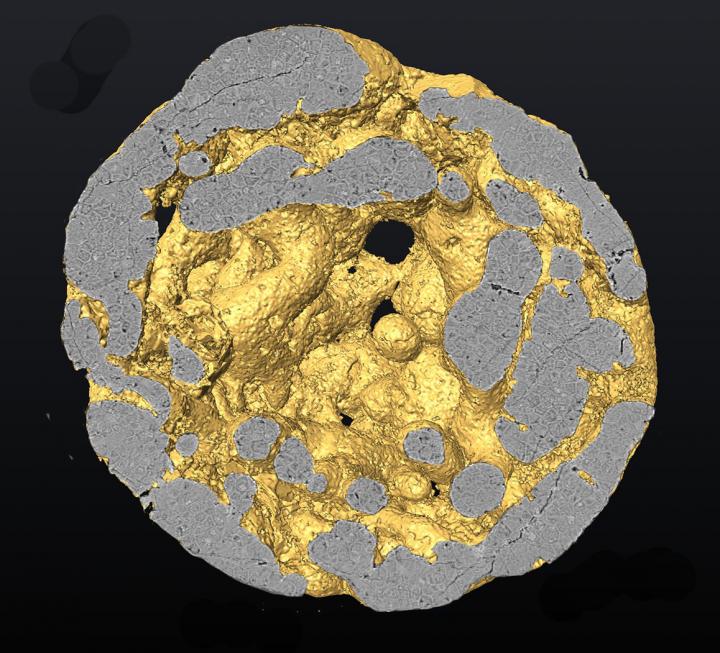
Animals evolved from single-celled ancestors before diversifying into 30-40 distinct anatomical designs. When and how animal ancestors made the transition from single-celled microbes to complex multicellular organisms is unclear. But a new scientific study suggests animal-like embryological traits developed long before animals themselves.

The research – by an international research team led by scientists from the Nanjing Institute of Geology and Palaeontology of the Chinese Academy of Sciences (NIGPAS) and the University of Bristol – focused on ancient fossils of Caveasphaera, a multicellular organism found in 609-million-year-old rocks in South China’s Guizhou Province that defies easy definition as animal or non-animal.

Using X-ray microscopy, the researchers analyzed the tiny fossils, which measure about a half-millimeter in diameter and were preserved down to their component cells. Various fossils displayed different stages of Caveasphaera development – from a single cell to a multicellular organism.

“We were able to sort the fossils into growth stages, reconstructing the embryology of Caveasphaera,” said Kelly Vargas from the University of Bristol.

YIN Zongjun of NIGPAS interpreted the discovery: “Our results show that Caveasphaera sorted its cells during embryo development in just the same way as living animals, including humans.” YIN emphasized, however, there is “no evidence that these embryos developed into more complex organisms.”

Still, the discovery offers the earliest evidence of a key step in the evolution of animals – the capacity to develop distinct tissue layers and organs.

The verdict still seems to be out on whether Caveasphaera was itself an animal or just an important step in animal evolution, even as researchers search for more fossils. Co-author ZHU Maoyan of NIGPAS said, “Caveasphaera looks a lot like the embryos of some starfish and corals – we don’t find the adult stages simply because they are harder to fossilize.”

Whatever Caveasphaera turns out to be, its fossils tell us that animal-like embryonic development evolved long before the oldest definitive animals appeared in the fossil record.

###

This research was funded through the Biosphere Evolution, Transitions and Resilience (BETR) programme, which is co-funded by the UK’s Natural Environment Research Council (NERC) and the Natural Science Foundation of China (NSFC).

Media Contact
CHEN Xiaozheng
[email protected]

Related Journal Article

http://dx.doi.org/10.1016/j.cub.2019.10.057

Tags: ArchaeologyEvolutionOld WorldPaleontology
Share13Tweet8Share2ShareShareShare2

Related Posts

How to sway group opinions: Encourage opponents to stay undecided

How to sway group opinions: Encourage opponents to stay undecided

March 23, 2026
Deep Learning Model Maps How Individual Cells Shape Disease Outcomes

Deep Learning Model Maps How Individual Cells Shape Disease Outcomes

March 20, 2026

Removing only 15 female sharks annually could endanger the entire population, scientists warn

March 20, 2026

Scientists Urge Fragrance Industry to Transition from Sustainability Talk to Active Funding of Plant Conservation

March 20, 2026
Please login to join discussion

POPULAR NEWS

  • blank

    Revolutionary AI Model Enhances Precision in Detecting Food Contamination

    96 shares
    Share 38 Tweet 24
  • Imagine a Social Media Feed That Challenges Your Views Instead of Reinforcing Them

    1003 shares
    Share 397 Tweet 248
  • Uncovering Functions of Cavernous Malformation Proteins in Organoids

    54 shares
    Share 22 Tweet 14
  • Promising Outcomes from First Clinical Trials of Gene Regulation in Epilepsy

    51 shares
    Share 20 Tweet 13

About

We bring you the latest biotechnology news from best research centers and universities around the world. Check our website.

Follow us

Recent News

In-Sensor Cryptography Links Physical Process to Digital Identity

Can Psychosocial Factors Influence Cancer Risk?

Depression Factors in Elderly: Pre vs. Post-COVID Analysis

Subscribe to Blog via Email

Success! An email was just sent to confirm your subscription. Please find the email now and click 'Confirm' to start subscribing.

Join 78 other subscribers
  • Contact Us

Bioengineer.org © Copyright 2023 All Rights Reserved.

Welcome Back!

Login to your account below

Forgotten Password?

Retrieve your password

Please enter your username or email address to reset your password.

Log In
No Result
View All Result
  • Homepages
    • Home Page 1
    • Home Page 2
  • News
  • National
  • Business
  • Health
  • Lifestyle
  • Science

Bioengineer.org © Copyright 2023 All Rights Reserved.