• HOME
  • NEWS
  • EXPLORE
    • CAREER
      • Companies
      • Jobs
    • EVENTS
    • iGEM
      • News
      • Team
    • PHOTOS
    • VIDEO
    • WIKI
  • BLOG
  • COMMUNITY
    • FACEBOOK
    • INSTAGRAM
    • TWITTER
Wednesday, May 13, 2026
BIOENGINEER.ORG
No Result
View All Result
  • Login
  • HOME
  • NEWS
  • EXPLORE
    • CAREER
      • Companies
      • Jobs
        • Lecturer
        • PhD Studentship
        • Postdoc
        • Research Assistant
    • EVENTS
    • iGEM
      • News
      • Team
    • PHOTOS
    • VIDEO
    • WIKI
  • BLOG
  • COMMUNITY
    • FACEBOOK
    • INSTAGRAM
    • TWITTER
  • HOME
  • NEWS
  • EXPLORE
    • CAREER
      • Companies
      • Jobs
        • Lecturer
        • PhD Studentship
        • Postdoc
        • Research Assistant
    • EVENTS
    • iGEM
      • News
      • Team
    • PHOTOS
    • VIDEO
    • WIKI
  • BLOG
  • COMMUNITY
    • FACEBOOK
    • INSTAGRAM
    • TWITTER
No Result
View All Result
Bioengineer.org
No Result
View All Result
Home NEWS Science News Chemistry

Patient’s place of residence matters when choosing cost-effective anticoagulation therapy

Bioengineer by Bioengineer
November 27, 2019
in Chemistry
Reading Time: 2 mins read
0
IMAGE
Share on FacebookShare on TwitterShare on LinkedinShare on RedditShare on Telegram

IMAGE

Credit: Mikko Pyykönen


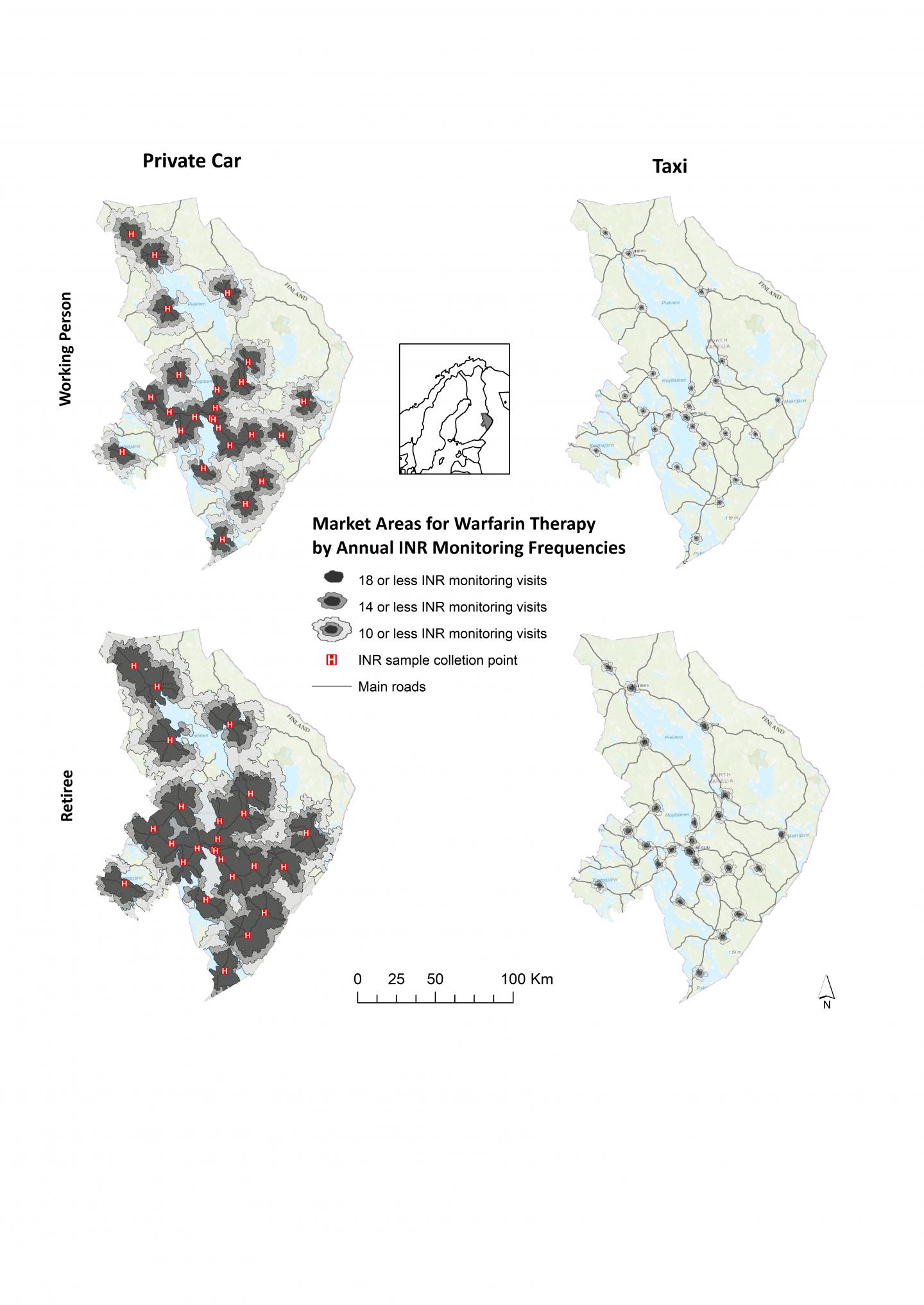
Appropriately selected anticoagulation therapy can help to reduce the medical costs of patients suffering from atrial fibrillation. A new study from the University of Eastern Finland shows that direct oral anticoagulants can be a more cost-effective alternative than traditional warfarin therapy when the patient’s place of residence is taken into consideration. Published in Geospatial Health, the study used GIS data to create a geospatial model comparing the costs of different anticoagulant therapies. The patient’s travel, time-loss and medication costs were used parameters to determine the overall costs of therapy.

Most atrial fibrillation patients need anticoagulation management to reduce the risk of thromboembolic events and stroke. Currently, two major drug therapies are available: warfarin and direct oral anticoagulants (DOACs).

Patients receiving warfarin therapy require regular INR monitoring. As a result, warfarin therapy is more cost-effective than DOACs only when the patient lives near the INR sample collection point, due to higher costs of travel and greater loss of leisure or working time. The study found that DOACs are a more cost-effective alternative also in situations where the patient requires INR monitoring more frequently than normal.

The researchers developed a geospatial model that determines market areas DOAC and warfarin therapy, taking into consideration the costs of travel, time-loss caused by INR monitoring, different modes of travel and the patient’s assumed working or retirement status. Using this data, they calculated distance limits for each market area by mode of transport, making is possible to compare the spatial costs of warfarin therapy also when using different modes of travel. The study compared the costs of warfarin and DOAC therapy in a hospital district in the eastern part of Finland.

The data used in the study included the regional sample collection point locations, the Finnish National Road and Street Database, and recent travel and medical cost parameters from the study area. The costs were looked at from the patient’s perspective, taking into consideration possible national reimbursements of medical costs and costs of using a taxi.

“Our model pertains to Finland, but it is possible to create a similar geospatial model for other countries as well, provided that road data and the required parameters are available. It is also possible to use this model to compare other drugs that have a treatment setting that is similar to anticoagulant therapy,” Project Researcher and lead author of the study Mikko Pyykönen from the University of Eastern Finland notes.

###

For further information, please contact:
Project Researcher Mikko Pyykönen, tel. +358 50 505 1480, [email protected]

Research article:
Pyykönen M, Leminen A, Tynkkynen J, Tykkyläinen M, Laatikainen T. Geospatial model to determine the spatial cost-efficiency of anticoagulation drug therapy: Patients’ perspective. Geospatial Health 2019, 14: 809. doi: https://doi.org/10.4081/gh.2019.809

Media Contact
Mikko Pyykönen
[email protected]
358-505-051-480

Related Journal Article

http://dx.doi.org/10.4081/gh.2019.809

Tags: Business/EconomicsCardiologyHealth CareMedicine/HealthPharmaceutical SciencePublic HealthStroke
Share12Tweet8Share2ShareShareShare2

Related Posts

Copper(II) Complexes Harnessed by Light Enable Efficient Anti-Markovnikov Alkene Hydration — Chemistry

Copper(II) Complexes Harnessed by Light Enable Efficient Anti-Markovnikov Alkene Hydration

May 13, 2026
Gravitational Wave Detectors Now Feature Automatic Signal Tuning — Chemistry

Gravitational Wave Detectors Now Feature Automatic Signal Tuning

May 13, 2026

Harnessing Neural Networks for Advances in Nonlinear Optics

May 12, 2026

Innovative Method Unveiled to Detect Signs of Dark Matter

May 12, 2026
Please login to join discussion

POPULAR NEWS

  • Research Indicates Potential Connection Between Prenatal Medication Exposure and Elevated Autism Risk

    842 shares
    Share 337 Tweet 211
  • New Study Reveals Plants Can Detect the Sound of Rain

    728 shares
    Share 290 Tweet 182
  • Salmonella Haem Blocks Macrophages, Boosts Infection

    62 shares
    Share 25 Tweet 16
  • Breastmilk Balances E. coli and Beneficial Bacteria in Infant Gut Microbiomes

    57 shares
    Share 23 Tweet 14

About

We bring you the latest biotechnology news from best research centers and universities around the world. Check our website.

Follow us

Recent News

Copper(II) Complexes Harnessed by Light Enable Efficient Anti-Markovnikov Alkene Hydration

American Society for Nutrition Foundation and Novo Nordisk Foundation Unveil 2026 Awardees Pioneering Advances in Nutrition and Obesity Science

Rhein Alleviates Intestinal Damage in Severe Acute Pancreatitis by Modulating Macrophage Activation via PPARγ

Subscribe to Blog via Email

Enter your email address to subscribe to this blog and receive notifications of new posts by email.

Join 82 other subscribers
  • Contact Us

Bioengineer.org © Copyright 2023 All Rights Reserved.

Welcome Back!

Login to your account below

Forgotten Password?

Retrieve your password

Please enter your username or email address to reset your password.

Log In
No Result
View All Result
  • Homepages
    • Home Page 1
    • Home Page 2
  • News
  • National
  • Business
  • Health
  • Lifestyle
  • Science

Bioengineer.org © Copyright 2023 All Rights Reserved.