‘Automated System for Small-Population Single-Particle Processing Enabled by Exclusive Liquid Repellency’ now accessible through December 20
Credit: David James Group
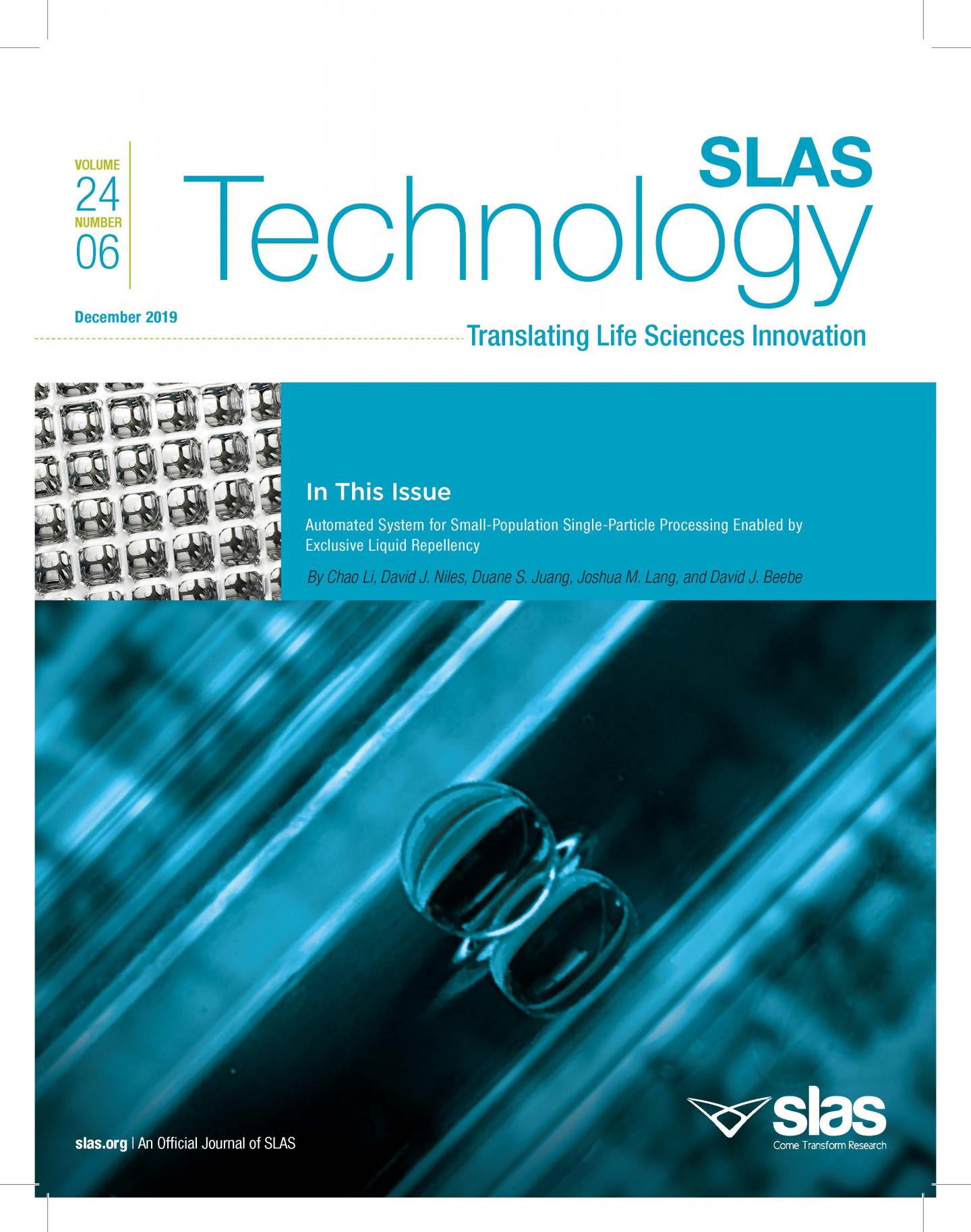
December’s SLAS Technology Cover Article Features University of Wisconsin Research, “Automated System for Small-Population Single-Particle Processing Enabled by Exclusive Liquid Repellency”
Oak Brook, IL – Next month’s SLAS Technology features the cover article, “Automated System for Small-Population Single-Particle Processing Enabled by Exclusive Liquid Repellency,” outlining research led by Chao Li, Ph.D., (University of Wisconsin-Madison, USA). In the article, Li and his team describe how they combined a robotic liquid handler, an automated microscopic imaging system and real-time image-processing software for single-particle identification to create an automated platform using exclusive liquid repellency (ELR) microdrops for single-particle isolation, identification and retrieval.
As the use of single-cell applications have become important to the study of cancer heterogeneity, developmental biology, neurobiology and immunology, there is also an increased interest in identifying and isolating specific single cells from a heterogeneous biological sample to discover its unique traits and heterogeneity. However, this isolation remains challenging due to the large sample volume and cell numbers needed, which could impede the isolation of single cells and make them unsuitable for rare-cell applications like circulating tumor cell (CTC) research.
As single-cell printing techniques that handle smaller sample sizes have developed over time, sample loss is still an issue due to the difficulty of using traditional single-liquid phase liquid-handling and storage equipment such as multiwell plates. Although a variety of specialized multi-liquid phase platforms have been developed for efficiently manipulating small amounts of cell samples without significant liquid loss, they are usually based on a closed-system design which makes external access for individual cell manipulation and retrieval difficult and remains extremely costly.
Li, along with David J. Niles, Ph.D., Duane S. Juang, Ph.D., Joshua M. Lang, Ph.D., and David J. Beebe, Ph.D., (University of Wisconsin-Madison, USA), developed an automated platform using ELR microdrops for lossless single-cell isolation, identification and retrieval. It combines the use of a robotic liquid handler, an automated microscopic imaging system and real-time image-processing software for single-particle identification and enables rapid, hands-free and robust isolation of microdrop-encapsulated rare cellular samples and further on-chip cell culture or down-stream analysis. This application is distinct from other liquid repellent systems and showed no compromise of liquid adhesion on solid surfaces enabling unique applications.
Chao Li received his Ph.D. in physical chemistry from the National Center for Nanoscience and Technology (China) in 2010. His postdoctoral research has included microfluidic systems and applications in biomedicine, including single-cell sample processing, in vitro organotypic model, biofilm dynamics, antimicrobial pharmacodynamics, multispecies microbial communities and host-microbe interactions.
###
To read the complete December SLAS Technology cover article, accessible through December 20, visit https:/
SLAS (Society for Laboratory Automation and Screening) is an international community of 16,000 professionals and students dedicated to life sciences discovery and technology. The SLAS mission is to bring together researchers in academia, industry and government to advance life sciences discovery and technology via education, knowledge exchange and global community building.
SLAS Technology: Translating Life Sciences Innovation, 2018 Impact Factor 2.048. Editor-in-Chief Edward Kai-Hua Chow, Ph.D., National University of Singapore (Singapore). SLAS Technology (Translating Life Sciences Innovation) was previously published (1996-2016) as the Journal of Laboratory Automation (JALA).
SLAS Discovery: Advancing Life Sciences R&D, 2018 Impact Factor 2.192. Editor-in-Chief Robert M. Campbell, Ph.D., Eli Lilly and Company, Indianapolis, IN (USA). SLAS Discovery (Advancing Life Sciences R&D) was previously published (1996-2016) as the Journal of Biomolecular Screening (JBS).
Media Contact
Jill Hronek
[email protected]
630-256-7527
Original Source
https:/
Related Journal Article
http://dx.