Adding a semiconducting polymer donor or non-fullerene acceptor component to binary organic solar cells enhances spectral response for better photon harvesting and high-power conversion efficiency
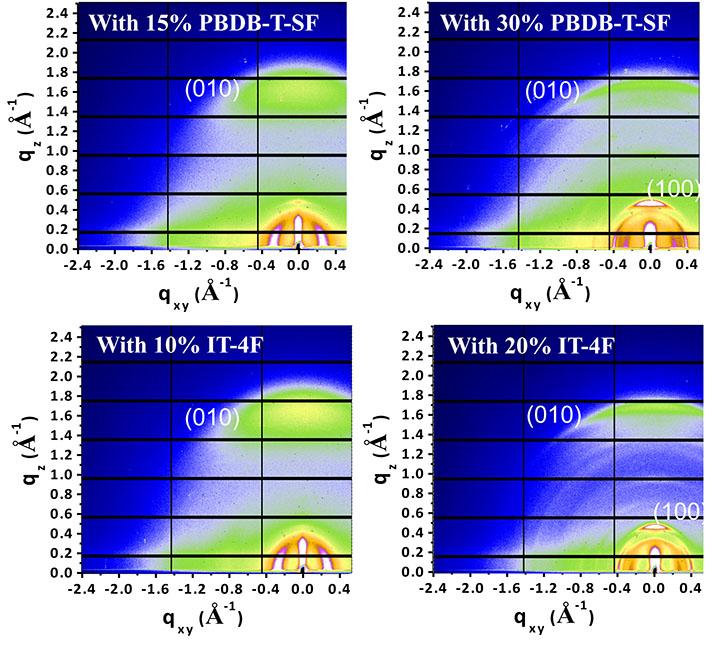
Credit: Data obtained at Beamline I07 at the Diamond Light Source (UK)
WASHINGTON, D.C., November 26, 2019 — Organic solar cells are steadily improving as new materials are developed for the active layer, particularly when materials are stacked in a bulk heterojunction design that takes advantage of multiple combined absorption windows to use photons at more parts of the spectrum.
Non-fullerene materials are especially promising in binary organic solar cells, making it possible to tune optical and energy properties. But, despite their advantages, these materials have narrow absorption windows. Attempts to incorporate non-fullerene acceptors into organic solar cells include adding a third component to increase photon harvesting.
The third component material must be carefully selected so it does not influence molecular form and structure in ways that decrease efficiency but does ensure energy and charge transfer in the correct direction.
A paper published this week in Applied Physics Reviews, from AIP Publishing, presents a practical guide for selecting materials for ternary organic solar cells. The authors set out to employ component engineering to extend the light absorption and efficiency of solar cells in a simple, physical way instead of the complicated process of synthesizing new semiconductors.
They start with a unique non-fullerene electron acceptor called COi8DFIC, which has high-power conversion efficiency due to its high bandgap and the ability to transform its molecular orientation from lamella orientations to H- and J-type aggregations during hot substrate casting. In the study, they combine a PTB7-Th:COi8DFIC binary system with the polymer electron donor PBDB-T-SF and the small molecular electron acceptor IT-4F to determine each material’s suitability for ternary devices.
They discovered that either a donor or acceptor material can be used successfully in ternary devices: PBDB-T-SF and IT-4F were found to be effective when added to the binary PTB7-Th:COi8DFIC system in amounts of 10% and 15%, respectively.
The materials improved spectral response, enhanced photon-harvesting and affected the molecular order of the host materials to enhance π-π stacking. Stacking the molecular planes parallel to the device electrode directly contributes to charge mobility, power conversion efficiency and maintaining fine phase separation.
“The coexistence of H- and J- type aggregations means the device has a broader absorption spectrum and will absorb more photons in both short and long wavelength ranges and convert them into charges, resulting in higher efficiency,” author Tao Wang said.
The authors plan to explore physical methods to better control the material’s formation, to inhibit H-type and encourage J-type aggregation, which extends the light absorption toward near-infrared, making semi-transparent organic solar cells possible.
###
The article, “Enhancing the efficiency of PTB7-Th:COi8DFIC-based ternary solar cells with versatile third components,” is authored by Wei Li, Zuo Xiao, Joel A. Smith, Jinlong Cai, Donghui Li, Rachel C. Kilbride, Emma L.K. Spooner, Onkar S. Game, Xianyi Meng, Dan Liu, Richard A.L. Jones, David G. Lidzey, Liming Ding and Tao Wang. The article will appear in the journal Applied Physics Reviews on Nov. 26, 2019 (DOI: 1 0.1063/1.5125438). After that date, it can be accessed at https:/
ABOUT THE JOURNAL
Applied Physics Reviews features articles on significant and current topics in experimental or theoretical research in applied physics, or in applications of physics to other branches of science and engineering. The journal publishes both original research on pioneering studies of broad interest to the applied physics community, and reviews on established or emerging areas of applied physics. See https:/
Media Contact
Larry Frum
[email protected]
301-209-3090
Related Journal Article
http://dx.