Max Planck-New York Center for Nonequilibrium Quantum Phenomena inaugurated in New York City
Credit: Asiya Khaki
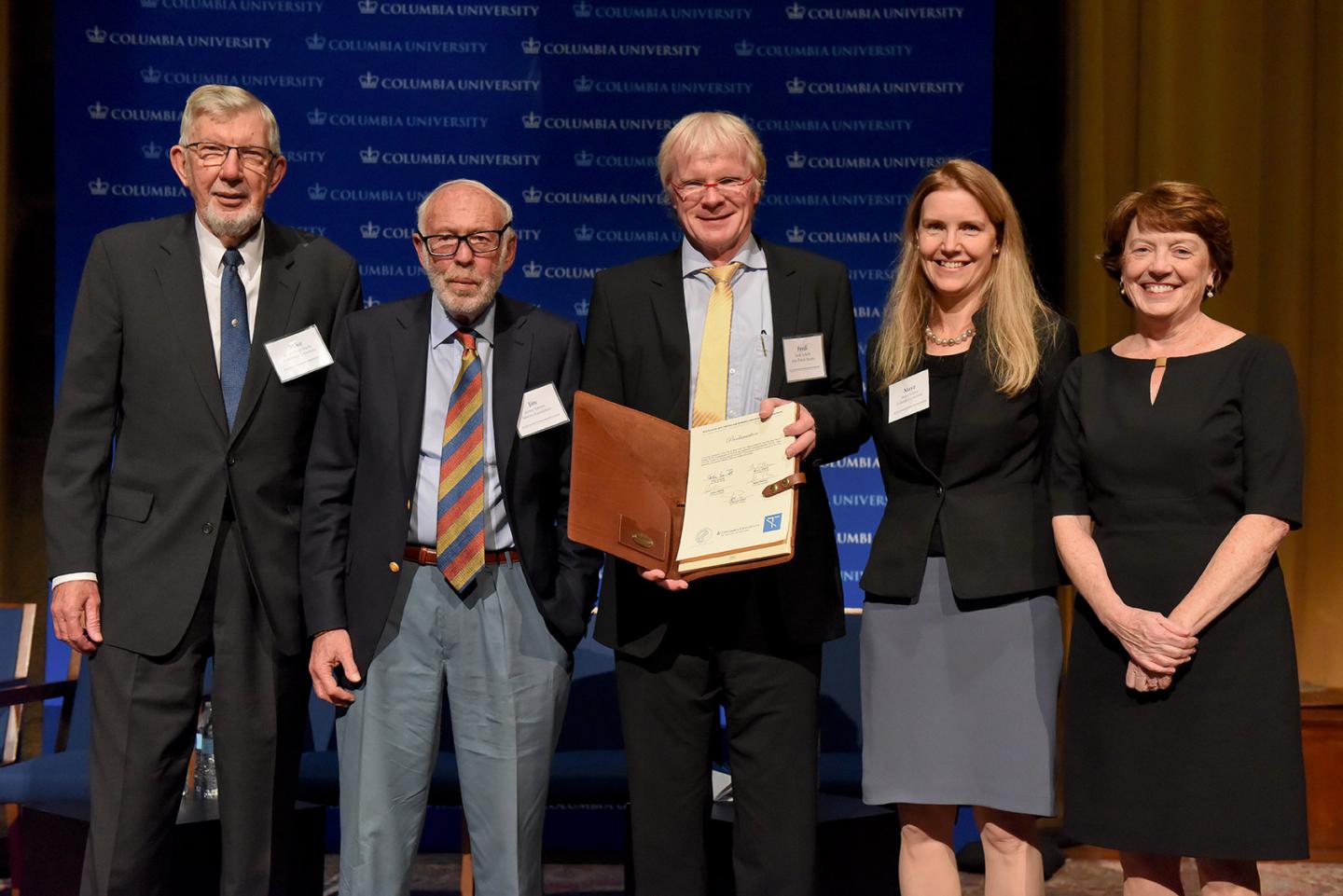
The Max Planck Institute for the Structure and Dynamics of Matter in Hamburg and the Max Planck Institute for Polymer Research in Mainz have launched a new joint research center with Columbia University and Flatiron Institute. The new partnership wants to understand, control and manipulate the uniquely useful properties of quantum materials. The aim is to harness these materials for a large set of applications, including quantum computing, sensing, cryptography and other technologies not yet imaginable. The new research center, the New York City Center for Non-Equilibrium Quantum Phenomena, was inaugurated by all four partner organizations on November 18 at Columbia University.
The Max Planck – New York City Center unites and complements the research areas of the participating partner organizations. “The participating Max Planck Institutes contribute unique experimental capabilities and possibilities, such as the free-electron laser XFEL in Hamburg, but also outstanding theoretical know-how,” said Ferdi Schüth in his welcoming address at Columbia University. “The theory building at the Center is optimally complemented by the Flatiron Center for Computational Quantum Physics. And Columbia University is a world leader in the design and analysis of new materials in which quantum phenomena play an important role,” the Vice President of the Max Planck Society continued. The Center is led by Andrea Cavalleri, Managing Director of the MPSD, and Dmitri Basov, Higgins Professor of Physics at Columbia University. Ángel Rubio, director of the MPSD Theory Department, and Andrew Millis, co-director of the Center for Computational Quantum Physics (CCQ) at Flatiron Institute, are deputy directors.
Together, the scientists want to investigate quantum materials in unstable states. With the help of electricity, heat pulses, photon bombardment or placement in quantum cavities, these substances are mixed up. In such non-equilibrium states, the materials can assume new properties and become magnetic, ferroelectric or superconducting, for example. By controlling these processes, researchers can develop materials for diverse and potentially groundbreaking purposes.
The Center opens up new scientific perspectives, says Andrea Cavalleri: “This center will greatly enrich the research already carried out on the properties of quantum materials by combining theoretical and experimental methods. It will also make a significant contribution to the training of young scientists.” “We are all working with different methods on a common topic – but they complement each other,” adds Dmitri Basov. “Given these research projects, the collaboration was a natural step.” A hallmark of the center will be the close interaction between theory and experimental physics, emphasizes Ángel Rubio: “It is much more interesting to embed theory in an experimental network. We can develop experimental tools to prove our theoretical ones.”
An important experimental approach used in both Hamburg and Mainz, will be to employ intensive laser pulses in the terahertz frequency range. At these frequencies of electromagnetic radiation, atomic arrangements can be perturbed. As long as this non-equilibrium state is maintained – which is typically only the case for about one picosecond, i.e. one trillionth of a second – new material phenomena can be investigated. “We will not only generate short-lived states, but also use our laser systems to control the electrons in these substances,” explains Mischa Bonn, director of the Max Planck Institute for Polymer Research. “This could be interesting and relevant for future applications in the optical or semiconductor industries”.
In addition to frontier research, the Center will establish new structures for the career development of young scientists. The Center will also support long-term visitors and exchange of researchers – both in Germany and the United States over the initial five-year funding term. All four partners each commit to a yearly amount of about 300k Euros to create and sustain the collaborative activities of the Center.
###
Media Contact
Petra Maaß
[email protected]
49-892-108-1488
Original Source
https:/