• HOME
  • NEWS
  • EXPLORE
    • CAREER
      • Companies
      • Jobs
    • EVENTS
    • iGEM
      • News
      • Team
    • PHOTOS
    • VIDEO
    • WIKI
  • BLOG
  • COMMUNITY
    • FACEBOOK
    • INSTAGRAM
    • TWITTER
Saturday, December 27, 2025
BIOENGINEER.ORG
No Result
View All Result
  • Login
  • HOME
  • NEWS
  • EXPLORE
    • CAREER
      • Companies
      • Jobs
        • Lecturer
        • PhD Studentship
        • Postdoc
        • Research Assistant
    • EVENTS
    • iGEM
      • News
      • Team
    • PHOTOS
    • VIDEO
    • WIKI
  • BLOG
  • COMMUNITY
    • FACEBOOK
    • INSTAGRAM
    • TWITTER
  • HOME
  • NEWS
  • EXPLORE
    • CAREER
      • Companies
      • Jobs
        • Lecturer
        • PhD Studentship
        • Postdoc
        • Research Assistant
    • EVENTS
    • iGEM
      • News
      • Team
    • PHOTOS
    • VIDEO
    • WIKI
  • BLOG
  • COMMUNITY
    • FACEBOOK
    • INSTAGRAM
    • TWITTER
No Result
View All Result
Bioengineer.org
No Result
View All Result
Home NEWS Science News

The first high-speed straight motion of magnetic skyrmion at room temperature demonstrated

Bioengineer by Bioengineer
November 19, 2019
in Science News
Reading Time: 2 mins read
0
IMAGE
Share on FacebookShare on TwitterShare on LinkedinShare on RedditShare on Telegram

IMAGE

Credit: Takaaki Dohi and Shunsuke Fukami


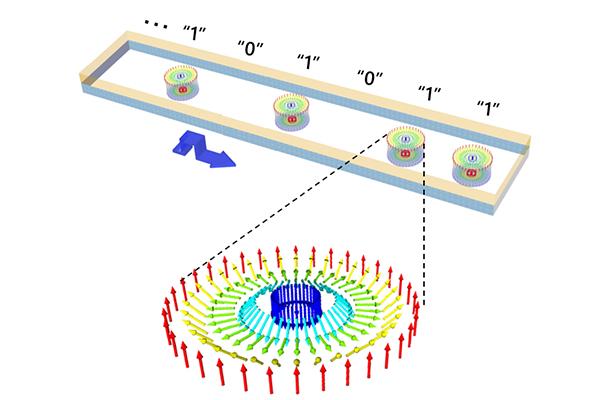
Researchers at Tohoku University have, for the first time, successfully demonstrated a formation and current-induced motion of synthetic antiferromagnetic magnetic skyrmions. The established findings are expected to pave the way towards new functional information processing and storage technologies.

Magnetic skyrmion is known to be a topological object, emerged in magnetic systems. It possesses the ability to be made at nanoscale and to be driven by a current, showing promise for various applications where information is represented by the presence, absence, number, or state of the skyrmion. However, there remains one stumbling block – the skyrmion Hall effect.

The skyrmion Hall effect entails the skyrmion not moving along the current, but in the direction diagonal to the current because of the inherent angular momentum of the skyrmion, degrading the efficiency and stability of devices. As such, demand is high for technology that overcomes the skyrmion Hall effect.

The research group – which includes Professor Hideo Ohno (current Tohoku University President), Associate Professor Shunsuke Fukami, and Ph.D. candidate Mr. Takaaki Dohi – developed a magnetic stack structure in which the skyrmion is moved along the current, avoiding the skyrmion Hall effect.

The developed structure effectively exploits three spintronics effects, Ruderman-Kittel-Kasuya-Yosida (RKKY) interaction, Dzyaloshinskii-Moriya (DM) interaction, and spin-orbit (SO) interaction. Due to the RKKY and DM interactions, a synthetic antiferromagnetically-coupled (SyAF) skyrmion is successfully formed. In addition, thanks to the SO interaction, the SyAF skyrmion is moved with a much smaller current than conventional single ferromagnetic skyrmion. Moreover, suppression of skyrmion Hall effect is confirmed for the SyAF system.

This is the first demonstration of the formation and current-induced motion of magnetic skyrmion circumventing the skyrmion Hall effect at room temperature. Ultimately, the present finding is expected to open the pathway to newer spintronics devices in which topology arising in magnetic materials is fully utilized.

###

Media Contact
Shunsuke Fukami
[email protected]
81-222-175-555

Original Source

https://www.tohoku.ac.jp/en/press/straight_motion_magnetic_skyrmion.html

Related Journal Article

http://dx.doi.org/10.1038/s41467-019-13182-6

Tags: Computer ScienceElectrical Engineering/ElectronicsTechnology/Engineering/Computer Science
Share12Tweet8Share2ShareShareShare2

Related Posts

Tissue-Specific Gene Expression Variance in Mice

Tissue-Specific Gene Expression Variance in Mice

December 27, 2025

Multi-Omics Uncovers Lung Repair Niches in Pediatric ARDS

December 27, 2025

DJ1 Regulates Autophagy in Ovarian Cancer via JNK

December 27, 2025

Microplastic Soil Pollution Detected via Optical Spectroscopy

December 27, 2025
Please login to join discussion

POPULAR NEWS

  • Robotic Waist Tether for Research Into Metabolic Cost of Walking

    NSF funds machine-learning research at UNO and UNL to study energy requirements of walking in older adults

    71 shares
    Share 28 Tweet 18
  • Nurses’ Views on Online Learning: Effects on Performance

    70 shares
    Share 28 Tweet 18
  • Exploring Audiology Accessibility in Johannesburg, South Africa

    51 shares
    Share 20 Tweet 13
  • Unraveling Levofloxacin’s Impact on Brain Function

    54 shares
    Share 22 Tweet 14

About

We bring you the latest biotechnology news from best research centers and universities around the world. Check our website.

Follow us

Recent News

Tissue-Specific Gene Expression Variance in Mice

Multi-Omics Uncovers Lung Repair Niches in Pediatric ARDS

DJ1 Regulates Autophagy in Ovarian Cancer via JNK

Subscribe to Blog via Email

Enter your email address to subscribe to this blog and receive notifications of new posts by email.

Join 71 other subscribers
  • Contact Us

Bioengineer.org © Copyright 2023 All Rights Reserved.

Welcome Back!

Login to your account below

Forgotten Password?

Retrieve your password

Please enter your username or email address to reset your password.

Log In
No Result
View All Result
  • Homepages
    • Home Page 1
    • Home Page 2
  • News
  • National
  • Business
  • Health
  • Lifestyle
  • Science

Bioengineer.org © Copyright 2023 All Rights Reserved.