Credit: ©Science China Press
Electrochromic films that display reversible spectral and color changes in response to electric or electrochemical stimulus are highly useful in a wide range of applications, such as smart windows, electronic displays, dynamic camouflage, and information storage. For practical applications, electrochromism with low operation voltage, high contrast ratio (in general no less than 30%), short response time (a few seconds or less), and excellent cyclic stability (at least over 1000 cycles) is required.
Compared to common materials and films showing electrochromism in the visible region, one challenging topic in this field is the realization of high-performance electrochromism in the near-infrared (NIR) region.
In recent years, Professor Yu-Wu Zhong’s group at the Institute of Chemistry, Chinese Academy of Sciences, have prepared thin films of organometallic ruthenium complexes by electropolymerization or self-assembly (1-3). These films displayed NIR electrochromism with moderate contrast ratios at different NIR wavelength. In addition, the film preparation and cyclic stability of these films need to be further improved.
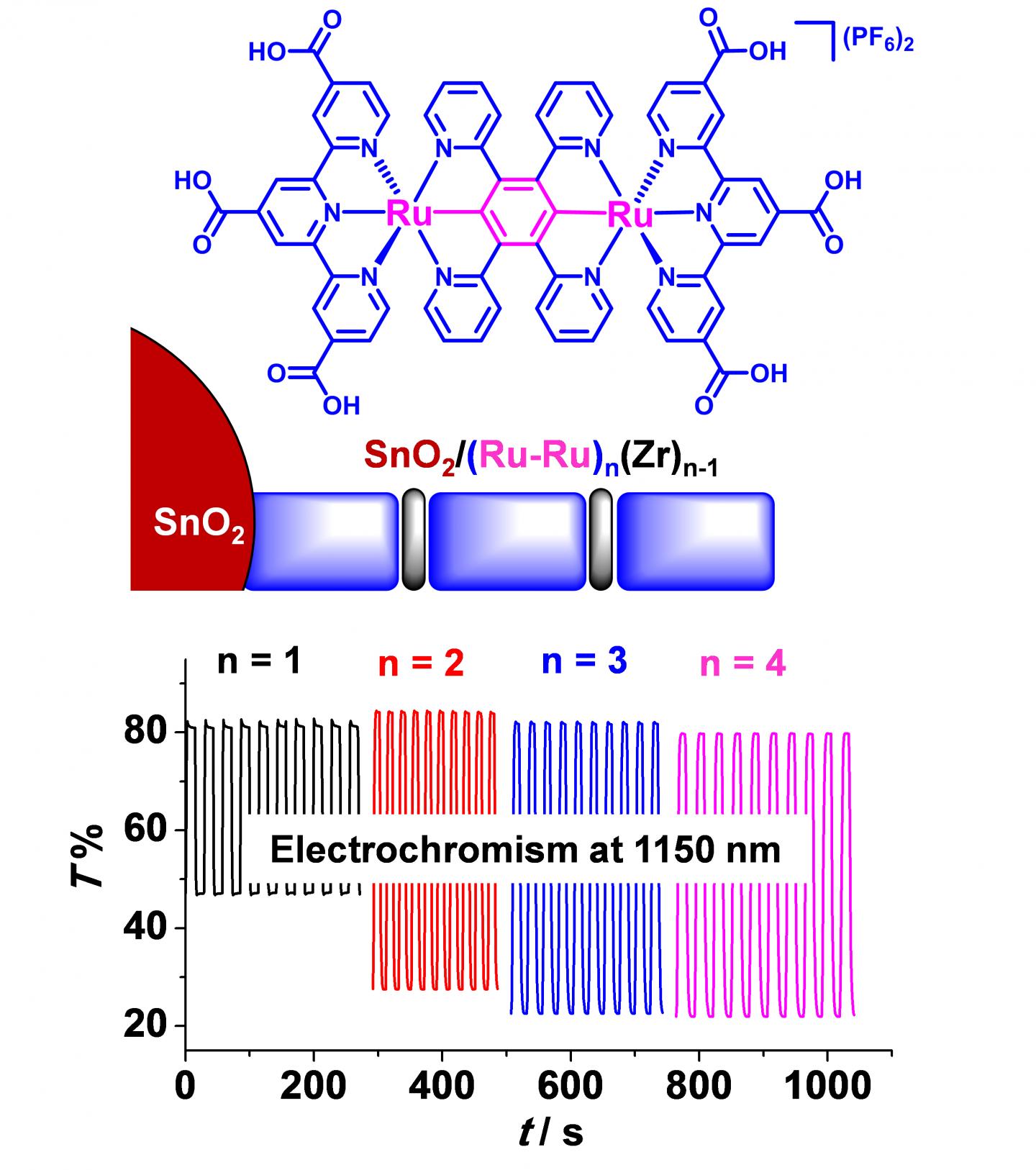
Currently (4), stimulated by the dye adsorption method commonly used in the fabrication of dye-sensitized solar cells, they prepared multilayer films of bridged diruthenium complexes by layer-by-layer (LBL) coordination assembly on metal oxide substrate and realized high-performance NIR electrochromism at 1150 nm (Figure 1).
A cyclometalated diruthenium complex with carboxylic acid groups on both terminal ligands has been prepared. The multilayer films of complex were prepared by the LBL coordinative deposition with Zr(IV)
ions on TiO2 or SnO2 substrates. The dye adsorption method is rather simple and high dye loading could be easily achieved by one-pot adsorption on metal oxides with high surface area, which is important for the efficient modulation of the contrast ratio of electrochromism.
These films display two reversible redox waves and electrochromism in the NIR region. In particular, the double-layered film on SnO2:Sb shows appealing electrochromic performance with a contrast ratio of 56% at 1150 nm, response time of a few seconds, and good cyclic stability being achieved. The higher electron conductivity and lower conduction band of SnO2:Sb with respect to TiO2 is believed beneficial to improve the electrochromic performance of the LBL films.
This work also demonstrates the capability of LBL films in realizing high-performance electrochromism and that the electrochromic performance could be regulated by the deposition cycles and the coordination LBL films on suitable substrates.
###
This work is supported by the National Natural Science Foundation of China (grant 21872154), Beijing National Science Foundation (grant 2191003), and the Strategic Priority Research Program of the Chinese Academy of Sciences (grant XDB12010400).
Reference
(1) J. Am. Chem. Soc. 2011, 133, 20720
(2) J. Am. Chem. Soc. 2015, 137, 4058
(3) J. Am. Chem. Soc. 2018, 140, 12337
(4) Sci. China Chem., 2019, DOI: 10.1007/s11426-019-9640-1
See the article: Li ZJ, Yao CJ, Zhong YW. Near-infrared electrochromism of multilayer films of a cyclometalated diruthenium complex prepared by layer-by-layer deposition on metal oxide substrates. Sci. China Chem., 2019, DOI: 10.1007/s11426-019-9640-1.
http://engine.
Media Contact
Yu-Wu Zhong
[email protected]
Related Journal Article
http://dx.