• HOME
  • NEWS
  • EXPLORE
    • CAREER
      • Companies
      • Jobs
    • EVENTS
    • iGEM
      • News
      • Team
    • PHOTOS
    • VIDEO
    • WIKI
  • BLOG
  • COMMUNITY
    • FACEBOOK
    • INSTAGRAM
    • TWITTER
Thursday, January 15, 2026
BIOENGINEER.ORG
No Result
View All Result
  • Login
  • HOME
  • NEWS
  • EXPLORE
    • CAREER
      • Companies
      • Jobs
        • Lecturer
        • PhD Studentship
        • Postdoc
        • Research Assistant
    • EVENTS
    • iGEM
      • News
      • Team
    • PHOTOS
    • VIDEO
    • WIKI
  • BLOG
  • COMMUNITY
    • FACEBOOK
    • INSTAGRAM
    • TWITTER
  • HOME
  • NEWS
  • EXPLORE
    • CAREER
      • Companies
      • Jobs
        • Lecturer
        • PhD Studentship
        • Postdoc
        • Research Assistant
    • EVENTS
    • iGEM
      • News
      • Team
    • PHOTOS
    • VIDEO
    • WIKI
  • BLOG
  • COMMUNITY
    • FACEBOOK
    • INSTAGRAM
    • TWITTER
No Result
View All Result
Bioengineer.org
No Result
View All Result
Home NEWS Science News Biology

Fishmeal developed for sustainable aquaculture

Bioengineer by Bioengineer
November 12, 2019
in Biology
Reading Time: 3 mins read
0
IMAGE
Share on FacebookShare on TwitterShare on LinkedinShare on RedditShare on Telegram

IMAGE

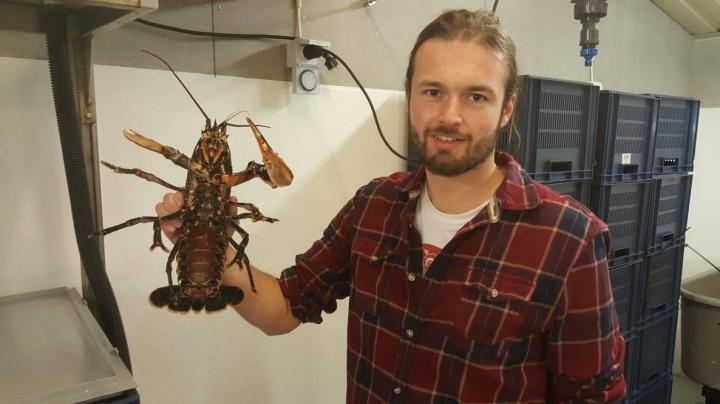
Credit: Linda Svanberg

Aquaculture in Sweden could be more sustainable if by-products from industrial feed production were used instead of wild-caught aquafeed. This is according to studies at the University of Gothenburg.

One of the most important challenges in aquaculture is access to fishmeal. Demand outweighs supply today due to the rapid expansion of aquaculture.

A new thesis has studied farming of the two species Atlantic wolffish and European lobster.

“These two species are popular among consumers and have a high market value in Sweden. The goal of the studies was to contribute to a knowledge base for the farming biology of these species with the welfare of the animals, a circular economy model and minimal environmental impact in mind, in accordance with the UN’s 2030 Agenda,” says thesis author James Hinchcliffe.

Increase the protein value

Studies from the thesis show that it is possible to produce high-value feed protein from unused by-products. For example, the meat left on the bones after fish fillets have been removed is not used today.

“With a new process, we can use fish meat to give fishmeal a higher protein content. By using feed containing by-products from the seafood industry to a greater extent in general, use of wild-caught aquafeed, like anchovies, can be reduced.”

Developed special feed for lobster larvae

Through laboratory experiments, James Hinchcliffe and his fellow researchers have also developed a species-specific feed to meet the need for suitable nutrients for lobster larvae.

“One of the greatest challenges of farming lobster is improving survival in the larval stages. That’s why we’ve developed a knowledge base about the most beneficial feed composition for the early life stages.”

Lobster larvae grow and survive best when they can eat related species, which is why a lot of cannibalism is seen in today’s lobster farming industry.

The studies investigated around ten different kinds of feed with local ingredients.

“We found that a diet with a percentage of shrimp, which came from local by-products from the industry, was the best source and most promising candidate for sustainable lobster feed.”

Atlantic wolffish good for farming

The studies also investigated the nutritional needs of Atlantic wolffish.

“The share of protein needed in the feed for optimum growth turned out to be relatively high – at least half the content of the feed.”

Collectively, the studies show that Atlantic wolffish seem to be a good species to farm. The fish are relatively easy to manage and resistant to stress.

“My hope is that the results of the studies will contribute information and can be used for environmentally sustainable aquaculture and production of nutritious food in Sweden,” says James Hinchcliffe.

###

Dissertation title: A circular economy approach for sustainable feed in Swedish aquaculture

Link: https://gupea.ub.gu.se/handle/2077/61866

Media Contact
James Hinchcliffe
[email protected]
46-072-318-4333

Original Source

https://www.gu.se/english/about_the_university/news-calendar/News_detail//fishmeal-developed-for-sustainable-aquaculture.cid1653642

Tags: AgricultureFisheries/AquacultureMarine/Freshwater Biology
Share12Tweet8Share2ShareShareShare2

Related Posts

Mitochondrial Insights into Phrynocephalus Guttatus Evolution

Mitochondrial Insights into Phrynocephalus Guttatus Evolution

January 15, 2026
Exploring SET Domain Genes in Neopyropia yezoensis

Exploring SET Domain Genes in Neopyropia yezoensis

January 14, 2026

Selective Tryptophan Detection in Milk via Enzyme Sensor

January 14, 2026

Structural and Functional Differences in Citrus PRR and R Genes

January 14, 2026
Please login to join discussion

POPULAR NEWS

  • Enhancing Spiritual Care Education in Nursing Programs

    155 shares
    Share 62 Tweet 39
  • PTSD, Depression, Anxiety in Childhood Cancer Survivors, Parents

    147 shares
    Share 59 Tweet 37
  • Robotic Ureteral Reconstruction: A Novel Approach

    75 shares
    Share 30 Tweet 19
  • Study Reveals Lipid Accumulation in ME/CFS Cells

    53 shares
    Share 21 Tweet 13
iv>

About

We bring you the latest biotechnology news from best research centers and universities around the world. Check our website.

Follow us

Recent News

Linking Reasoning Skills and Eating Disorders: An Insight

Workplace Violence Against Nurses: Causes and Prevention Strategies

KLHL6 Ubiquitin Ligase Fuels CD8+ T Cell Resistance

Subscribe to Blog via Email

Success! An email was just sent to confirm your subscription. Please find the email now and click 'Confirm' to start subscribing.

Join 71 other subscribers
  • Contact Us

Bioengineer.org © Copyright 2023 All Rights Reserved.

Welcome Back!

Login to your account below

Forgotten Password?

Retrieve your password

Please enter your username or email address to reset your password.

Log In
No Result
View All Result
  • Homepages
    • Home Page 1
    • Home Page 2
  • News
  • National
  • Business
  • Health
  • Lifestyle
  • Science

Bioengineer.org © Copyright 2023 All Rights Reserved.