Max Planck scientists map mouse personality
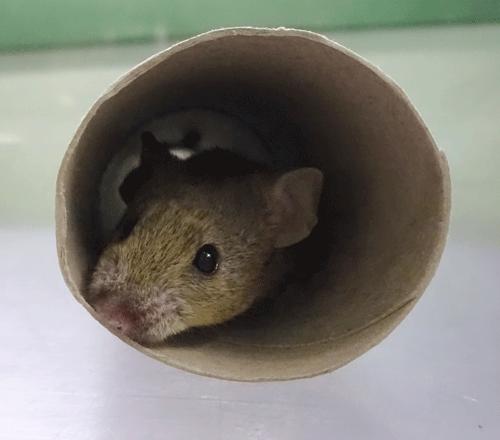
Credit: MPI for Molecular Genetics
Scientists at the Max Planck Institute of Psychiatry in Munich, Germany, together with colleagues at the Weizmann Institute of Sciencein Israel have developed a computational method to objectively measure the personality of mice living in a semi-natural, group environment.
Just like humans, every mouse is different. Some are quick to explore a new environment while others prefer to stay within the comfort of their nest. Some prefer to stay close to their cage-mates, while others prefer to be alone. These unique characteristics of an individual remain fairly stable through life and define their personality. In humans, personality can be measured using multiple-choice questionnaires to derive personality scores but how can one measure personality in animals?
Oren Forkosh and Stoyo Karamihalev, together with other colleagues collected huge amounts of data by analyzing video footage taken of groups of mice. To do this, they dyed the fur of each mouse a different color allowing them to track the groups of mice behaving undisturbed. Each video was analyzed for a repertoire of 60 behaviors, such as how close a mouse stays to other mice, if they chase one another or run away, or the time spent in the nest or eating.
Stable personalities
The scientists developed a mathematical algorithm that sought stable traits that were able to discriminate individuals based on differences in behavior. This method works somewhat in the same way as personality tests in humans in which people are often assessed on five dimensions, however it specifically searches for traits that are consistent over time. In mice, the algorithm identified four trait-like dimensions that could capture and describe the behavior of mice. To test that these traits were stable, the researchers mixed up the groups and found that while some of the behaviors had changed, the personalities of the mice were still stable. Using advanced RNA-sequencing tools and genetically modified mouse strains, the researchers were also able to show that individual differences captured in these traits corresponded to a variety of differences in gene expression in the mouse brain and could identify mice with different genetic makeup.
“This method has the potential to greatly advance our knowledge beyond what is possible using the current simplified methods for assessing behavior and toward stable and consistent differences in personality. It opens up the possibility to study how personality is affected by genes, drugs, aging, etc., how it is represented and maintained by the brain, and how it contributes to mental health and disease”, explains Karamihalev, together with Oren Forkosh one of the first authors of the study. “This is a good first step in the direction of better pre-clinical methods for assessing individual differences in behavior and physiology,” says Alon Chen, the principal investigator for this study. “Our hope is that such approaches will aid in the effort toward a more personalized psychiatry”.
###
Original Publication
Oren Forkosh, Stoyo Karamihalev, Simone Roeh, Uri Alon, Sergey Anpilov, Chadi Touma, Markus Nussbaumer, Cornelia Flachskamm, Paul M. Kaplick, Yair Shemesh & Alon Chen
Identity domains capture individual differences from across the behavioral repertoire.
Nature Neuroscience; 4 November, 2019
Media Contact
Anke Schlee
[email protected]
49-893-062-2263
Original Source
https:/