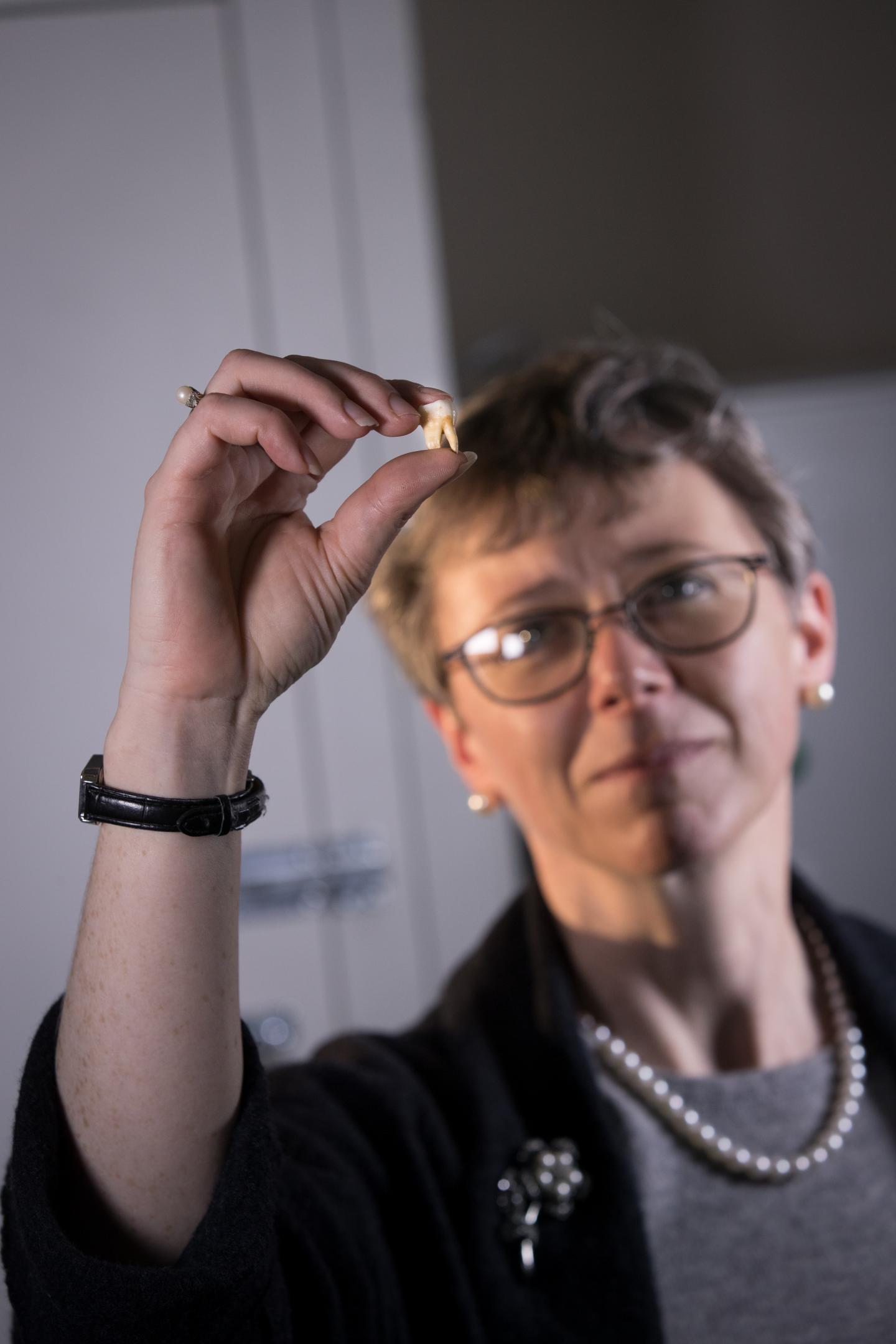
Credit: McMaster University
Researchers at McMaster University have found that a person’s first permanent molars carry a life-long record of health information dating back to the womb, storing vital information that can connect maternal health to a child’s health, even hundreds of years later.
Dentin, the material under the enamel that makes up the bulk of a tooth, forms in microscopic layers that compare to the rings of a tree. Adequate formation of those layers is dependent on Vitamin D. Dark streaks develop in periods when the body is deprived of the critical nutrient, usually because of a lack of sunlight.
The researchers, led by anthropologist Megan Brickley, had previously established that such microscopic defects remain in place and can be read later, in the same way a tree trunk can show years of good and poor growth. Because teeth do not decay as rapidly as flesh and bone, they can retain such information for hundreds of years post-mortem.
Combined with other data, Brickley says, patterns in dentin can create rich banks of knowledge about past conditions, including the health impacts of living in low-light environments.
“It’s a living fossil of your life, starting in utero,” Brickley says. “Conceivably, it would be possible to remove the molar of anyone and compare their health to the evidence in the tooth.”
Early colonial settlers in Canada, for example, who were often wrapped head to toe, even in summer, commonly developed conditions such as rickets, or died prematurely from other conditions related to poor access to vitamin D.
Now the same team of researchers has established the value of such records, which begin during the original formation of teeth in the fetal stage, for reflecting the health of the mother during pregnancy. All of the body’s primary or “baby” teeth, which start forming in utero, are lost in childhood.
The first permanent molars – which emerge around age 6 – also start forming in utero and stay in the mouth throughout one’s adult life, where they retain a record of Vitamin D intake dating back to the mother’s pregnancy.
That record provides a critical intergenerational link that can offer valuable clues connecting maternal health to the eventual fate of a child.
“We’ve been able to set out really clear evidence that there is part of the first permanent molar that records what happened in the life of the mother,” Brickley says. “This is a tool that people can use. It can be used in current health research, and in bio-archaeological research.”
The researchers examined modern and archaeological tooth samples, including teeth taken from two skeletons from 19th century Quebec – one from a three-year-old girl who had survived rickets as a toddler, and one from a young man. The toddler’s undescended molar showed that her mother had suffered a Vitamin D deficiency during pregnancy – a possible clue to the child’s early death. The young man’s molar also showed his mother had suffered Vitamin D deficiency, raising the possibility of a connection between his mother’s health and his early death.
In that time, Brickley explained, social practices and weather conditions meant that pregnant women in particular would have had very little exposure to the sun, before it became clear how necessary sunlight or substitute sources of Vitamin D are to good health.
###
Megan Brickley is available at [email protected] and 905-525-9150 ext. 24256.
Media Contact
Wade Hemsworth
[email protected]
289-925-8382