• HOME
  • NEWS
  • EXPLORE
    • CAREER
      • Companies
      • Jobs
    • EVENTS
    • iGEM
      • News
      • Team
    • PHOTOS
    • VIDEO
    • WIKI
  • BLOG
  • COMMUNITY
    • FACEBOOK
    • INSTAGRAM
    • TWITTER
Saturday, February 7, 2026
BIOENGINEER.ORG
No Result
View All Result
  • Login
  • HOME
  • NEWS
  • EXPLORE
    • CAREER
      • Companies
      • Jobs
        • Lecturer
        • PhD Studentship
        • Postdoc
        • Research Assistant
    • EVENTS
    • iGEM
      • News
      • Team
    • PHOTOS
    • VIDEO
    • WIKI
  • BLOG
  • COMMUNITY
    • FACEBOOK
    • INSTAGRAM
    • TWITTER
  • HOME
  • NEWS
  • EXPLORE
    • CAREER
      • Companies
      • Jobs
        • Lecturer
        • PhD Studentship
        • Postdoc
        • Research Assistant
    • EVENTS
    • iGEM
      • News
      • Team
    • PHOTOS
    • VIDEO
    • WIKI
  • BLOG
  • COMMUNITY
    • FACEBOOK
    • INSTAGRAM
    • TWITTER
No Result
View All Result
Bioengineer.org
No Result
View All Result
Home NEWS Science News Chemistry

A distinct spin on atomic transport

Bioengineer by Bioengineer
November 8, 2019
in Chemistry
Reading Time: 2 mins read
0
IMAGE
Share on FacebookShare on TwitterShare on LinkedinShare on RedditShare on Telegram

Work that demonstrates simultaneous control over transport and spin properties of cold atoms establishes a framework for exploring concepts of spintronics and solid-state physics
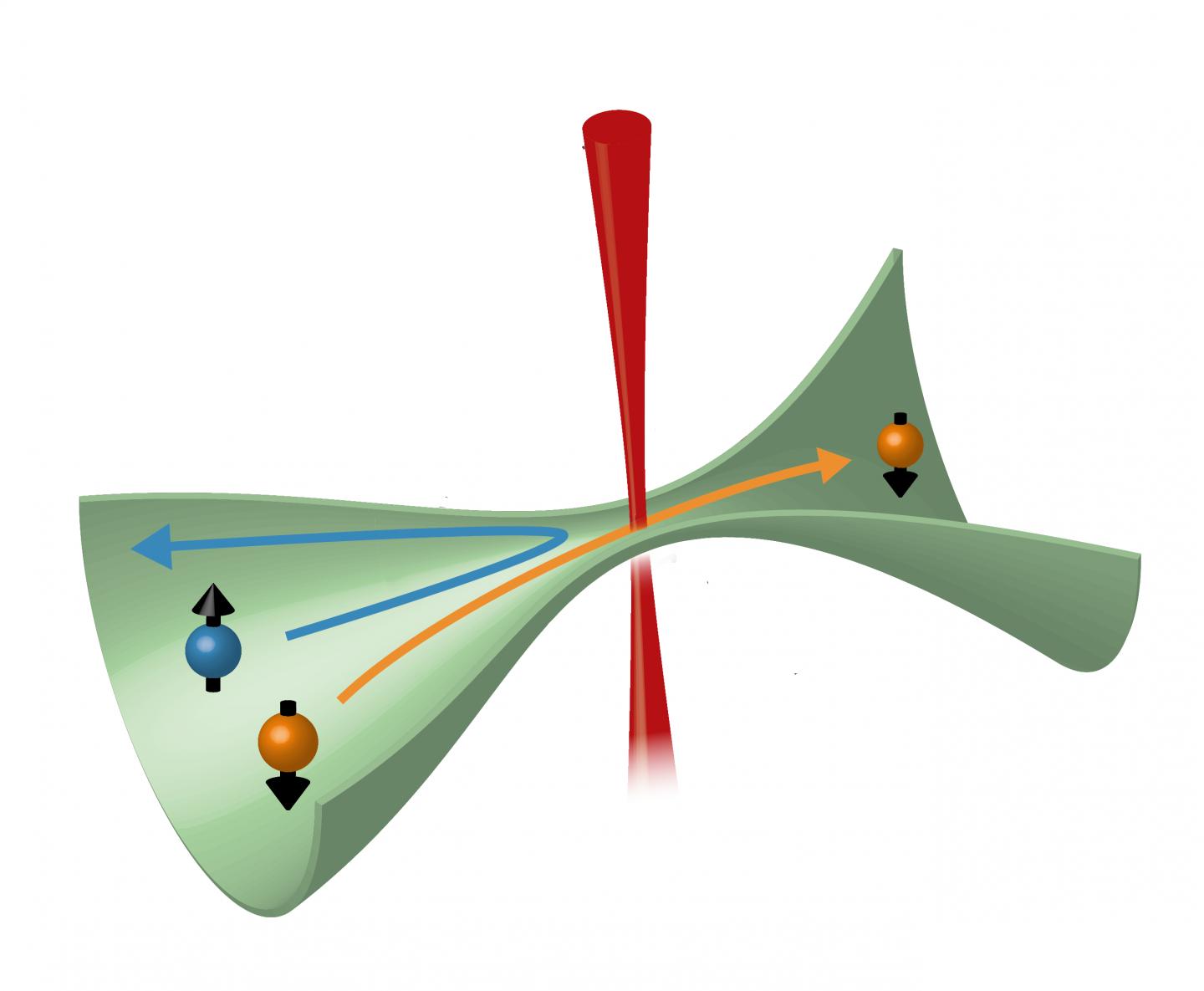
IMAGE

Credit: (ETH Zurich/D-PHYS, adapted from doi: 10.1103/PhysRevLett.123.193605)


One of the more unexpected things that can be done with charge-neutral atoms is to use them to emulate the fundamental behaviour of electrons. In the past few years, the group of Tilman Esslinger at the Institute of Quantum Electronics in the Department of Physics of ETH Zurich has pioneered a platform in which atoms cooled to temperatures close to absolute zero are transported through one- and two-dimensional structures, driven by a potential difference. In this way defining phenomena occuring in mesoscopic electronic systems can be studied in great detail, not least quantized conductance. In a pair of papers published today in Physical Review Letters and Physical Review A, postdoc Laura Corman, former PhD student Martin Lebrat and colleagues in the Esslinger group report that they have mastered in their transport experiments control over another quantum property of the atoms — their spin.

The team added to the transport channel a tightly focussed light beam, which induces local interactions that are equivalent to exposing the atoms to a strong magnetic field. As a consequence, the degeneracy of the spin states is lifted, which in turn serves as the basis for an efficient spin filter: atoms of one spin orientation are repelled, whereas those of another orientation are free to pass (see the figure). Importantly, even though the application of an additional light field leads to the loss of atoms, these dissipative processes do not destroy the quantization of conductance. The ETH researchers replicate this experimental finding in numerical simulation and substantiate its validity through an extension of the Landauer–Büttiker model, the key formalism for quantum transport.

The efficiency of the atomic spin filter demonstrated by the Esslinger group matches that of the best equivalent elements for electronic systems. This, together with the extraordinary ‘cleanness’ and controllability of the cold-atom platform, opens up exciting new perspectives for exploring the dynamics of quantum transport. In particular, as the interaction between the atoms can be tuned, the platform provides access to spin transport of strongly correlated quantum systems. This regime is difficult to study otherwise, but is of considerable fundamental and practical interest, not least for applications in spintronic devices and to explore fundamental phases of matter.

###

Media Contact
Andreas Trabesinger
[email protected]
41-791-289-860

Original Source

https://www.phys.ethz.ch/news-and-events/d-phys-news/2019/11/a-distinct-spin-on-atomic-transport.html

Related Journal Article

http://dx.doi.org/10.1103/PhysRevLett.123.193605

Tags: Atomic PhysicsChemistry/Physics/Materials SciencesOptics
Share13Tweet8Share2ShareShareShare2

Related Posts

blank

Breakthrough in Environmental Cleanup: Scientists Develop Solar-Activated Biochar for Faster Remediation

February 7, 2026
blank

Cutting Costs: Making Hydrogen Fuel Cells More Affordable

February 6, 2026

Scientists Develop Hand-Held “Levitating” Time Crystals

February 6, 2026

Observing a Key Green-Energy Catalyst Dissolve Atom by Atom

February 6, 2026
Please login to join discussion

POPULAR NEWS

  • Robotic Ureteral Reconstruction: A Novel Approach

    Robotic Ureteral Reconstruction: A Novel Approach

    82 shares
    Share 33 Tweet 21
  • Digital Privacy: Health Data Control in Incarceration

    63 shares
    Share 25 Tweet 16
  • Study Reveals Lipid Accumulation in ME/CFS Cells

    57 shares
    Share 23 Tweet 14
  • Breakthrough in RNA Research Accelerates Medical Innovations Timeline

    53 shares
    Share 21 Tweet 13

About

We bring you the latest biotechnology news from best research centers and universities around the world. Check our website.

Follow us

Recent News

Boosting Remote Healthcare: Stepped-Wedge Trial Insights

Barriers and Boosters of Seniors’ Physical Activity in Karachi

Evaluating Pediatric Emergency Care Quality in Ethiopia

Subscribe to Blog via Email

Enter your email address to subscribe to this blog and receive notifications of new posts by email.

Join 73 other subscribers
  • Contact Us

Bioengineer.org © Copyright 2023 All Rights Reserved.

Welcome Back!

Login to your account below

Forgotten Password?

Retrieve your password

Please enter your username or email address to reset your password.

Log In
No Result
View All Result
  • Homepages
    • Home Page 1
    • Home Page 2
  • News
  • National
  • Business
  • Health
  • Lifestyle
  • Science

Bioengineer.org © Copyright 2023 All Rights Reserved.