Credit: Please cite the article: Grindstaff, B., M. E. Mabry, P. D. Blischak, M. Quinn, and J. C. Pires. 2019. Affordable remote monitoring of plant growth in facilities using Raspberry Pi…
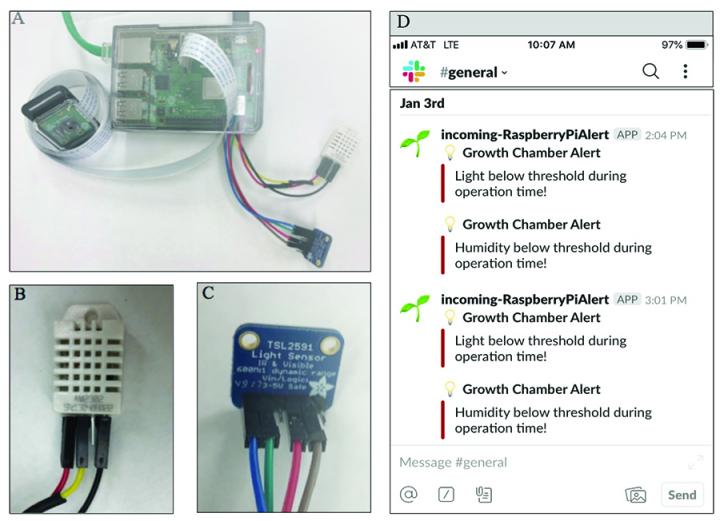
Growth chambers are a cornerstone of laboratory-based plant science, allowing for the tightly controlled conditions necessary for many experimental designs. However, these conditions can sometimes be a little less than controlled, creating headaches ranging from reproducibility issues to the loss of entire experiments. Remote monitoring of conditions helps, but the equipment can be expensive, or lack features or sensors important for a particular experiment. In research presented in a recent issue of Applications in Plant Sciences, Makenzie Mabry, MS, and colleagues at the University of Missouri and University of Arizona developed a flexible and inexpensive monitoring system for plant growth facilities, called Growth Monitor pi, or GMpi. The system uses open source software and a single-board Raspberry Pi computer, and can be connected to a wide variety of different sensors to meet researchers’ specific needs.
Necessity is often the mother of invention, and that was the case for GMpi. “We wanted to be able to monitor some sensitive experiments but were traveling a lot at the time and couldn’t find anything that completely met our needs with notifications and alerts at an affordable price,” said Mabry, the corresponding author of the manuscript. “We hope that the GMpi is approachable for other plant scientists who wish to monitor their plants more closely, have extra security in alerting users to conditions in plant growth facilities, or just wish to increase reproducibility across studies.”
The GMpi system’s “internet of things” approach maximizes flexibility while keeping costs low, making it an appealing tool to a variety of plant researchers. “We hope that researchers can take the GMpi and expand on it in ways that suit their research,” said Mabry. “For example, we think that those interested in phenotyping their plants can adapt the GMpi relatively easily for that purpose, as well as retaining the use of it for monitoring their plants.”
The low cost of the GMpi system (about US$200), made possible by open source software and inexpensive hardware, is also likely to lure researchers looking for a way to ensure their growth chamber experiments are running smoothly. “Many researchers do not have the funding or resources to afford expensive monitoring systems, but still would like to know the conditions their plants experience day-to-day,” said Mabry. “We also feel there is always room for improving reproducibility across science and hope that by providing an inexpensive and open source platform this will be more accessible to all scientists who wish to use it.”
To make the GMpi system even more accessible, detailed protocols are provided with the article, describing the necessary equipment, Raspberry Pi set up, and software installation.
In addition to ensuring reproducibility, the GMpi system has already brought peace of mind to the Pires lab at the University of Missouri, where Mabry is pursuing her doctorate. “When I am out of town, I am still in the loop about what is going on with the chamber and plants and can delegate tasks to check on the plants when we get an alert that the facility is out of our specified range for temperature, humidity, or light,” said Mabry.
It seems the GMpi system has many uses, not least of which is as a guardian against plant researchers’ nightmares about a growth chamber breaking over a holiday weekend.
###
Brandin Grindstaff, Makenzie E. Mabry, Paul D. Blischak, Micheal Quinn, and J. Chris Pires. 2019. Affordable remote monitoring of plant growth in facilities using Raspberry Pi computers. Applications in Plant Sciences 7(8): e11280. https:/
Applications in Plant Sciences (APPS) is a monthly, peer-reviewed, open access journal focusing on new tools, technologies, and protocols in all areas of the plant sciences. It is published by the Botanical Society of America (http://www.
For further information, please contact the APPS staff at [email protected].
Media Contact
Beth Parada
[email protected]
Related Journal Article
http://dx.