• HOME
  • NEWS
  • EXPLORE
    • CAREER
      • Companies
      • Jobs
    • EVENTS
    • iGEM
      • News
      • Team
    • PHOTOS
    • VIDEO
    • WIKI
  • BLOG
  • COMMUNITY
    • FACEBOOK
    • INSTAGRAM
    • TWITTER
Wednesday, May 13, 2026
BIOENGINEER.ORG
No Result
View All Result
  • Login
  • HOME
  • NEWS
  • EXPLORE
    • CAREER
      • Companies
      • Jobs
        • Lecturer
        • PhD Studentship
        • Postdoc
        • Research Assistant
    • EVENTS
    • iGEM
      • News
      • Team
    • PHOTOS
    • VIDEO
    • WIKI
  • BLOG
  • COMMUNITY
    • FACEBOOK
    • INSTAGRAM
    • TWITTER
  • HOME
  • NEWS
  • EXPLORE
    • CAREER
      • Companies
      • Jobs
        • Lecturer
        • PhD Studentship
        • Postdoc
        • Research Assistant
    • EVENTS
    • iGEM
      • News
      • Team
    • PHOTOS
    • VIDEO
    • WIKI
  • BLOG
  • COMMUNITY
    • FACEBOOK
    • INSTAGRAM
    • TWITTER
No Result
View All Result
Bioengineer.org
No Result
View All Result
Home NEWS Science News Biology

Water mold research leads to greater understanding of corn diseases

Bioengineer by Bioengineer
November 6, 2019
in Biology
Reading Time: 2 mins read
0
IMAGE
Share on FacebookShare on TwitterShare on LinkedinShare on RedditShare on Telegram

IMAGE

Credit: J. A. Rojas, A. Witte, Z. A. Noel, J. L. Jacobs, and M. I. Chilvers


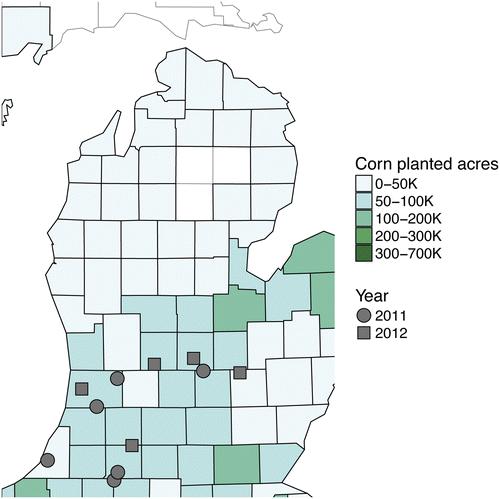
Corn is a staple feed and biofuel crop with a value close to $3.7 billion in the Michigan economy alone. However, knowledge about seedling pathogens in Michigan corn fields is limited. A group of scientists in the Department of Plant, Soil and Microbial Sciences at Michigan State University set out to gain a better understanding of the composition of seedling pathogens, with results that will aid disease management research not only in corn but in rotational crops such as soybean and wheat.

This research focused on oomycetes, also known as water molds, which comprise several hundred organisms that include some of the most devastating plant pathogens some of which cause seedling disease and root rot. They used both traditional pathogen isolation methods and amplicon sequencing to identify the most abundant oomycetes from corn seedlings and characterize the isolates for their ability to cause disease on corn.

“The study is unique as we combined both a traditional pathogen isolation and amplicon sequencing to characterize oomycetes of corn,” explained Martin Chilvers, one of the researchers. “Using both of these approaches enabled us to get a snap shot of oomycetes in soil and corn seedlings, but also enabled virulence and fungicide sensitivity phenotyping.”

This research will lead to a greater understanding of the causes of seedling disease and root rot and enable more targeted approaches for disease management, from breeding hybrids with improved root rot resistance to screening fungicides that combat disease and improve management. To learn more, read “Diversity and Characterization of Oomycetes Associated with Corn Seedlings in Michigan,” published in the September issue of the open access Phytobiomes Journal.

###

Media Contact
Ashley Bergman Carlin
[email protected]
651-994-3832

Related Journal Article

http://dx.doi.org/10.1094/PBIOMES-12-18-0059-R

Tags: Agricultural Production/EconomicsAgricultureEcology/EnvironmentFertilizers/Pest ManagementFood/Food ScienceGeology/SoilMycologyPlant Sciences
Share12Tweet8Share2ShareShareShare2

Related Posts

Cutting-Edge Genomic Techniques Reveal Unexpected Cellular Changes in the Aging Brain — Biology

Cutting-Edge Genomic Techniques Reveal Unexpected Cellular Changes in the Aging Brain

May 12, 2026
USC Researchers Initiate Study on the Most Advanced Lab-Grown Kidney Structures — Biology

USC Researchers Initiate Study on the Most Advanced Lab-Grown Kidney Structures

May 12, 2026

Childbirth in Humans Is Not Uniquely Challenging Among Mammals, New Research Shows

May 12, 2026

From Complexity to Clarity: Unraveling the “Topological Laws” Governing Cell Death

May 11, 2026
Please login to join discussion

POPULAR NEWS

  • Research Indicates Potential Connection Between Prenatal Medication Exposure and Elevated Autism Risk

    842 shares
    Share 337 Tweet 211
  • New Study Reveals Plants Can Detect the Sound of Rain

    728 shares
    Share 290 Tweet 182
  • Salmonella Haem Blocks Macrophages, Boosts Infection

    62 shares
    Share 25 Tweet 16
  • Breastmilk Balances E. coli and Beneficial Bacteria in Infant Gut Microbiomes

    57 shares
    Share 23 Tweet 14

About

We bring you the latest biotechnology news from best research centers and universities around the world. Check our website.

Follow us

Recent News

Anti-Nogo-A Treatment Alters Spinal Cord Structure Post-Injury

Older Adults’ Views on Medication After Hospital Discharge

Flexible Carbon Nanotube Transistors Surpass 100 GHz

Subscribe to Blog via Email

Enter your email address to subscribe to this blog and receive notifications of new posts by email.

Join 82 other subscribers
  • Contact Us

Bioengineer.org © Copyright 2023 All Rights Reserved.

Welcome Back!

Login to your account below

Forgotten Password?

Retrieve your password

Please enter your username or email address to reset your password.

Log In
No Result
View All Result
  • Homepages
    • Home Page 1
    • Home Page 2
  • News
  • National
  • Business
  • Health
  • Lifestyle
  • Science

Bioengineer.org © Copyright 2023 All Rights Reserved.