• HOME
  • NEWS
  • EXPLORE
    • CAREER
      • Companies
      • Jobs
    • EVENTS
    • iGEM
      • News
      • Team
    • PHOTOS
    • VIDEO
    • WIKI
  • BLOG
  • COMMUNITY
    • FACEBOOK
    • INSTAGRAM
    • TWITTER
Saturday, February 7, 2026
BIOENGINEER.ORG
No Result
View All Result
  • Login
  • HOME
  • NEWS
  • EXPLORE
    • CAREER
      • Companies
      • Jobs
        • Lecturer
        • PhD Studentship
        • Postdoc
        • Research Assistant
    • EVENTS
    • iGEM
      • News
      • Team
    • PHOTOS
    • VIDEO
    • WIKI
  • BLOG
  • COMMUNITY
    • FACEBOOK
    • INSTAGRAM
    • TWITTER
  • HOME
  • NEWS
  • EXPLORE
    • CAREER
      • Companies
      • Jobs
        • Lecturer
        • PhD Studentship
        • Postdoc
        • Research Assistant
    • EVENTS
    • iGEM
      • News
      • Team
    • PHOTOS
    • VIDEO
    • WIKI
  • BLOG
  • COMMUNITY
    • FACEBOOK
    • INSTAGRAM
    • TWITTER
No Result
View All Result
Bioengineer.org
No Result
View All Result
Home NEWS Science News Chemistry

The first Cr-based nitrides superconductor Pr3Cr10-xN11

Bioengineer by Bioengineer
November 6, 2019
in Chemistry
Reading Time: 2 mins read
0
IMAGE
Share on FacebookShare on TwitterShare on LinkedinShare on RedditShare on Telegram

IMAGE

Credit: ©Science China Press


Since the discovery of superconductivity in the chromium-based compound CrAs, which is more complex than those within the realm of the Bardeen-Cooper-Schrieffer (BCS) theory, the study on chromium based superconductors has attracted much attention. Among the 3d transitional metallic compounds, the Cr and Mn based materials can hardly become superconducting due to robust static magnetism which can destroy the superconductivity. Following the discovery of superconductivity in CrAs, a search for new chromium based superconducting materials was conducted. Recently, quasi one-dimensional A2Cr3As3 and ACr3As3 (A =Na, K, Rb, Cs) were reported in other arsenide materials. Exploration of those quasi one-dimensional superconductor is a hot spot primarily owing to their reduced dimensionality, significant electron correlations, and possible unconventional superconductivity.

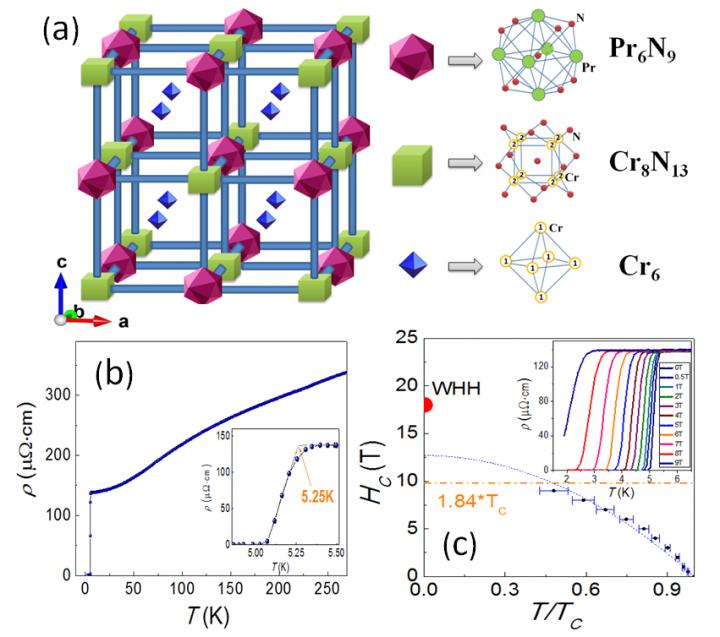
Recently, Wei Wu, Jianlin Luo et al. from Institute of Physics, Chinese Academy of Sciences, and Kai Liu from Renmin University of China now report the discovery of the first Cr-based Nitrides superconductor of Pr3Cr10-xN11 with cubic structure. Pr3Cr10-xN11 was first synthesized and characterized by Broil et al. in 1995. The compound crystallizes in space group Fm-3m (No. 225) with lattice constant a = 12.891 Å. It contains 192 atoms in a face-centered cubic (FCC) unit cell with 3 kinds of building blocks as illustrated in Fig (a).

The electrical resistivity [Fig (b)], magnetization and specific heat of Pr3Cr10-xN11 show bulk superconductivity at 5.25 K. The superconductivity in Pr3Cr10-XN11 shows several distinct characters. A relatively large upper critical field is found at the zero-temperature limit, Hc2(0) ~ 12.6 T, which is larger than the Pauli limit for paramagnetic pair-breaking field as shown in Fig (c). The material has a large electronic specific-heat coefficient of 170 mJ K-2 mol-1, about 10 times larger than that estimated by the electronic structure calculation, which suggests that correlations between 3d electrons is very strong in Pr3Cr10-xN11, and thus quantum fluctuations might be involved. From electronic structure calculations, the density of states at the Fermi energy is predominately contributed by Cr 3d electrons. This result demonstrates that Pr3Cr10-xN11 is the first Cr-based superconductor discovered in Chromium Nitrides and it represents a rare example that possibly unconventional superconductivity emerges in a 3D system with strong electron correlations.

###

See the article:

Wei Wu, Kai Liu, Yanjie Li, Zhenhai Yu, Desheng Wu, Yuting Shao, Shihang Na, Gang Li, Ruizhen Huang, Tao Xiang and Jianlin Luo

Superconductivity in Chromium Nitrides Pr3Cr10-xN11 with Strong Electron Correlations

https://doi.org/10.1093/nsr/nwz129

Media Contact
Jianlin Luo
[email protected]

Related Journal Article

http://dx.doi.org/10.1093/nsr/nwz129

Tags: Chemistry/Physics/Materials Sciences
Share12Tweet8Share2ShareShareShare2

Related Posts

blank

Breakthrough in Environmental Cleanup: Scientists Develop Solar-Activated Biochar for Faster Remediation

February 7, 2026
blank

Cutting Costs: Making Hydrogen Fuel Cells More Affordable

February 6, 2026

Scientists Develop Hand-Held “Levitating” Time Crystals

February 6, 2026

Observing a Key Green-Energy Catalyst Dissolve Atom by Atom

February 6, 2026
Please login to join discussion

POPULAR NEWS

  • Robotic Ureteral Reconstruction: A Novel Approach

    Robotic Ureteral Reconstruction: A Novel Approach

    82 shares
    Share 33 Tweet 21
  • Digital Privacy: Health Data Control in Incarceration

    63 shares
    Share 25 Tweet 16
  • Study Reveals Lipid Accumulation in ME/CFS Cells

    57 shares
    Share 23 Tweet 14
  • Breakthrough in RNA Research Accelerates Medical Innovations Timeline

    53 shares
    Share 21 Tweet 13

About

We bring you the latest biotechnology news from best research centers and universities around the world. Check our website.

Follow us

Recent News

Decoding Prostate Cancer Origins via snFLARE-seq, mxFRIZNGRND

Digital Health Perspectives from Baltic Sea Experts

Florida Cane Toad: Complex Spread and Selective Evolution

Subscribe to Blog via Email

Enter your email address to subscribe to this blog and receive notifications of new posts by email.

Join 73 other subscribers
  • Contact Us

Bioengineer.org © Copyright 2023 All Rights Reserved.

Welcome Back!

Login to your account below

Forgotten Password?

Retrieve your password

Please enter your username or email address to reset your password.

Log In
No Result
View All Result
  • Homepages
    • Home Page 1
    • Home Page 2
  • News
  • National
  • Business
  • Health
  • Lifestyle
  • Science

Bioengineer.org © Copyright 2023 All Rights Reserved.