• HOME
  • NEWS
  • EXPLORE
    • CAREER
      • Companies
      • Jobs
    • EVENTS
    • iGEM
      • News
      • Team
    • PHOTOS
    • VIDEO
    • WIKI
  • BLOG
  • COMMUNITY
    • FACEBOOK
    • INSTAGRAM
    • TWITTER
Monday, May 11, 2026
BIOENGINEER.ORG
No Result
View All Result
  • Login
  • HOME
  • NEWS
  • EXPLORE
    • CAREER
      • Companies
      • Jobs
        • Lecturer
        • PhD Studentship
        • Postdoc
        • Research Assistant
    • EVENTS
    • iGEM
      • News
      • Team
    • PHOTOS
    • VIDEO
    • WIKI
  • BLOG
  • COMMUNITY
    • FACEBOOK
    • INSTAGRAM
    • TWITTER
  • HOME
  • NEWS
  • EXPLORE
    • CAREER
      • Companies
      • Jobs
        • Lecturer
        • PhD Studentship
        • Postdoc
        • Research Assistant
    • EVENTS
    • iGEM
      • News
      • Team
    • PHOTOS
    • VIDEO
    • WIKI
  • BLOG
  • COMMUNITY
    • FACEBOOK
    • INSTAGRAM
    • TWITTER
No Result
View All Result
Bioengineer.org
No Result
View All Result
Home NEWS Science News Chemistry

Scientists crack structure of a novel enzyme linked to cell growth and cancer

Bioengineer by Bioengineer
November 6, 2019
in Chemistry
Reading Time: 3 mins read
0
IMAGE
Share on FacebookShare on TwitterShare on LinkedinShare on RedditShare on Telegram

UC Riverside-led study could lead to the development of drugs that target liver and other cancers
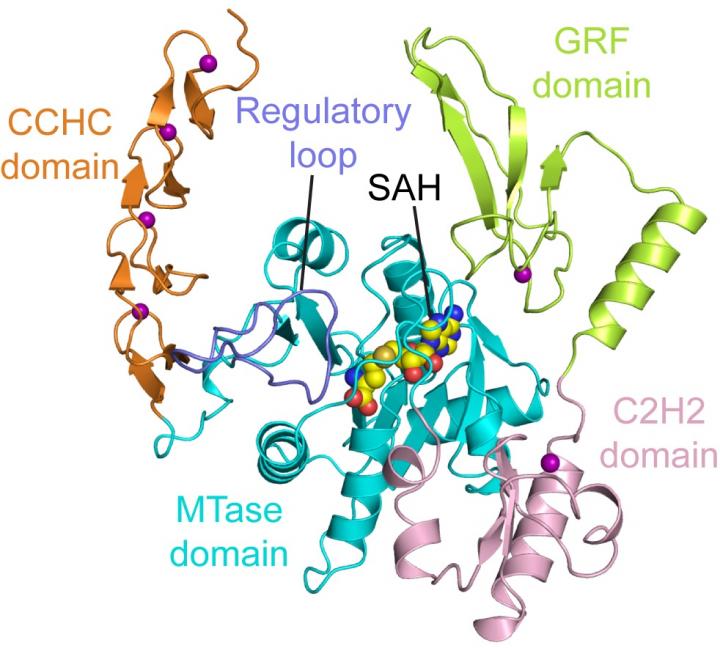
IMAGE

Credit: Song lab, UC Riverside


RIVERSIDE, Calif. — RNA, or ribonucleic acid, is present in the cells of all living beings and required to synthesize proteins. A research team at the University of California, Riverside, has discovered the structure of a novel RNA-modifying enzyme, ZCCHC4, and identified the mechanism that controls how this enzyme recognizes its substrate.

ZCCHC4 influences cell proliferation and has been linked to cancers. It uniquely introduces one kind of RNA modification, N6-methyladenosine (m6A), into ribosomes, which are cell organelles made up of RNA molecules and protein.

The study, published in Nature Communications, explains how protein machineries in cells are regulated to target RNA molecules for m6A modification.

Jikui Song, an associate professor of biochemistry at UC Riverside who led the study, explained ZCCHC4 controls protein synthesis and cell proliferation by introducing an m6A modification into ribosomes. ZCCHC4, he added, is overexpressed in tumors associated with hepatocellular carcinoma — the most common type of primary liver cancer.

“This is the first time anyone has determined the crystal structure of ZCCHC4,” Song said. “Our discovery can be used for structure-based drug design against cancers and lead to a better understanding of how m6A, a modification associated with numerous biological processes, is installed on ribosomal RNA.”

The m6A modification has received enormous attention in recent years due to the important role it plays in RNA metabolism and biology. How this modification is dynamically programmed and distributed in cells, however, remains poorly understood.

“The structure of ZCCHC4 provides an understanding of how this enzyme is wired to specifically act on ’28S ribosomal RNA,'” Song said, noting a ribosome is assembled with differently sized subunits. 28S ribosomal RNA refers to the RNA component in the 28S ribosomal subunit. “We now understand that this enzyme is controlled by an ‘autoinhibitory’ mechanism that has been observed in many other cellular processes.”

To crack the structure of ZCCHC4, Song’s team first produced an enzymatically active and structurally rigid ZCCHC4 fragment. The researchers then coaxed this protein to crystallize. Finally, they diffracted the crystals using X-rays and analyzed the data, which led to the eventual discovery of ZCCHC4’s structure.

Last year, Song’s lab solved the crystal structure for an enzyme that plays a key role in DNA methylation, the process by which methyl groups are added to the DNA molecule.

Next, the research team will continue to explore how various DNA and RNA modifications in cells are created, which has strong implications in health and diseases.

###

Song was joined in the research by Wendan Ren, Jiuwei Lu, Mengjiang Huang, and Linfeng Gao of UC Riverside; and Dongxu Li and Gang Greg Wang of the University of North Carolina at Chapel Hill.

The research was supported by grants from the National Institutes of Health.

The University of California, Riverside (http://www.ucr.edu) is a doctoral research university, a living laboratory for groundbreaking exploration of issues critical to Inland Southern California, the state and communities around the world. Reflecting California’s diverse culture, UCR’s enrollment is more than 24,000 students. The campus opened a medical school in 2013 and has reached the heart of the Coachella Valley by way of the UCR Palm Desert Center. The campus has an annual statewide economic impact of almost $2 billion. To learn more, email [email protected].

Media Contact
Iqbal Pittalwala
[email protected]
951-827-6050

Related Journal Article

http://dx.doi.org/10.1038/s41467-019-12923-x

Tags: BiochemistryBiologycancerCell BiologyGeneticsLiverMedicine/HealthMolecular BiologyScience/Math
Share13Tweet8Share2ShareShareShare2

Related Posts

Enhancing Surgical Safety with Laser-Induced Acoustic Imaging #ASA190 — Chemistry

Enhancing Surgical Safety with Laser-Induced Acoustic Imaging #ASA190

May 11, 2026
Miniature Sensor Uses Light to Detect Touch — Chemistry

Miniature Sensor Uses Light to Detect Touch

May 8, 2026

Iron Minerals Determine Whether Dissolved Organic Matter Fuels Microbes or Becomes Long-Term Carbon Storage

May 8, 2026

Kate Evans Appointed Associate Lab Director for Biological and Environmental Systems Science at ORNL

May 8, 2026
Please login to join discussion

POPULAR NEWS

  • Research Indicates Potential Connection Between Prenatal Medication Exposure and Elevated Autism Risk

    841 shares
    Share 336 Tweet 210
  • New Study Reveals Plants Can Detect the Sound of Rain

    728 shares
    Share 290 Tweet 182
  • Salmonella Haem Blocks Macrophages, Boosts Infection

    62 shares
    Share 25 Tweet 16
  • Breastmilk Balances E. coli and Beneficial Bacteria in Infant Gut Microbiomes

    57 shares
    Share 23 Tweet 14

About

We bring you the latest biotechnology news from best research centers and universities around the world. Check our website.

Follow us

Recent News

Author Correction: New Astrocyte-Specific Brain Therapies Sought

NYU Quantum Institute and IBM Launch Postdoctoral Research Program in Quantum Computing

Decarbonizing Desert Greenhouses with Direct Air Capture

Subscribe to Blog via Email

Enter your email address to subscribe to this blog and receive notifications of new posts by email.

Join 82 other subscribers
  • Contact Us

Bioengineer.org © Copyright 2023 All Rights Reserved.

Welcome Back!

Login to your account below

Forgotten Password?

Retrieve your password

Please enter your username or email address to reset your password.

Log In
No Result
View All Result
  • Homepages
    • Home Page 1
    • Home Page 2
  • News
  • National
  • Business
  • Health
  • Lifestyle
  • Science

Bioengineer.org © Copyright 2023 All Rights Reserved.