• HOME
  • NEWS
  • EXPLORE
    • CAREER
      • Companies
      • Jobs
    • EVENTS
    • iGEM
      • News
      • Team
    • PHOTOS
    • VIDEO
    • WIKI
  • BLOG
  • COMMUNITY
    • FACEBOOK
    • INSTAGRAM
    • TWITTER
Thursday, March 26, 2026
BIOENGINEER.ORG
No Result
View All Result
  • Login
  • HOME
  • NEWS
  • EXPLORE
    • CAREER
      • Companies
      • Jobs
        • Lecturer
        • PhD Studentship
        • Postdoc
        • Research Assistant
    • EVENTS
    • iGEM
      • News
      • Team
    • PHOTOS
    • VIDEO
    • WIKI
  • BLOG
  • COMMUNITY
    • FACEBOOK
    • INSTAGRAM
    • TWITTER
  • HOME
  • NEWS
  • EXPLORE
    • CAREER
      • Companies
      • Jobs
        • Lecturer
        • PhD Studentship
        • Postdoc
        • Research Assistant
    • EVENTS
    • iGEM
      • News
      • Team
    • PHOTOS
    • VIDEO
    • WIKI
  • BLOG
  • COMMUNITY
    • FACEBOOK
    • INSTAGRAM
    • TWITTER
No Result
View All Result
Bioengineer.org
No Result
View All Result
Home NEWS Science News Health

3D-printed plastics with high performance electrical circuits

Bioengineer by Bioengineer
November 5, 2019
in Health
Reading Time: 2 mins read
0
IMAGE
Share on FacebookShare on TwitterShare on LinkedinShare on RedditShare on Telegram

Rutgers innovation could lead to better drones, satellites, biomedical devices
IMAGE

Credit: Md Naim Jahangir

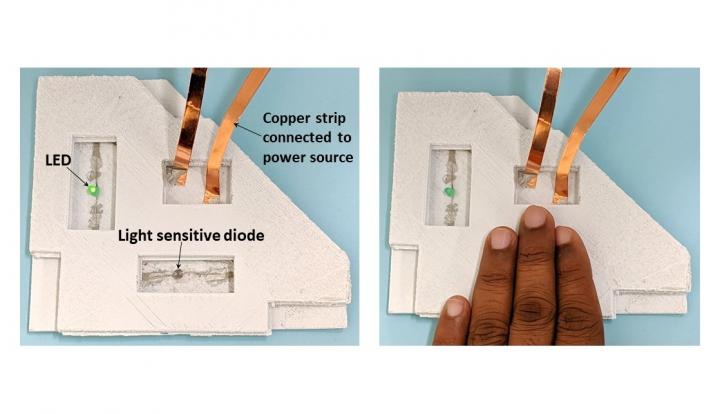
Rutgers engineers have embedded high performance electrical circuits inside 3D-printed plastics, which could lead to smaller and versatile drones and better-performing small satellites, biomedical implants and smart structures.

They used pulses of high-energy light to fuse tiny silver wires, resulting in circuits that conduct 10 times more electricity than the state of the art, according to a study in the journal Additive Manufacturing. By increasing conductivity 10-fold, the engineers can reduce energy use, extend the life of devices and increase their performance.

“Our innovation shows considerable promise for developing an integrated unit – using 3D printing and intense pulses of light to fuse silver nanoparticles – for electronics,” said senior author Rajiv Malhotra, an assistant professor in the Department of Mechanical and Aerospace Engineering in the School of Engineering at Rutgers University-New Brunswick.

Embedding electrical interconnections inside 3D-printed structures made of polymers, or plastics, can create new paradigms for devices that are smaller and more energy-efficient. Such devices could include CubeSats (small satellites), drones, transmitters, light and motion sensors and Global Positioning Systems. Such interconnections are also often used in antennas, pressure sensors, electrical coils and electrical grids for electromagnetic shielding.

The engineers used high-tech “intense pulsed light sintering” – featuring high-energy light from a xenon lamp – to fuse long thin rods of silver called nanowires. Nanomaterials are measured in nanometers (a nanometer is a millionth of a millimeter – about 100,000 times thinner than a human hair). Fused silver nanomaterials are already used to conduct electricity in devices such as solar cells, displays and radio-frequency identification (RFID) tags.

Next steps include making fully 3D internal circuits, enhancing their conductivity and creating flexible internal circuits inside flexible 3D structures, Malhotra said.

###

The lead author is Rutgers doctoral student Md Naim Jahangir. Rutgers co-authors include undergraduate Jeremy Cleeman and postdoctoral student Hyun-Jun Hwang.

Media Contact
Todd Bates
[email protected]
848-932-0550

Original Source

https://news.rutgers.edu/3d-printed-plastics-high-performance-electrical-circuits/20191030#.XbmqnppKi70

Related Journal Article

http://dx.doi.org/10.1016/j.addma.2019.100886

Tags: Biomedical/Environmental/Chemical EngineeringDiagnosticsElectrical Engineering/ElectronicsElectromagneticsMaterialsMechanical EngineeringNanotechnology/MicromachinesTechnology/Engineering/Computer ScienceVehicles
Share12Tweet8Share2ShareShareShare2

Related Posts

Aversive Learning Hijacks Brain Sugar Sensor

March 25, 2026

Can Psychosocial Factors Influence Cancer Risk?

March 23, 2026

Depression Factors in Elderly: Pre vs. Post-COVID Analysis

March 23, 2026

Hidden Health Crises Among US and UK Volunteers in Ukraine Uncovered in New Study

March 23, 2026
Please login to join discussion

POPULAR NEWS

  • blank

    Revolutionary AI Model Enhances Precision in Detecting Food Contamination

    96 shares
    Share 38 Tweet 24
  • Imagine a Social Media Feed That Challenges Your Views Instead of Reinforcing Them

    1003 shares
    Share 397 Tweet 248
  • Uncovering Functions of Cavernous Malformation Proteins in Organoids

    54 shares
    Share 22 Tweet 14
  • Promising Outcomes from First Clinical Trials of Gene Regulation in Epilepsy

    51 shares
    Share 20 Tweet 13

About

We bring you the latest biotechnology news from best research centers and universities around the world. Check our website.

Follow us

Recent News

In-Sensor Cryptography Links Physical Process to Digital Identity

Can Psychosocial Factors Influence Cancer Risk?

Depression Factors in Elderly: Pre vs. Post-COVID Analysis

Subscribe to Blog via Email

Success! An email was just sent to confirm your subscription. Please find the email now and click 'Confirm' to start subscribing.

Join 78 other subscribers
  • Contact Us

Bioengineer.org © Copyright 2023 All Rights Reserved.

Welcome Back!

Login to your account below

Forgotten Password?

Retrieve your password

Please enter your username or email address to reset your password.

Log In
No Result
View All Result
  • Homepages
    • Home Page 1
    • Home Page 2
  • News
  • National
  • Business
  • Health
  • Lifestyle
  • Science

Bioengineer.org © Copyright 2023 All Rights Reserved.