• HOME
  • NEWS
  • EXPLORE
    • CAREER
      • Companies
      • Jobs
    • EVENTS
    • iGEM
      • News
      • Team
    • PHOTOS
    • VIDEO
    • WIKI
  • BLOG
  • COMMUNITY
    • FACEBOOK
    • INSTAGRAM
    • TWITTER
Saturday, June 27, 2026
BIOENGINEER.ORG
No Result
View All Result
  • Login
  • HOME
  • NEWS
  • EXPLORE
    • CAREER
      • Companies
      • Jobs
        • Lecturer
        • PhD Studentship
        • Postdoc
        • Research Assistant
    • EVENTS
    • iGEM
      • News
      • Team
    • PHOTOS
    • VIDEO
    • WIKI
  • BLOG
  • COMMUNITY
    • FACEBOOK
    • INSTAGRAM
    • TWITTER
  • HOME
  • NEWS
  • EXPLORE
    • CAREER
      • Companies
      • Jobs
        • Lecturer
        • PhD Studentship
        • Postdoc
        • Research Assistant
    • EVENTS
    • iGEM
      • News
      • Team
    • PHOTOS
    • VIDEO
    • WIKI
  • BLOG
  • COMMUNITY
    • FACEBOOK
    • INSTAGRAM
    • TWITTER
No Result
View All Result
Bioengineer.org
No Result
View All Result
Home NEWS Science News Chemistry

Vicinal reaction: A radical strategy for linking three organic groups together

Bioengineer by Bioengineer
October 31, 2019
in Chemistry
Reading Time: 3 mins read
0
IMAGE
Share on FacebookShare on TwitterShare on LinkedinShare on RedditShare on Telegram

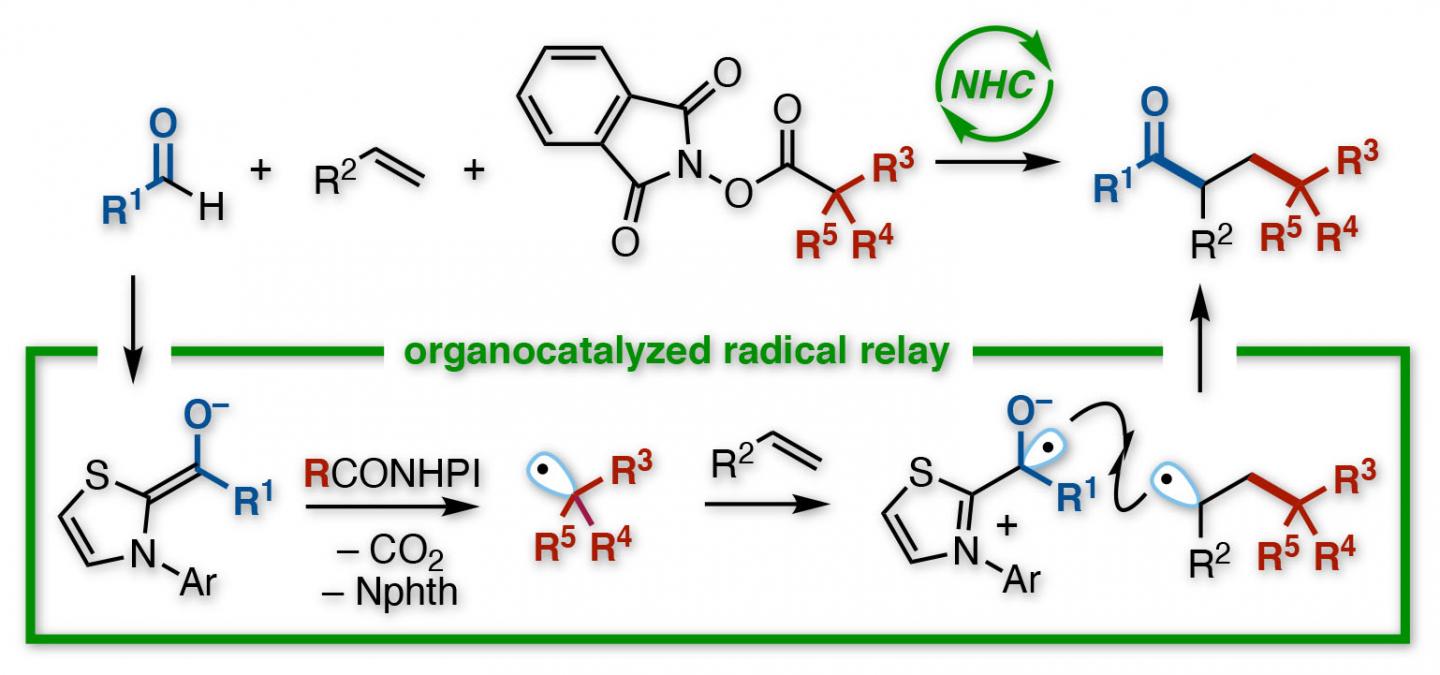
Kanazawa University researchers design a radical reaction to build highly functionalized ketones, installing two new carbon-carbon bonds at adjacent positions using a non-metal catalyst
IMAGE

Credit: Kanazawa University


Kanazawa, Japan – Organic chemists are molecular architects, designing sophisticated structures. As the molecules used in science and medicine become ever more complex, new tools are needed to piece together the building blocks. Now, a Japanese team at Kanazawa University has developed a reaction that links up three components at once using free radical chemistry.

Carbon-carbon double bonds, known as alkenes, are more reactive than single bonds. This makes them useful for connecting different groups: if the double bond is broken, two new molecules can be added at either end, bridged together by the now single-bonded former alkene.

The Kanazawa team looked at ways to achieve this transformation using aldehydes, which contain a double bond between oxygen and carbon, as one of the two molecules grafted onto an alkene. As reported in the Journal of the American Chemical Society, the goal was to create highly functionalized ketones, an important family of compounds in organic synthesis.

Their chosen method was a reaction known, evocatively enough, as a radical relay. Containing an unpaired electron, and thus a half-empty orbital, radicals (or free radicals) tend to be voraciously reactive. So reactive, indeed, that they cannot be stored, but must be generated in-situ by whipping off an electron from somewhere during a reaction, sparking a cascade of bond-breaking and making.

Chemists can make radicals in various ways, but the Kanazawa team wanted to road-test oraganocatalyst, termed an N-heterocyclic carbene (NHC). With an aldehyde as one reactant, and a functionalized redox ester as the other, the NHC triggered their transformation into radicals. Previous studies hinted that both radicals would react faster with an alkene than with each other.

“The challenge with radicals is that, being so unstable, they often react with themselves,” says study co-author Kazunori Nagao. “Then you get either your starting materials back, or a side-product, instead of the target. We minimized this here. In fact, the reaction proceeded as a relay–first the alkyl radical added to one carbon of the alkene, and then the acyl radical added to the other.”

The resulting compound had a ketone and an ester-derived group bonded to two adjacent carbons, in a so-called vicinal arrangement. Although direct reaction between the different radicals also occurred–giving an unwanted two-component product, instead of the alkene-bridged three-component target–it was minor. Furthermore, a wide range of starting materials were compatible with the process.

“Two crucial points are worth mentioning,” says Hirohisa Ohmiya, corresponding author of the study. “First, unlike some reactions, ours is free of metal catalysts and does not need a light source to produce radicals, making it green and versatile. Second, the NHC precisely controls the relay, so we can be selective in the positions of functional groups. We are now working on an asymmetric version for chiral products.”

###

Media Contact
Tomoya Sato
[email protected]
81-762-645-076

Original Source

https://doi.org/10.1021/jacs.9b07194

Related Journal Article

http://dx.doi.org/10.1021/jacs.9b07194

Tags: Chemistry/Physics/Materials SciencesIndustrial Engineering/ChemistryPharmaceutical SciencesPharmaceutical/Combinatorial Chemistry
Share12Tweet8Share2ShareShareShare2

Related Posts

AI and Physics Collaborate to Design Advanced Hydrogen Storage Materials

June 25, 2026

International Team Including Dresden Scientists Develops Novel Designer Proteins for Advanced Study of Living Tissue

June 25, 2026

New Study Uncovers Key Factors Driving Water Chemistry in Nanoscale Environments

June 25, 2026

Plasma Technology Extends Catalyst Lifespan in Hydrogen Production

June 24, 2026
Please login to join discussion

POPULAR NEWS

  • Saying Goodbye to PGY-6: Pediatric Fellowship Realities

    103 shares
    Share 41 Tweet 26
  • Multi-Hospital Study Reveals Long Covid Burden Is Twice as High as Current Estimates

    92 shares
    Share 36 Tweet 23
  • Detection of EDCs in Breast Milk and Infant Urine Up to Six Months Highlights Early Exposure Risks

    77 shares
    Share 31 Tweet 19
  • New Drug Candidate Developed at McMaster Shows Potential for Treating Brain Cancer

    58 shares
    Share 23 Tweet 15

About

We bring you the latest biotechnology news from best research centers and universities around the world. Check our website.

Follow us

Recent News

Tracking Lanthanide-Labeled Microplastics in Plants

POSTECH Researchers Slash Cost of Reconstituted Cell-Free Systems by 95%

AI and Physics Collaborate to Design Advanced Hydrogen Storage Materials

Subscribe to Blog via Email

Success! An email was just sent to confirm your subscription. Please find the email now and click 'Confirm' to start subscribing.

Join 82 other subscribers
  • Contact Us

Bioengineer.org © Copyright 2023 All Rights Reserved.

Welcome Back!

Login to your account below

Forgotten Password?

Retrieve your password

Please enter your username or email address to reset your password.

Log In
No Result
View All Result
  • Homepages
    • Home Page 1
    • Home Page 2
  • News
  • National
  • Business
  • Health
  • Lifestyle
  • Science

Bioengineer.org © Copyright 2023 All Rights Reserved.