• HOME
  • NEWS
  • EXPLORE
    • CAREER
      • Companies
      • Jobs
    • EVENTS
    • iGEM
      • News
      • Team
    • PHOTOS
    • VIDEO
    • WIKI
  • BLOG
  • COMMUNITY
    • FACEBOOK
    • INSTAGRAM
    • TWITTER
Sunday, March 29, 2026
BIOENGINEER.ORG
No Result
View All Result
  • Login
  • HOME
  • NEWS
  • EXPLORE
    • CAREER
      • Companies
      • Jobs
        • Lecturer
        • PhD Studentship
        • Postdoc
        • Research Assistant
    • EVENTS
    • iGEM
      • News
      • Team
    • PHOTOS
    • VIDEO
    • WIKI
  • BLOG
  • COMMUNITY
    • FACEBOOK
    • INSTAGRAM
    • TWITTER
  • HOME
  • NEWS
  • EXPLORE
    • CAREER
      • Companies
      • Jobs
        • Lecturer
        • PhD Studentship
        • Postdoc
        • Research Assistant
    • EVENTS
    • iGEM
      • News
      • Team
    • PHOTOS
    • VIDEO
    • WIKI
  • BLOG
  • COMMUNITY
    • FACEBOOK
    • INSTAGRAM
    • TWITTER
No Result
View All Result
Bioengineer.org
No Result
View All Result
Home NEWS Science News Chemistry

Visible light and nanoparticle catalysts produce desirable bioactive molecules

Bioengineer by Bioengineer
October 30, 2019
in Chemistry
Reading Time: 2 mins read
0
IMAGE
Share on FacebookShare on TwitterShare on LinkedinShare on RedditShare on Telegram

Simple photochemical method takes advantage of quantum mechanics
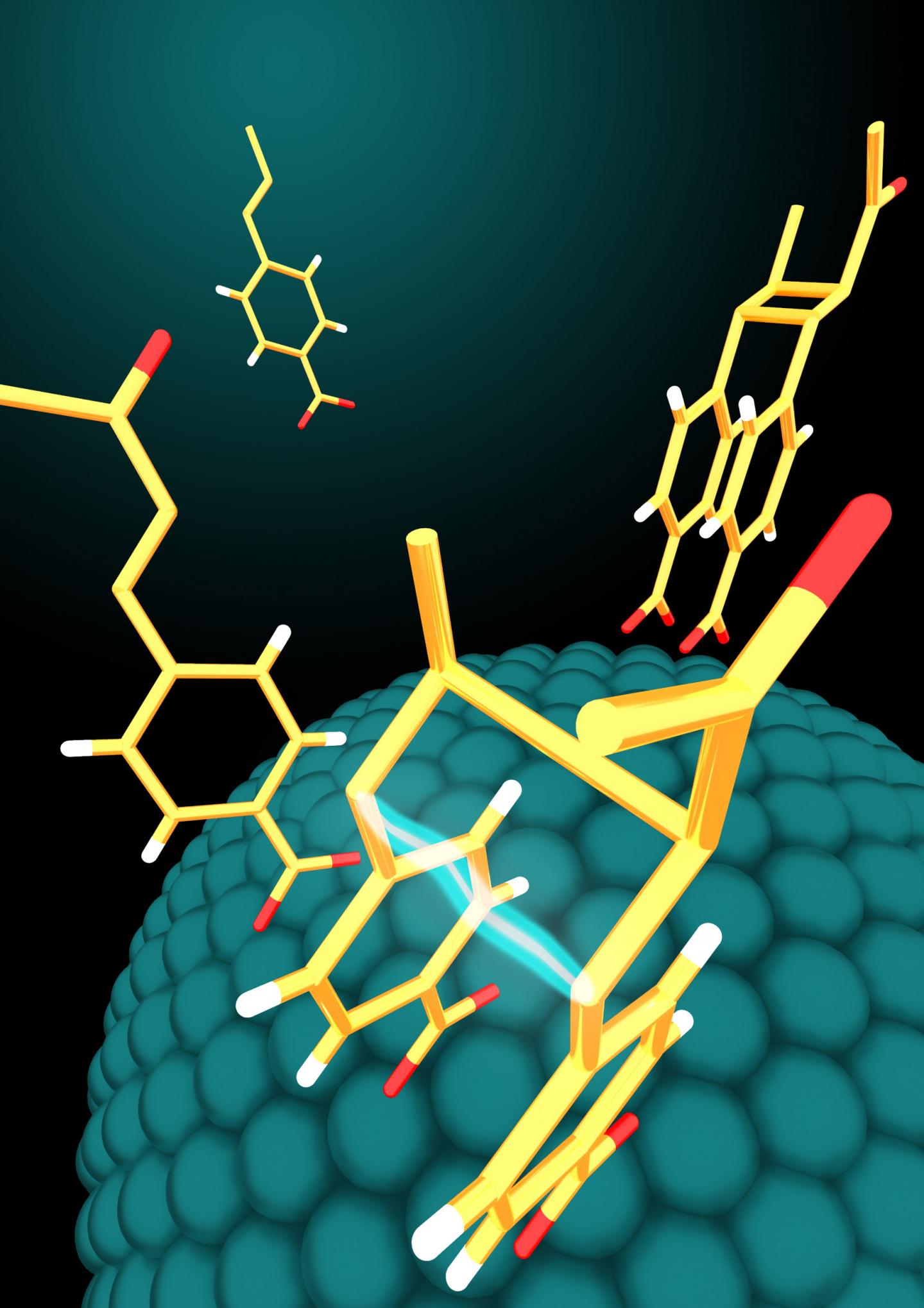
IMAGE

Credit: Credit: Yishu Jiang, Northwestern University


Northwestern University chemists have used visible light and extremely tiny nanoparticles to quickly and simply make molecules that are of the same class as many lead compounds for drug development.

Driven by light, the nanoparticle catalysts perform chemical reactions with very specific chemical products — molecules that don’t just have the right chemical formulas but also have specific arrangements of their atoms in space. And the catalyst can be reused for additional chemical reactions.

The semiconductor nanoparticles are known as quantum dots — so small that they are only a few nanometers across. But the small size is power, providing the material with attractive optical and electronic properties not possible at greater length scales.

“Quantum dots behave more like organic molecules than metal nanoparticles,” said Emily A. Weiss, who led the research. “The electrons are squeezed into such a small space that their reactivity follows the rules of quantum mechanics. We can take advantage of this, along with the templating power of the nanoparticle surface.”

This work, published recently by the journal Nature Chemistry, is the first use of a nanoparticle’s surface as a template for a light-driven reaction called a cycloaddition, a simple mechanism for making very complicated, potentially bioactive compounds.

“We use our nanoparticle catalysts to access this desirable class of molecules, called tetrasubstituted cyclobutanes, through simple, one-step reactions that not only produce the molecules in high yield, but with the arrangement of atoms most relevant for drug development,” Weiss said. “These molecules are difficult to make any other way.”

Weiss is the Mark and Nancy Ratner Professor of Chemistry in the Weinberg College of Arts and Sciences. She specializes in controlling light-driven electronic processes in quantum dots and using them to perform light-driven chemistry with unprecedented selectivity.

The nanoparticle catalysts use energy from visible light to activate molecules on their surfaces and fuse them together to form larger molecules in configurations useful for biological applications. The larger molecule then detaches easily from the nanoparticle, freeing the nanoparticle to be used again in another reaction cycle.

In their study, Weiss and her team used three-nanometer nanoparticles made of the semiconductor cadmium selenide and a variety of starter molecules called alkenes in solution. Alkenes have core carbon-carbon double bonds which are needed to form the cyclobutanes.

###

The study is titled “Regio- and diastereoselective intermolecular [2+2] cycloadditions photocatalysed by quantum dots.” Yishu Jiang, a graduate student in Weiss’ lab, is the study’s first author.

Media Contact
Amanda Morris
[email protected]
847-467-6790

Related Journal Article

http://dx.doi.org/10.1038/s41557-019-0344-4

Tags: Chemistry/Physics/Materials SciencesMaterialsNanotechnology/Micromachines
Share12Tweet8Share2ShareShareShare2

Related Posts

Isolated H2-Reduced Clusters Boost CO2-to-Methanol Catalysis

Isolated H2-Reduced Clusters Boost CO2-to-Methanol Catalysis

March 25, 2026
blank

Physicists Identify Electronic Drivers Behind Flat Band Quantum Materials

March 21, 2026

Würzburg Chemistry Professor Claudia Höbartner Receives Prestigious Honor

March 20, 2026

Scientists Reveal How Magnets Control Metamaterial Behavior

March 20, 2026
Please login to join discussion

POPULAR NEWS

  • blank

    Revolutionary AI Model Enhances Precision in Detecting Food Contamination

    96 shares
    Share 38 Tweet 24
  • Imagine a Social Media Feed That Challenges Your Views Instead of Reinforcing Them

    1004 shares
    Share 397 Tweet 248
  • Uncovering Functions of Cavernous Malformation Proteins in Organoids

    54 shares
    Share 22 Tweet 14
  • Promising Outcomes from First Clinical Trials of Gene Regulation in Epilepsy

    51 shares
    Share 20 Tweet 13

About

We bring you the latest biotechnology news from best research centers and universities around the world. Check our website.

Follow us

Recent News

In-Sensor Cryptography Links Physical Process to Digital Identity

Can Psychosocial Factors Influence Cancer Risk?

Depression Factors in Elderly: Pre vs. Post-COVID Analysis

Subscribe to Blog via Email

Success! An email was just sent to confirm your subscription. Please find the email now and click 'Confirm' to start subscribing.

Join 78 other subscribers
  • Contact Us

Bioengineer.org © Copyright 2023 All Rights Reserved.

Welcome Back!

Login to your account below

Forgotten Password?

Retrieve your password

Please enter your username or email address to reset your password.

Log In
No Result
View All Result
  • Homepages
    • Home Page 1
    • Home Page 2
  • News
  • National
  • Business
  • Health
  • Lifestyle
  • Science

Bioengineer.org © Copyright 2023 All Rights Reserved.