Advances understanding of which ‘stage 0’ breast cancer patients are most likely to progress to advanced cancer and who may benefit from additional therapy
Credit: Case Western Reserve University
New research at Case Western Reserve University could help better determine which patients diagnosed with the pre-malignant breast cancer commonly as stage 0 are likely to progress to invasive breast cancer and therefore might benefit from additional therapy over and above surgery alone.
Once a lumpectomy of breast tissue reveals this pre-cancerous tumor, most women have surgery to remove the remainder of the affected tissue and some are given radiation therapy as well, said Anant Madabhushi, the F. Alex Nason Professor II of Biomedical Engineering at the Case School of Engineering.
“Current testing places patients in high risk, low risk and indeterminate risk–but then treats those ‘indeterminates’ with radiation, anyway,” said Madabhushi, whose Center for Computational Imaging and Personalized Diagnostics (CCIPD) conducted the new research. “They err on the side of caution, but we’re saying that it appears that it should go the other way–the middle should be classified with the lower risk.
“In short, we’re probably over-treating patients,” Madabhushi continued. “That goes against prevailing wisdom, but that’s what our analysis is finding.”
The most common breast cancer
Stage 0 breast cancer is the most common type and known clinically as ductal carcinoma in situ (DCIS), indicating that the cancer cell growth starts in the milk ducts.
About 60,000 cases of DCIS are diagnosed in the United States each year, accounting for about one of every five new breast cancer cases, according to the American Cancer Society. People with a type of breast cancer that has not spread beyond the breast tissue live at least five years after diagnosis, according to the cancer society.
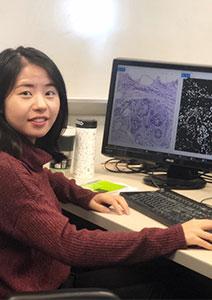
Lead researcher Haojia Li, a graduate student in the CCIPD, used a computer program analyze the spatial architecture, texture and orientation of the individual cells and nuclei from scanned and digitized lumpectomy tissue samples from 62 DCIS patients.
The result: Both the size and orientation of the tumors characterized as “indeterminate” were actually much closer to those confirmed as low risk for recurrence by an expensive genetic test called Oncotype DX.
Li then validated the features that distinguished the low and high risk Oncotype groups in being able to predict the likelihood of progression from DCIS to invasive ductal carcinoma in an independent set of 30 patients.
“This could be a tool for determining who really needs the radiation, or who needs the gene test, which is also very expensive,” she said.
The research led by Li was published Oct. 17 in the journal Breast Cancer Research.
Madabhushi established the CCIPD at Case Western Reserve in 2012. The lab now includes nearly 60 researchers. The lab has become a global leader in the detection, diagnosis and characterization of various cancers and other diseases, including breast cancer, by meshing medical imaging, machine learning and artificial intelligence (AI).
Some of the lab’s most recent work, in collaboration with New York University and Yale University, has used AI to predict which lung cancer patients would benefit from adjuvant chemotherapy based on tissue slide images.
That advancement was named by Prevention Magazine as one of the top 10 medical breakthroughs of 2018.
###
Case Western Reserve University is one of the country’s leading private research institutions. Located in Cleveland, we offer a unique combination of forward-thinking educational opportunities in an inspiring cultural setting. Our leading-edge faculty engage in teaching and research in a collaborative, hands-on environment. Our nationally recognized programs include arts and sciences, dental medicine, engineering, law, management, medicine, nursing and social work. About 5,100 undergraduate and 6,200 graduate students comprise our student body. Visit case.edu to see how Case Western Reserve thinks beyond the possible.
Media Contact
Michael Scott
[email protected]
216-368-1004