UC3M research
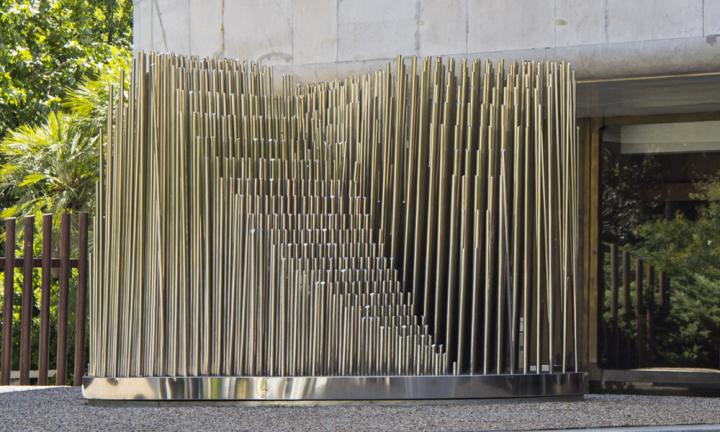
Credit: Dolores Iglesias, Fundación Juan March
The research falls within the field of study of the condensed matter physics, more specifically the field of topological materials, which are solid and which behave as electrical insulators in their interior while allowing for electric conduction on the surface. Another feature that makes these materials interesting is that they are “topologically protected”, that is, a signal remains robust and insensitive to the presence of impurities and defects of the material. Several recent research projects have shown that the higher order topological insulators can concentrate energy in corners. What the UC3M and NJU scientists have done is to “translate” this phenomenon, which is well-known in the theory of quantum physics, to classical acoustics in order to be able to focus acoustic energy in corners. The results were recently published in the journal Physical Review Letters.
To explain the process intuitively, the researchers use the sculpture “Organo” (Organ) by Eusebio Sempere as an example. Located in the gardens of the Fundación Juan March in Madrid (see image), this sculpture is composed of hollow aluminium bars which are separated from each other by a few centimetres and placed in a square lattice. In 1995, Spanish scientists showed that the sculpture was capable of attenuating sound.
Using this idea as a starting point, several studies have been carried out in which, by combining two crystals with different topologies, sound could be transported only through the interface between the two. “In this case, we have taken a further step. The study structure is formed by two sonic crystals with different topology concentrically placed. This new configuration means that the sound cannot be transmitted through the entire structure, but rather it is focused in the corners between the two crystals. The intensity of the sound in each of these corners will depend on the physical properties taken into account”, explains one of the authors of the study, Johan Christensen, from the Physics Department of UC3M.
These theoretical predictions have also been validated experimentally in an article published in the latest issue of the journal Advanced Materials. “Beyond its academic importance, we anticipate that the results obtained could be used to focus acoustic energy”, adds another of the authors, María Rosendo López, a researcher from the PHONOMETA project at UC3M. Potential applications include the development of new waveguides, that is, physical structures which are used to guide sound waves. “We can achieve this without the need for a physical channel, but rather simply through the topology of the study system. This case of sound transport is relevant for filtering and conducting applications. Unlike traditional passive systems, this one is highly robust against imperfections”, says María Rosendo López.
Another potential application is acoustic-electric conversion. “Since we are able to concentrate the sound in the corners, harvest the acoustic energy, concentrate in the corners and then convert it into electrical energy”, the researchers add. These advances could also have applications in industrial ultrasound technologies or in the improvement of certain medical diagnostic tests such as ultrasound, for example.
###
This line of research is carried out within the framework of a broader scientific project, an ERC Starting Grant Horizon 2020 funded by the European Union (GA 714577) called “Frontiers in Phononics: Parity-Time Symmetric Phononic Metamaterials” (PHONOMETA). Within this context, its objective is to analyse and design a new generation of piezoelectric semiconductors that optimise the performance of complex acoustic systems.
Bibliographic references:
Zhang, Z. Rosendo López, M. Cheng, Y. Liu, X. Christensen, J. (2019): Non-Hermitian Sonic Second-Order Topological Insulator. Phys. Rev. Lett. 122, 195501. doi:10.1103/PhysRevLett.122.19550 e-Archivo de la UC3M: http://hdl.
Zhang, Z. Long, H. Liu, C. Shao, C. Cheng, Y. Liu, X. Christensen, J. (2019): Deep-Subwavelength Holey Acoustic Second-Order Topological Insulators. Adv. Mater. 2019. https:/
Media Contact
Francisco Javier Alonso
[email protected]