Credit: Dr. Yan-Peng Liu
Going upstream, and against a current, involves a front-first downward tilt and then moving along a surface, shows new research by a team of scientists, which created “nano-motors” to uncover this effective means of locomotion under such conditions. Its findings and the creation of these tiny motors offer new insights into the nature of movement in fluids and have implications for engineering.
“These nano-motors not only helped us better understand the nature of moving against flows at the tiny scales we can’t easily see, but also could be the first step in developing smart material and robotic systems in the microscopic world,” says Jun Zhang, a professor of physics and mathematics at New York University and a co-author of the paper, which appears in the journal Physical Review Letters.
“While this effect of movement has long been known, our work offers a comprehensive explanation for it, which enhances our understanding of this widespread dynamic,” adds co-author Michael Shelley, a professor at NYU’s Courant Institute of Mathematical Sciences.
The researchers, who also included Quentin Brosseau, a postdoctoral fellow at NYU’s Courant Institute and the paper’s first author, focused on a previously discovered phenomenon, rheotaxis–movement involving a change of direction to head upstream or into a current.
However, detailed explanations for rheotaxis had been lacking. To fully understand this process, the scientists created nano-motors composed of two metals–platinum and gold (Pt/Au). Shelley, Zhang, also a professor at NYU Shanghai, and their colleagues had previously created a more basic version of these nano-motors, which are less than the width of a human hair.
Fabricated in the Molecular Design Institute in NYU’s Department of Chemistry, the motors described in the Physical Review Letters paper were more advanced; the researchers varied the proportions of these metals in order to vary their movement–in some models, the composition was evenly split while others had a 3:1 gold-to-platinum ratio or a 3:1 platinum-to-gold make-up.
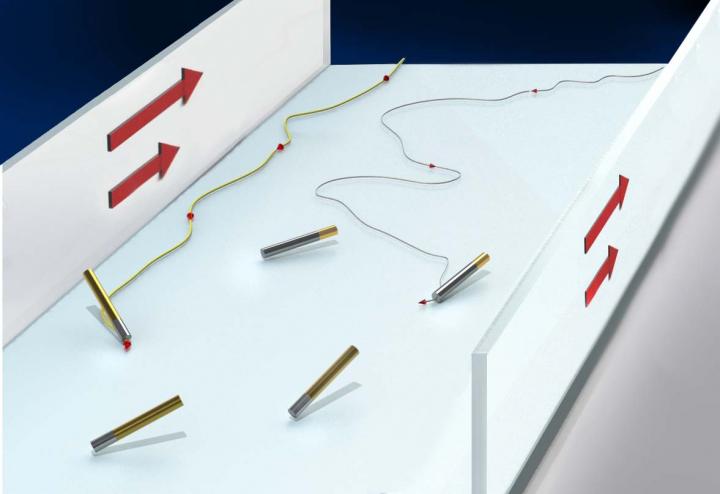
Fueled chemically by a hydrogen peroxide dilution when placed in water, the nano-motors could swim–with the platinum end always serving as the head. However, these motors had different “tilts,” which differed depending on their make-up. Those composed primarily of gold were labeled “pullers” while those largely made up of platinum were called “pushers.” The pullers tended to move with their tails up (a pronounced tilt) while the pushers remained relatively flat.
This difference was significant when it came to moving against currents.
When the tilt is large (pullers), the tail is more exposed to an oncoming flow, which catches the tail and turns the motor around–similar to the way wind turns a weather vane. Consequently, the motor’s front faces the flow, after which the motor continues forward, now moving against the current. By contrast, if the motor is not tilted (pushers), a current cannot catch its tail and spin it around to move against this flow–and, as a result, it is unlikely to respond to an oncoming flow.
“This synthetic system mimics natural micro-organisms, such as E. coli in flow, and offers a means for predicting their pathways through the human body,” observes Brosseau. “It is key to understand contamination processes and engineer smart material for targeted drug delivery.”
###
The paper’s other authors included Michael Ward, a professor in NYU’s Department of Chemistry, Florencio Balboa Usabiaga of the Flatiron Institute, Enkeleida Lushi of the New Jersey Institute of Technology, Yang Wu, a doctoral candidate in NYU’s Department of Chemistry, and Leif Ristroph, an associate professor at NYU’s Courant Institute.
This work was supported by the MRSEC Program of the National Science Foundation (DMR-1420073) and also by additional NSF grants (DMS-1463962 and DMS-1620331).
DOI: 10.1103/PhysRevLett.123.178004
Media Contact
James Devitt
[email protected]
212-998-6808
Related Journal Article
http://dx.