• HOME
  • NEWS
  • EXPLORE
    • CAREER
      • Companies
      • Jobs
    • EVENTS
    • iGEM
      • News
      • Team
    • PHOTOS
    • VIDEO
    • WIKI
  • BLOG
  • COMMUNITY
    • FACEBOOK
    • INSTAGRAM
    • TWITTER
Thursday, January 1, 2026
BIOENGINEER.ORG
No Result
View All Result
  • Login
  • HOME
  • NEWS
  • EXPLORE
    • CAREER
      • Companies
      • Jobs
        • Lecturer
        • PhD Studentship
        • Postdoc
        • Research Assistant
    • EVENTS
    • iGEM
      • News
      • Team
    • PHOTOS
    • VIDEO
    • WIKI
  • BLOG
  • COMMUNITY
    • FACEBOOK
    • INSTAGRAM
    • TWITTER
  • HOME
  • NEWS
  • EXPLORE
    • CAREER
      • Companies
      • Jobs
        • Lecturer
        • PhD Studentship
        • Postdoc
        • Research Assistant
    • EVENTS
    • iGEM
      • News
      • Team
    • PHOTOS
    • VIDEO
    • WIKI
  • BLOG
  • COMMUNITY
    • FACEBOOK
    • INSTAGRAM
    • TWITTER
No Result
View All Result
Bioengineer.org
No Result
View All Result
Home NEWS Science News Health

Attacking metastatic breast cancer with sound

Bioengineer by Bioengineer
October 28, 2019
in Health
Reading Time: 2 mins read
0
IMAGE
Share on FacebookShare on TwitterShare on LinkedinShare on RedditShare on Telegram

IMAGE

Credit: Tohoku University


Drugs can be safely delivered to cancerous lymph nodes via the lymphatic system and then released inside the nodes using sound waves. Tohoku University researchers tested the treatment on mice with metastatic breast cancer and published their findings in the journal Scientific Reports.

“We believe that our technique has the potential to be developed into a new treatment for lymph nodes invaded by metastatic tumour cells,” says Tetsuya Kodama, the Tohoku University biomedical engineer who led the study.

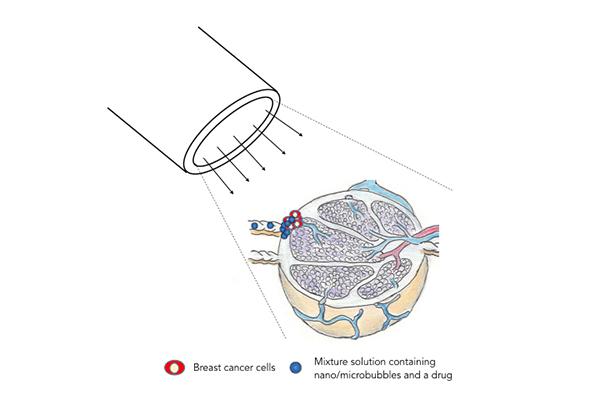
The treatment involves injecting vesicles carrying anticancer drugs into a pelvic lymph node. The vesicles travel through the lymphatic system to reach lymph nodes in the armpit affected by breast cancer metastases. When high power ultrasound is applied to the armpit, the vesicles rupture, leading to targeted drug release.

Breast cancer is the most common cancer in women and causes the greatest number of cancer-related deaths amongst them. In its advanced stages, cancer cells can break away from the original tumour and travel through the lymphatic system to establish metastases in lymph nodes that can then travel to other parts of the body.

Disease prognosis could be improved if there was a way to safely and effectively treat lymph node metastases. Currently available treatments are highly invasive and can have severe side effects.

Kodama and his colleagues in Japan had previously tested their treatment on mice with a type of breast tumour that produces lymph node metastases with low invasive growth and well-defined borders. For this study, they tried the treatment on the more invasive metastases generated by breast cancer.

The team first used an ultrasound imaging technique to follow the movement of drug-free ‘acoustic liposomes’, vesicles containing gas bubbles, through the lymphatic system in mice. They were able to confirm that liposomes injected into a pelvic lymph node travelled to an armpit lymph node, where they settled.

They then injected breast cancer cells into the pelvic lymph nodes of another group of mice. The cancer cells quickly reached and invaded the armpit lymph node.

Acoustic liposomes carrying the anticancer drug doxorubicin were then injected into the pelvic lymph node. High-intensity sound waves were applied to the armpit area on the same and third days following the injection to rupture the liposomes and release the drug.

The team demonstrated that the treatment was effective in killing the cancerous tissue using a bioluminescence technique that monitors cancer growth, and by studying excised lymph nodes under a microscope.

Further investigations will be needed to determine the optimal injection rate and volume of the treatment to prevent lymphatic complications.

###

Media Contact
Tetsuya Kodama
[email protected]
81-227-177-583

Original Source

https://www.tohoku.ac.jp/en/press/attacking_metastatic_breast_cancer_with_sound.html

Related Journal Article

http://dx.doi.org/10.1038/s41598-019-49386-5

Tags: Breast CancercancerMedicine/Health
Share12Tweet8Share2ShareShareShare2

Related Posts

Gestational Diabetes Alters Weight Gain’s Impact on Outcomes

January 1, 2026

Coping Strategies in Rural Seniors with Chronic Illness

January 1, 2026

Physicians Embrace New Anemia Support in Hemodialysis

January 1, 2026

Preterm Birth’s Impact on Childhood Psychomotor Skills

January 1, 2026
Please login to join discussion

POPULAR NEWS

  • blank

    PTSD, Depression, Anxiety in Childhood Cancer Survivors, Parents

    108 shares
    Share 43 Tweet 27
  • NSF funds machine-learning research at UNO and UNL to study energy requirements of walking in older adults

    71 shares
    Share 28 Tweet 18
  • Exploring Audiology Accessibility in Johannesburg, South Africa

    52 shares
    Share 21 Tweet 13
  • SARS-CoV-2 Subvariants Affect Outcomes in Elderly Hip Fractures

    44 shares
    Share 18 Tweet 11

About

We bring you the latest biotechnology news from best research centers and universities around the world. Check our website.

Follow us

Recent News

Storing Light in Cages Enables Scalable Quantum Memories

Gestational Diabetes Alters Weight Gain’s Impact on Outcomes

Dual Delayed Fluorescence and Phosphorescence in Organics

Subscribe to Blog via Email

Enter your email address to subscribe to this blog and receive notifications of new posts by email.

Join 71 other subscribers
  • Contact Us

Bioengineer.org © Copyright 2023 All Rights Reserved.

Welcome Back!

Login to your account below

Forgotten Password?

Retrieve your password

Please enter your username or email address to reset your password.

Log In
No Result
View All Result
  • Homepages
    • Home Page 1
    • Home Page 2
  • News
  • National
  • Business
  • Health
  • Lifestyle
  • Science

Bioengineer.org © Copyright 2023 All Rights Reserved.