• HOME
  • NEWS
  • EXPLORE
    • CAREER
      • Companies
      • Jobs
    • EVENTS
    • iGEM
      • News
      • Team
    • PHOTOS
    • VIDEO
    • WIKI
  • BLOG
  • COMMUNITY
    • FACEBOOK
    • INSTAGRAM
    • TWITTER
Saturday, February 7, 2026
BIOENGINEER.ORG
No Result
View All Result
  • Login
  • HOME
  • NEWS
  • EXPLORE
    • CAREER
      • Companies
      • Jobs
        • Lecturer
        • PhD Studentship
        • Postdoc
        • Research Assistant
    • EVENTS
    • iGEM
      • News
      • Team
    • PHOTOS
    • VIDEO
    • WIKI
  • BLOG
  • COMMUNITY
    • FACEBOOK
    • INSTAGRAM
    • TWITTER
  • HOME
  • NEWS
  • EXPLORE
    • CAREER
      • Companies
      • Jobs
        • Lecturer
        • PhD Studentship
        • Postdoc
        • Research Assistant
    • EVENTS
    • iGEM
      • News
      • Team
    • PHOTOS
    • VIDEO
    • WIKI
  • BLOG
  • COMMUNITY
    • FACEBOOK
    • INSTAGRAM
    • TWITTER
No Result
View All Result
Bioengineer.org
No Result
View All Result
Home NEWS Science News Chemistry

Always on beat: ultrashort flashes of light under optical control

Bioengineer by Bioengineer
October 17, 2019
in Chemistry
Reading Time: 2 mins read
0
IMAGE
Share on FacebookShare on TwitterShare on LinkedinShare on RedditShare on Telegram

Scientists from the University of Bayreuth and the University of Göttingen have discovered a new method
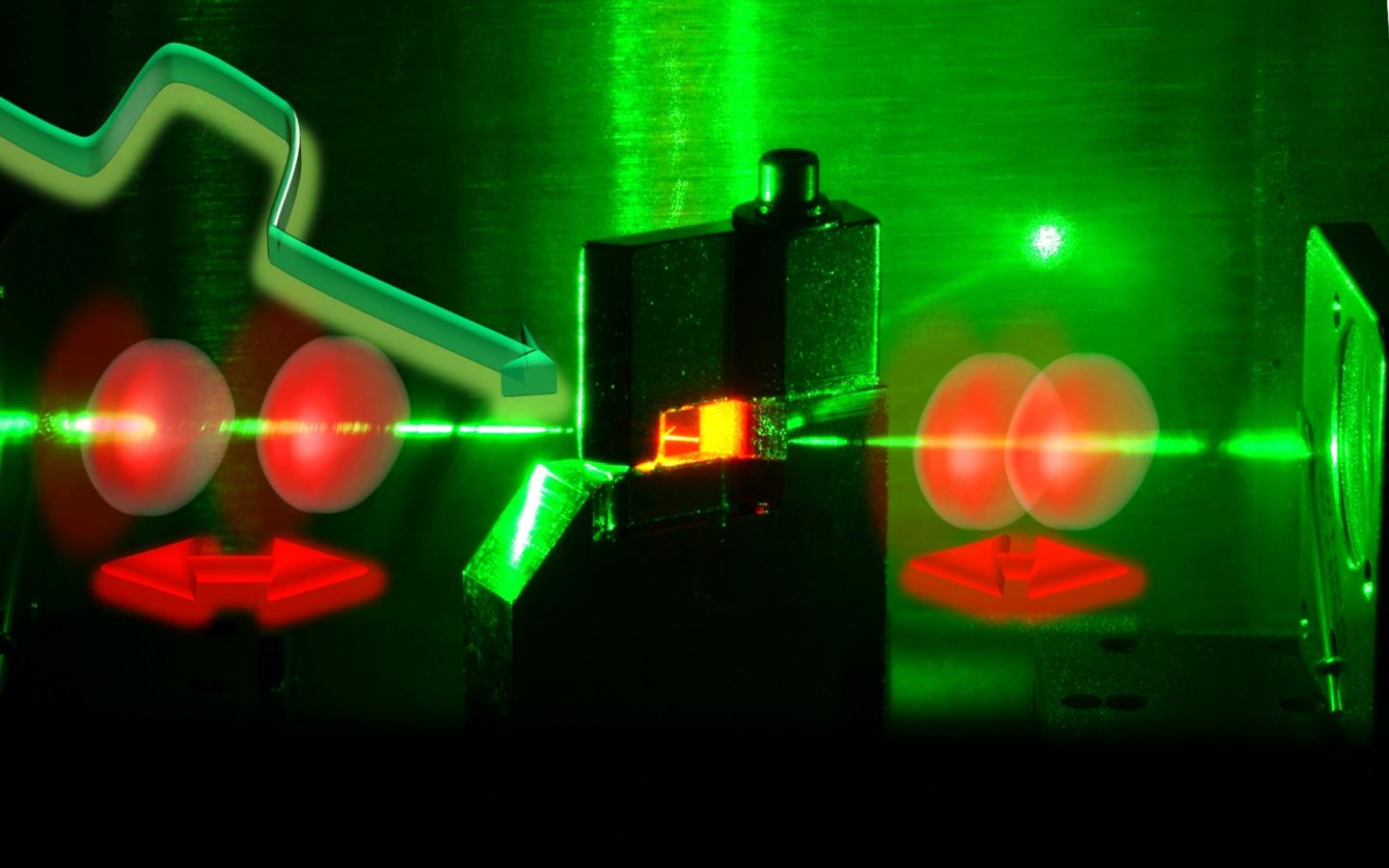
IMAGE

Credit: University of Bayreuth

Ultrashort laser pulses have enabled scientists and physicians to carry out high-precision material analyses and medical procedures. Physicists from the Universities of Bayreuth and Göttingen have now discovered a new method for adjusting the extremely short time intervals between laser flashes with exceptional speed and precision. The intervals can be increased or decreased as needed, all at the push of a button. Potential applications range from laser spectroscopy to microscopy and materials processing. The results were published in Nature Photonics.

Laser pulses have long been utilized in research laboratories, industrial production, and medical therapies. In these applications it is often crucial that the pulses – also known as optical solitons – occur at certain intervals. Using a special high-speed measurement technique, the researchers were able to show how a short-pulse laser widely applied in research can be made to automatically generate pairs of light pulses separated by the desired interval. All that is required are small disturbances in the green “pump beam” (which generates the laser pulses) triggered by electric signals.

The new process centres on the targeted manipulation of solitons, wave packets that can occur in pairs in ultrashort laser pulses. “The resonance excitation and the short disturbance of soliton pairs trigger effects that can be used to specifically control ultrashort laser pulses. This opens up an exciting new area of research with a yet unforeseeable range of possible applications,” said Professor Georg Herink from the University of Bayreuth, corresponding author of the new study.

“At the right frequency, a tiny external modulation of the laser is all you need, and ultrashort laser pulses are set into reciprocal, resonant oscillation. Similar phenomena can be observed in water molecules heated in the microwave,” added lead author Felix Kurtz from the University of Göttingen. The newly published findings show that in the future, ultra-short pulse lasers will not only be considered as a tool, but also remain a fascinating object of research.

###

F. Kurtz, C. Ropers. G. Herink: Resonant excitation and all-optical switching of femtosecond soliton molecules. Nature Photonics (2019). https://doi.org/10.1038/s41566-019-0530-3

Contact:

Professor Georg Herink

Experimental Physics VIII

University of Bayreuth

Phone: +49 (0)921 / 55-3161

E-mail: [email protected]

Professor Claus Ropers

IV. Physical Institute

University of Göttingen

Email: [email protected]

Felix Kurtz

IV. Physical Institute

University of Göttingen

Email: [email protected]

Media Contact
Georg Herink
[email protected]
49-092-15531

Original Source

http://www.uni-goettingen.de/en/3240.html?id=5651

Related Journal Article

http://dx.doi.org/10.1038/s41566-019-0530-3

Tags: Chemistry/Physics/Materials Sciences
Share12Tweet8Share2ShareShareShare2

Related Posts

blank

Breakthrough in Environmental Cleanup: Scientists Develop Solar-Activated Biochar for Faster Remediation

February 7, 2026
blank

Cutting Costs: Making Hydrogen Fuel Cells More Affordable

February 6, 2026

Scientists Develop Hand-Held “Levitating” Time Crystals

February 6, 2026

Observing a Key Green-Energy Catalyst Dissolve Atom by Atom

February 6, 2026
Please login to join discussion

POPULAR NEWS

  • Robotic Ureteral Reconstruction: A Novel Approach

    Robotic Ureteral Reconstruction: A Novel Approach

    82 shares
    Share 33 Tweet 21
  • Digital Privacy: Health Data Control in Incarceration

    63 shares
    Share 25 Tweet 16
  • Study Reveals Lipid Accumulation in ME/CFS Cells

    57 shares
    Share 23 Tweet 14
  • Breakthrough in RNA Research Accelerates Medical Innovations Timeline

    53 shares
    Share 21 Tweet 13

About

We bring you the latest biotechnology news from best research centers and universities around the world. Check our website.

Follow us

Recent News

Boosting Remote Healthcare: Stepped-Wedge Trial Insights

Barriers and Boosters of Seniors’ Physical Activity in Karachi

Evaluating Pediatric Emergency Care Quality in Ethiopia

Subscribe to Blog via Email

Enter your email address to subscribe to this blog and receive notifications of new posts by email.

Join 73 other subscribers
  • Contact Us

Bioengineer.org © Copyright 2023 All Rights Reserved.

Welcome Back!

Login to your account below

Forgotten Password?

Retrieve your password

Please enter your username or email address to reset your password.

Log In
No Result
View All Result
  • Homepages
    • Home Page 1
    • Home Page 2
  • News
  • National
  • Business
  • Health
  • Lifestyle
  • Science

Bioengineer.org © Copyright 2023 All Rights Reserved.