Killer T cells identified in blood that can hone in on mutations uniquely expressed in cancer cells pave the way for an alternative and personalized therapeutic avenue
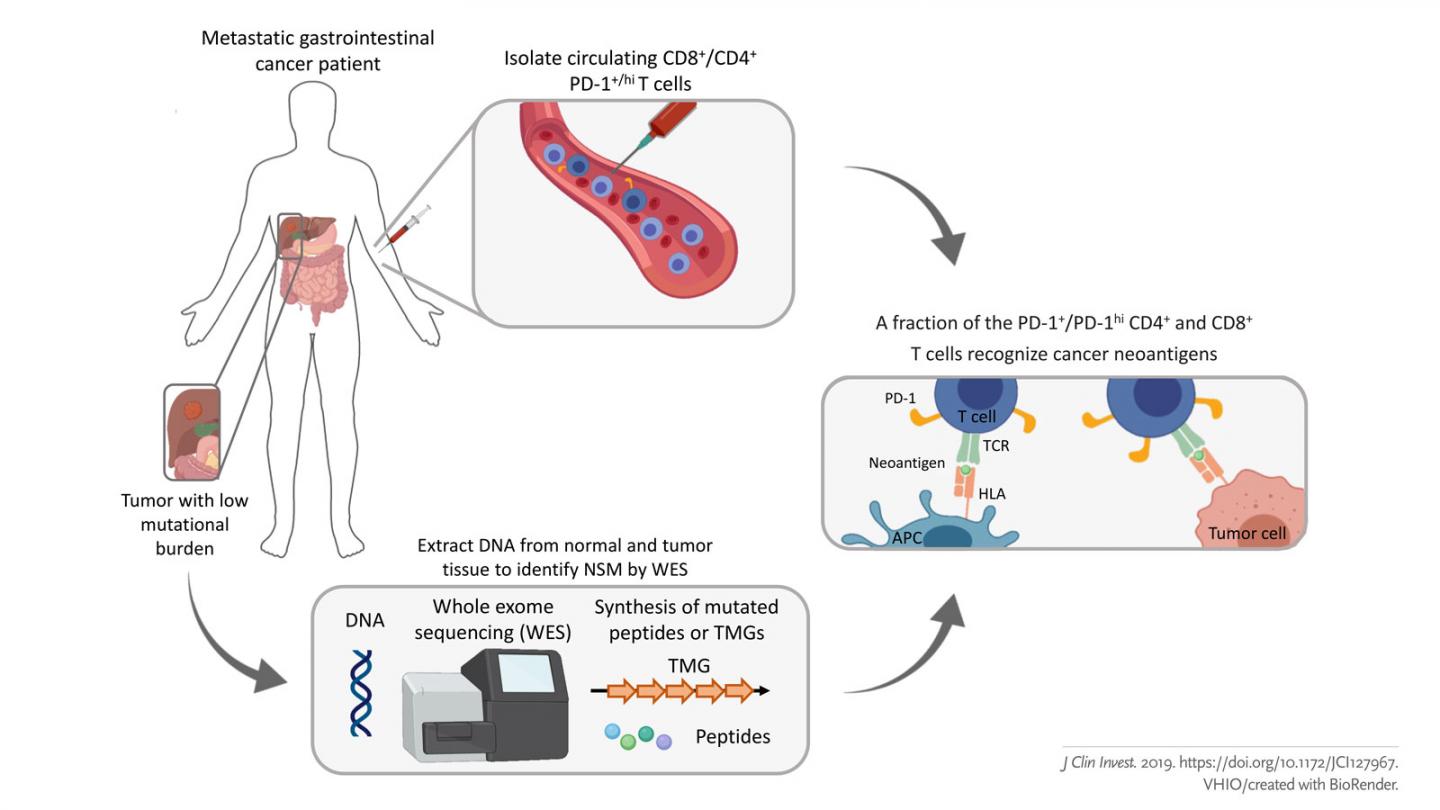
Credit: VHIO/created with BioRender.
Research led by VHIO’s Alena Gros signposts a new, less invasive approach to identify killer T lymphocytes in patients with gastrointestinal tumors with low mutational burden who are refractory to approved immune-based treatments.
Killer T cells identified in blood that can hone in on mutations uniquely expressed in cancer cells pave the way for an alternative and personalized therapeutic avenue.
In today’s current era of precision medicine against cancer, we are increasingly witnessing how research is successfully potentiating and personalizing immunotherapy to more effectively unleash the power of the immune system in a greater number of patients to attack disease. Despite such progress, much work still needs to be done to better predict those patients who would be most likely benefit from them, extend their promise to more patients as well as tumor types – either as monotherapy, or, most likely in combination. “As importantly, we must pursue new therapeutic directions for those patients who are refractory to these novel treatments,” said Alena Gros, Principal Investigator of VHIO’s Tumor Immunology & Immunotherapy Group, and lead and senior author of a study published open access this week in The Journal of Clinical Investigation*.
Carried out in collaboration with Steven A. Rosenberg at the National Cancer Institute (NCI-NIH, Bethesda, USA) – an internationally renowned trailblazer in cancer immunotherapy, along with other researchers at the Robert W. Franz Cancer Center (Portland, USA), and the Karolinska Institute (Stockholm, Sweden), this study represents an important forward step in seeking out alternative treatment approaches for those patients who do not respond to current immunotherapies.
More specifically, those patients with gastrointestinal tumors with low mutational burden, so-called ‘cold’ tumors, constitute a current challenge for immunotherapy. Novel cell therapies based on the administration of killer T cells that can recognize neoantigens, have shown promising antitumor activity in a small number of patients with cold tumors.
These present findings break new ground within the field by promoting the development of these treatments towards ultimately providing new hope for patients with metastatic disease who do not respond to treatment with approved cancer immunotherapies. Additionally, the investigators have described a less invasive, blood-based method to identify, measure and track lymphocytes against neoantigens expressed in advanced gastrointestinal cancers including pancreas, gastroesophageal, bile duct, colon and rectum.
“While we did not expect to find killer T lymphocytes in the blood of these patients with cold tumors, with low mutational burden, we have now shown that we can identify and select these cells in blood, which will facilitate and spur the future development of pioneering and personalized cell therapies by liquid biopsy,” noted Alena Gros.
“It is thanks to our strong collaboration with the BBVA Foundation, one of VHIO’s patrons, that we launched our Comprehensive Program of Cancer Immunotherapy & Immunology (CAIMI). This institutional program seeks to advance agents that inhibit checkpoint regulation of the immune system, decipher mechanisms of resistance and response to these therapies, and prioritize the early development of those agents showing most promise. One of our major objectives is to generate novel cell therapies for the more effective treatment of cancer patients,” she concluded.
This study will promote the identification of neoantigen-specific T lymphocytes derived from blood towards ultimately offering a new array of personalized and more promising anti-cancer immunotherapeutic for these patients.
###
This work was supported by the BBVA Foundation through the BBVA-VHIO Comprehensive Program of Cancer Immunotherapy & Immunology (CAIMI), as well as the Instituto de Salud Carlos III (ISCIII) – Carlos III Institute of Health, and FERO Foundation. We also acknowledge and gratefully thank the CELLEX Foundation for VHIO’s state-of-the-art research facilities and scientific equipment.
*Alena Gros, Eric Tran, Maria R. Parkhurst, Sadia Ilyas, Anna Pasetto, Eric M. Groh, Paul F. Robbins, Rami Yossef, Andrea Garcia-Garijo, Carlos A. Fajardo, Todd D. Prickett, Li Jia, Jared J. Gartner, Satyajit Ray, Lien Ngo, John R. Wunderllich, James C. Yang, and Steven A. Rosenberg. Recognition of human gastrointestinal cancer neoantigens by circulating PD-1+ lymphocytes. J Clin Invest. 2019. https:/
Media Contact
Amanda Wren
[email protected]
34-695-207-886
Original Source
http://www.
Related Journal Article
http://dx.