Credit: Credit: Florencia Fahnestock/UNH
DURHAM, N.H.–As global temperatures continue to rise, the thawing of permafrost in Arctic areas is being accelerated and mercury that has been trapped in the frozen ground is now being released in various forms into surrounding waterways, soil and air. According to researchers at the University of New Hampshire, this process can result in the major transformation of the mercury into more mobile and potentially toxic forms that can lead to environmental consequences and health concerns for wildlife, the fishing industry and people in the Arctic and beyond.
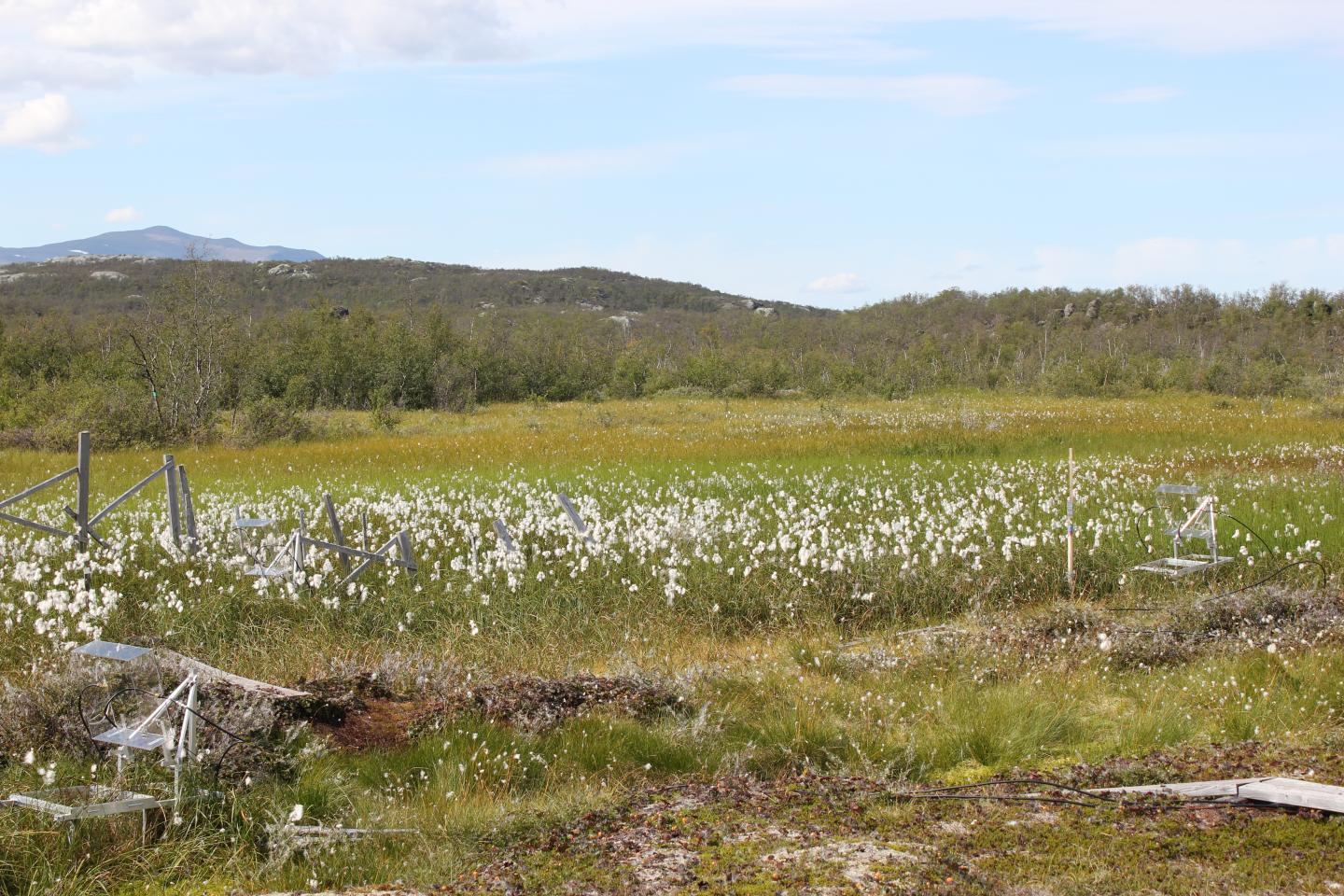
In their research, recently published in Geochemical Perspectives Letters, scientists examined mercury reallocation–the movement from previously frozen soils into the surrounding environments–north of the Arctic Circle in Abisko, Sweden. They found that as the landscape changes due to warming temperatures, they see a significant increase in the levels of methylmercury, a neurotoxin, that could have a cascade of effects.
“Our research suggests that Arctic wildlife, such as birds and fish, may be at increased risk of exposure to higher levels of methylmercury that could ultimately impact their reproduction and populations,” said Florencia Fahnestock, a doctoral candidate in Earth sciences and the lead author of the study. “It also has the potential to impact indigenous people if they are eating methylmercury-contaminated wildlife, and possibly the fishing industry, if the mercury is flushed out of the watershed into the ocean.”
The study took a comprehensive look at how climate change is causing landscapes to transform and therefore favor methylmercury production. They looked at “total mercury”–all different forms of mercury including solid, gaseous, methyl–and the way it changes, along with the thawing landscapes, into the more harmful methylmercury. The most toxic form of mercury, it is more readily taken up by animals. Three different landscapes were examined for the evolution of the mercury and microbial communities along these landscapes to determine how these changes occurred. They assessed palsa, or frozen permafrost, the semi-thawed area often known as a bog, and the fen, a saturated landscape filled with flowing water and fully thawed peat.
Air, water and soil were analyzed for methylmercury and researchers found that the fens had much higher concentrations of methylmercury than the other landscapes. Fahnestock explains that while permafrost contains mercury it is not methylated. It’s only when it reaches the watery fens that the lack of oxygen in the sediments provides the perfect environment for it to convert to methylmercury.
“We don’t have a good handle on how the mercury gets into terrestrial food webs; it may depend on where land-based animals graze,” said Julie Bryce, professor of geochemistry. “Plants growing in some of these thawing environments could be laden with mercury.”
Mercury is naturally emitted into the atmosphere from volcanoes, forest fires and the weathering of rocks, but fossil fuels and gold mining are also major contributors. While the study looked at landscape changes in the Arctic, researchers say this same mercury migration and methylmercury production could happen in other areas. Mercury, released during thaw, can be carried by both water and wind – often very far away from its original source. If it is converted into methylmercury upon release or during transport it has more potential to enter the food chain – through fish, birds and wildlife – and the potency increases as it moves up the food chain, making it a possible public health concern.
###
The University of New Hampshire inspires innovation and transforms lives in our state, nation, and world. More than 16,000 students from all 50 states and 71 countries engage with an award-winning faculty in top-ranked programs in business, engineering, law, health and human services, liberal arts and the sciences across more than 200 programs of study. As one of the nation’s highest-performing research universities, UNH partners with NASA, NOAA, NSF and NIH, and receives more than $110 million in competitive external funding every year to further explore and define the frontiers of land, sea and space.
Media Contact
Robbin Ray
[email protected]
603-862-4864
Original Source
https:/