Achieved densities of 2D organic quantum-dot arrays an order of magnitude larger than conventional inorganic systems
Credit: FLEET
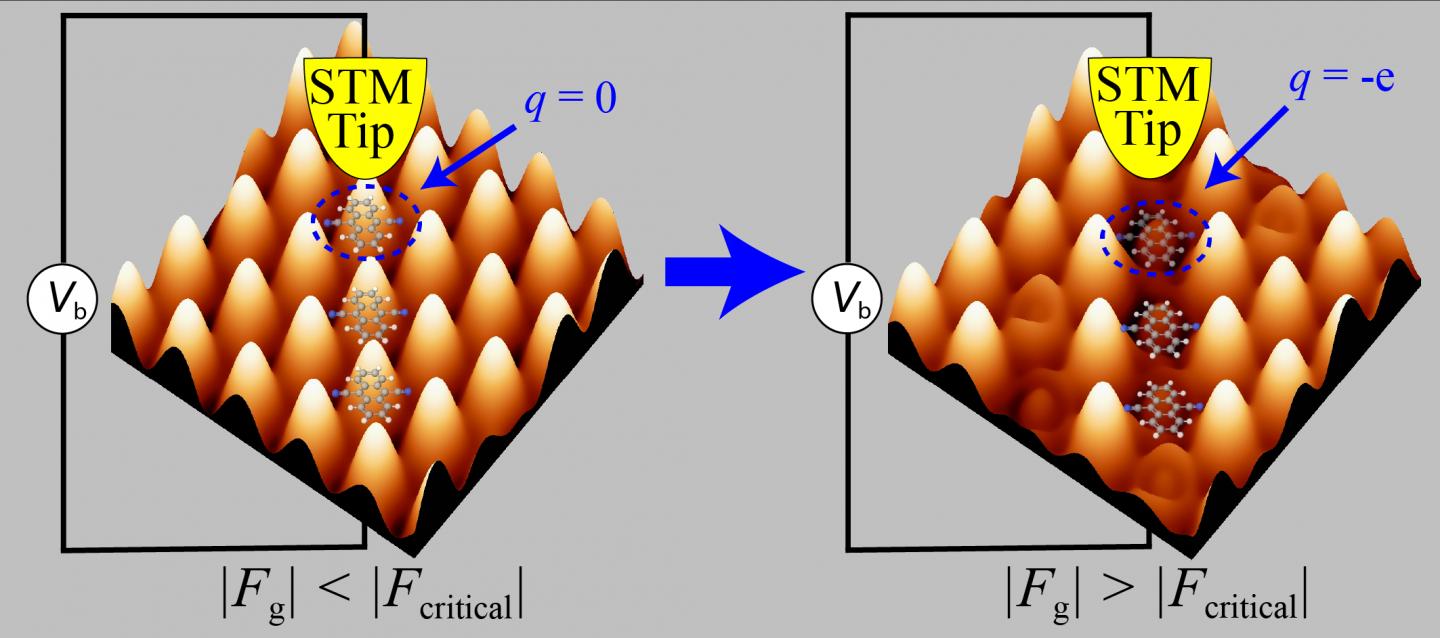
Australian researchers have fabricated a self-assembled, carbon-based nanofilm where the charge state (ie, electronically neutral or positive) can be controlled at the level of individual molecules, on a length scale of around one nanometre.
Molecular self-assembly on a metal results in a high-density, 2D, organic quantum-dot array with electric-field-controllable charge state, with the organic molecules used as ‘nano-sized building blocks’ in fabrication of functional nanomaterials.
Achieved densities are an order of magnitude larger than conventional inorganic systems.
The atomically-thin nanofilm consists of an ordered two-dimensional (2D) array of molecules which behave as ‘zero dimensional’ entities called quantum dots (QDs).
This system has exciting implications for fields such as computer memory, light-emitting devices and quantum computing.
The School of Physics and Astronomy study shows that a single-component, self-assembled 2D array of the organic (carbon-based) molecule dicyanoanthracene can be synthesised on a metal, such that the charge state of each molecule can be controlled individually via an applied electric field.
“This discovery would enable the fabrication of 2D arrays of individually addressable (switchable) quantum dots from the bottom-up, via self-assembly, says lead author Dhaneesh Kumar.
“We would be able to achieve densities tens of times larger than state-of-the-art, top-down synthesised inorganic systems.”
QUANTUM DOTS: TINY, ‘ZERO-DIMENSIONAL’ POWERHOUSES
Quantum dots are extremely small – about one nanometre across (ie, a millionth of a millimetre).
Because their size is similar to the wavelength of electrons, their electronic properties are radically different to conventional materials.
In quantum dots, the motion of electrons is constrained by this extremely small scale, resulting in discrete electronic quantum energy levels.
Effectively, they behave as ‘zero-dimensional’ (0D) objects, where the degree of occupancy (filled or empty) of their quantised electronic states determines the charge (in this study, neutral or negative) of the quantum dot.
Ordered arrays of charge-controllable quantum dots can find application in computing memory as well as light-emitting devices (eg, low-energy TV or smartphone screens).
Arrays of quantum dots are conventionally synthesised from inorganic materials via top-down fabrication approaches. However, using such ‘top-down’ approaches, it can be challenging to achieve arrays with large densities and high homogeneity (in terms of quantum-dot size and spacing).
Because of their tunability and self-assembling capability, using organic (carbon-based) molecules as nano-sized building blocks can be particularly useful for the fabrication of functional nanomaterials, in particular well-defined scalable ensembles of quantum dots.
THE STUDY
The researchers synthesised a homogeneous, single-component, self-assembled 2D array of the organic molecule dicyanoanthracene (DCA) on a metal surface.
The study was led by Monash University’s Faculty of Science, with support by theory from the Monash Faculty of Engineering.
This atomic-scale structural and electronic properties of this nanoscale array were studied experimentally via low-temperature scanning tunnelling microscopy (STM) and atomic force microscopy (AFM) (School of Physics and Astronomy, under Dr Agustin Schiffrin). Theoretical studies using density functional theory supported the experimental findings (Department of Material Science and Engineering, under A/Prof Nikhil Medhekar).
The researchers found that the charge of individual DCA molecules in the self-assembled 2D array can be controlled (switched from neutral to negative and vice versa) by an applied electric field. This charge state electric-field-control is enabled by an effective tunneling barrier between molecule and surface (resulting from limited metal-adsorbate interactions) and a significant DCA electron affinity.
Subtle, site-dependent variations of the molecular adsorption geometry were found to give rise to significant variations in the susceptibility for electric-field-induced charging.
###
Electric field control of molecular charge state in a single-component 2D organic nanoarray was published in ACS Nano. (DOI: 10.1021/acsnano.9b05950 )
As well as funding from the Australian Research Council (Centres of Excellence and Future Fellowship programs), the authors acknowledge the support of the Monash high-performance computing cluster, the National Computing Infrastructure (NCI) and the Pawsey Supercomputing Facility.
Media Contact
Errol Hunt
[email protected]
61-423-139-210
Original Source
http://www.
Related Journal Article
http://dx.