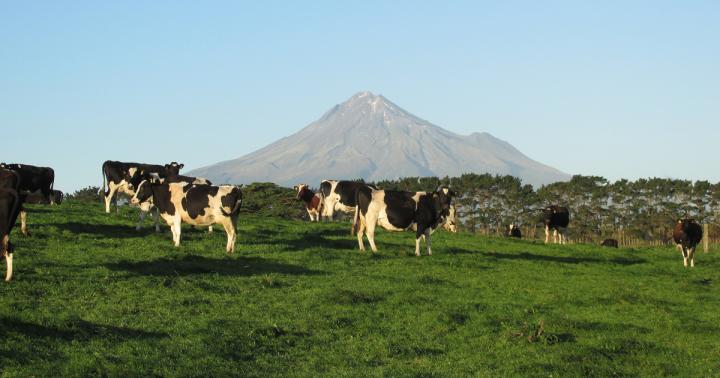
Credit: Valerio Hoyos-Villegas
Four-leaved clovers may or may not bring good luck. What’s indisputable is that all white clovers, whether with three or four leaves, have many benefits.
The United States Department of Agriculture calls white clover “one of the most important pasture legumes.” In New Zealand, it is one of the main species, along with ryegrass, grown in pastures.
On farms, white clover provides multiple services. Bacteria in clover root nodules ‘fix’ atmospheric nitrogen and make it available to crops. White clover is a great source of protein for farm animals. In cities, white clover often accompanies the grass used in lawns and playgrounds.
Despite its many uses, white clover breeders in New Zealand did not have access to a comprehensive map of the population structure or genetic landscape of white clover diversity in the country. Now, researchers in New Zealand have created the first detailed map of white clover ancestry and genetics.
“This ‘pedigree map’ – achieved via pedigree analysis – will serve as an important resource to white clover breeders,” says Valerio Hoyos-Villegas, lead author of the study. “It will also help make more informed decisions in the breeding of different white clover varieties.”
For all crops, different varieties may be needed to grow in different environments for varying purposes. For example, some crop varieties might need to be drought resistant. Others may be bred to have high yields while growing on poor soils.
In addition to gaining a resource for breeding white clover varieties with desired traits, researchers also found information on the heritage of the species. Pedigree analysis provided this vital information.
For example, the researchers were able to confirm the genetic makeup of the plants initially used to establish white clover crops in New Zealand. They could trace how these initial group of plants, brought in by early plant breeders, were the basis for other varieties of white clover developed later.
“Understanding this genetic history of white clover will help maximize diversity in breeding populations,” says Hoyos-Villegas. A diverse breeding population can help breeders develop varieties of white clover with more desired traits.
The researchers focused on a collection of white clover germplasm, maintained in the Margot Forde Germplasm Centre (seed bank) in Palmerston North, New Zealand. Germplasm refers to genetic resources or material maintained for breeding or conservation goals.
“Safeguarding germplasm is the most inexpensive and efficient method of genetic conservation for important plants,” says Hoyos-Villegas. But, simply having a germplasm collection is of limited use. “We have created a curated resource of pedigree information,” he says. “This resource can be used by any breeder or geneticist interested in using the white clover germplasm.”
The study also provides a summary and results of white clover breeding efforts over the last 80 years. The historical nature of the research threw up some unique obstacles. “We were dealing with data from many different sources,” says Hoyos-Villegas. “One of the main challenges was curating the data to reach a standard that gave us confidence in the results.”
The researchers collected and analyzed a lot of historical information in the study. Now, their results can serve as a launch pad for future research and breeding efforts. For example, researchers can use the pedigree analysis to associate traits of interest with specific genes.
“We can also cross populations of white clover based on data from the pedigree analysis,” says Hoyos-Villegas. “We can test these populations to determine what sort of novel genetic variations we can create.” These data can then be used to complement ongoing breeding efforts in the private sector.
Researchers are now thinking about expanding pedigree analysis into different species beyond clover. “It would be very useful to extend this analysis to other important forage species,” he says. “Perennial ryegrass, which is often used as a companion species to clover in pastures, would be a great next choice.”
###
This research was recently published in Crop Science. Funding was provided by AgResearch internal investment.
Media Contact
Rachel Leege
[email protected]
608-268-3976
Related Journal Article
http://dx.