• HOME
  • NEWS
  • EXPLORE
    • CAREER
      • Companies
      • Jobs
    • EVENTS
    • iGEM
      • News
      • Team
    • PHOTOS
    • VIDEO
    • WIKI
  • BLOG
  • COMMUNITY
    • FACEBOOK
    • INSTAGRAM
    • TWITTER
Friday, December 5, 2025
BIOENGINEER.ORG
No Result
View All Result
  • Login
  • HOME
  • NEWS
  • EXPLORE
    • CAREER
      • Companies
      • Jobs
        • Lecturer
        • PhD Studentship
        • Postdoc
        • Research Assistant
    • EVENTS
    • iGEM
      • News
      • Team
    • PHOTOS
    • VIDEO
    • WIKI
  • BLOG
  • COMMUNITY
    • FACEBOOK
    • INSTAGRAM
    • TWITTER
  • HOME
  • NEWS
  • EXPLORE
    • CAREER
      • Companies
      • Jobs
        • Lecturer
        • PhD Studentship
        • Postdoc
        • Research Assistant
    • EVENTS
    • iGEM
      • News
      • Team
    • PHOTOS
    • VIDEO
    • WIKI
  • BLOG
  • COMMUNITY
    • FACEBOOK
    • INSTAGRAM
    • TWITTER
No Result
View All Result
Bioengineer.org
No Result
View All Result
Home NEWS Science News Health

Lymphoma stage at diagnosis may predict when and where new cancer forms

Bioengineer by Bioengineer
October 8, 2019
in Health
Reading Time: 2 mins read
0
IMAGE
Share on FacebookShare on TwitterShare on LinkedinShare on RedditShare on Telegram

IMAGE

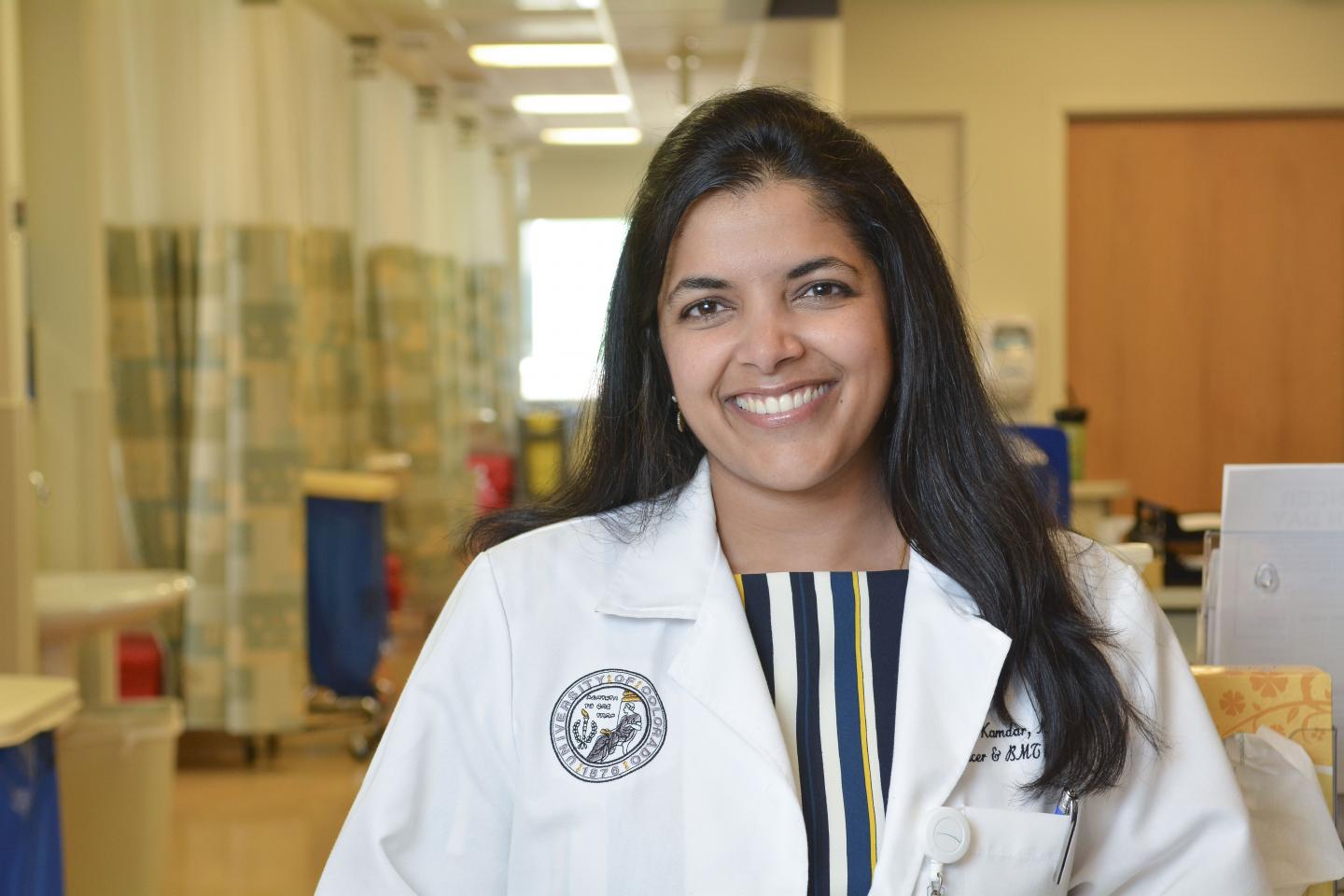
Credit: University of Colorado Cancer Center

With improved treatments, especially the use of anti-cancer immunotherapies, more than two-thirds of all patients diagnosed with diffuse large B-cell lymphoma (DLBCL) will survive. However, after treatment, patients are at a small but real risk of developing a new cancer, called a second primary cancer. Now a Colorado study of long term DLBCL survivors shows, for the first time, that the stage at which DLBCL is originally diagnosed impacts the types of second cancers that may form after treatment.

“We have made tremendous progress in this field, and as a result, patients are living longer. Thus, survivorship has taken center stage in the management of these lymphomas. Given that these patients are at an increased risk of developing second primary cancers, our goal is to identify risk factors that can predict or mitigate this risk,” says Manali Kamdar, MD, investigator at the University of Colorado Cancer Center and Clinical Director of Lymphoma Services at UCHealth University of Colorado Hospital.

The study explored the outcomes of 26,038 patients diagnosed with DLBCL between 1973 and 2010, more than half of whom were diagnosed with stage 1 or 2 disease, and a little less than half of whom were diagnosed with stage 3 or 4 disease. Overall, 13 percent of survivors went on to develop second primary cancers.

“We’ve known that, genetically, early and late stage disease is different, and our hypothesis was that the type and timing of secondary primary cancers may thus be different as well,” Kamdar says.

In fact, the study showed that compared with late-stage cancers, patients diagnosed with early-stage DLBCL had a higher risk of developing second primary cancers in the five years following successful treatment, and that these new cancers tended to be mostly solid tumors, such as those of the breast, colon, or prostate. In contrast, patients whose DLBCL was stage 3 or 4 at the time of diagnosis had an increased risk of developing second primary cancers in the 10-15-year window after successful treatment, and instead of solid tumors, these cancers tended to be hematologic malignancies, including forms of leukemia.

“This is a first step toward identifying tools in survivorship clinics to better surveil survivors. It benefits patients because we may be able to better identify risk,” Kamdar says.

For example, Kamdar, suggests that if a patient were to find low blood counts 10 years after treatment for late-stage DLBCL, it would warrant further testing given the risk associated with a history of late-stage DLBCL. Similarly, the study reinforces the need for DLBCL survivors to follow through with age-based screening recommendations, such as colonoscopies and mammograms.

Kamdar and colleagues hope this study will lead the way for prospective trials with the goal of decreasing not only DLBCL relapse, but also the development of second primary cancers.

###

Media Contact
Garth Sundem
[email protected]

Original Source

https://coloradocancerblogs.org/lymphoma-stage-predict-secondary-cancer/

Related Journal Article

http://dx.doi.org/10.1002/cncr.32513

Tags: BiologycancerEpidemiologyGeneticsHealth Care Systems/ServicesHealth ProfessionalsHematologyInternal MedicineMedicine/HealthPublic Health
Share13Tweet8Share2ShareShareShare2

Related Posts

Metformin-Alogliptin Combo vs. Monotherapy in Diabetes

December 3, 2025

Botanical Extracts’ Antibacterial Activity Boosted by Enhancers

December 3, 2025

Global Guidelines for Shared Decision-Making in Valvular Heart Disease

December 3, 2025

Hidradenitis Suppurativa Remission Achieved Using Bacteriophage Therapy

December 3, 2025
Please login to join discussion

POPULAR NEWS

  • New Research Unveils the Pathway for CEOs to Achieve Social Media Stardom

    New Research Unveils the Pathway for CEOs to Achieve Social Media Stardom

    204 shares
    Share 82 Tweet 51
  • Scientists Uncover Chameleon’s Telephone-Cord-Like Optic Nerves, A Feature Missed by Aristotle and Newton

    121 shares
    Share 48 Tweet 30
  • Neurological Impacts of COVID and MIS-C in Children

    107 shares
    Share 43 Tweet 27
  • MoCK2 Kinase Shapes Mitochondrial Dynamics in Rice Fungal Pathogen

    69 shares
    Share 28 Tweet 17

About

We bring you the latest biotechnology news from best research centers and universities around the world. Check our website.

Follow us

Recent News

Boosting Cancer Immunotherapy by Targeting DNA Repair

Evaluating eGFR Equations in Chinese Children

Metformin-Alogliptin Combo vs. Monotherapy in Diabetes

Subscribe to Blog via Email

Success! An email was just sent to confirm your subscription. Please find the email now and click 'Confirm' to start subscribing.

Join 69 other subscribers
  • Contact Us

Bioengineer.org © Copyright 2023 All Rights Reserved.

Welcome Back!

Login to your account below

Forgotten Password?

Retrieve your password

Please enter your username or email address to reset your password.

Log In
No Result
View All Result
  • Homepages
    • Home Page 1
    • Home Page 2
  • News
  • National
  • Business
  • Health
  • Lifestyle
  • Science

Bioengineer.org © Copyright 2023 All Rights Reserved.