SUTD worked with International Researchers to develop a novel approach to allow for a small, well-defined risk of constraint violation to overcome the challenges that come with conservative current approaches used in modern power grids
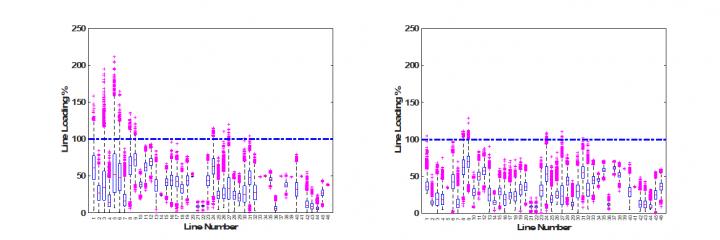
Credit: SUTD
Modern power grids are rapidly developing due to the increasing penetration of renewable energy sources such as solar photovoltaic and wind power. This trend is expected to rise in the near future, as attested by major countries worldwide in their commitments to the production of large renewable power penetration.
A modern power grid, with its reduced dependence on non-renewable energy, has indisputable advantages in terms of environmental safeguards, but its introduction does not come without a cost.
Renewable energy generation technologies are highly variable and not fully dispatchable, resulting in new challenges to the existing power system operational paradigm. In fact, when uncontrollable resources such as a renewable energy resource fluctuates, classical optimal power flow (OPF) solutions can provide very inefficient power generation policies that result in line overloads and potentially cascading outages.
Classical OPF dispatch is typically computed based on simple predictions of expected loads and generation levels for the upcoming time window. Although these predictions can be fairly precise for traditional power grids, they may be highly unreliable in the case of renewable generators, thus explaining its failure in these latter situations.
Despite the increasingly larger investments, which are costly and subject to several regulatory and policy limitations, power outages due to the uncertainty introduced by renewable power generation still occur frequently. This situation shows that a strategy based solely on investments in technological improvements of the transmission lines and controllable generation capacity is not sufficient anymore. Instead, radically new dispatch philosophies need to be devised to cope with the increasing uncertainty due to unpredictable fluctuations in renewable output.
One of the major challenges in today’s power grids is to design a dispatch policy that minimizes generation costs, while ensuring not to violate generation and transmission constraints for all admissible values of renewable power and variable demand.
Researchers from the Singapore University of Technology and Design (SUTD), Singapore, CNR-IEIIT, Politecnico di Torino, Italy and the Pennsylvania State University, USA proposed a novel probabilistic dispatch strategy for modern power grids that not only reduces the generation cost and possibly the amount of greenhouse gas injected into the atmosphere, but also ensures that all constraints in the power network are satisfied, preventing overload and cascading outage. Their research was published in IEEE Transactions on Control of Network Systems.
The researchers proposed a randomized algorithm based on the novel concept of scenario with certificates and convex relaxations of power flow problems. The effectiveness of the proposed solution, as illustrated in figure 1, shows that one can significantly decrease the probability of constraint violation without a significant impact on the nominal power generation cost. Moreover, the approach is shown to be very efficient from a computational viewpoint.
“One of the advantages of the probabilistic approach pursued in this research is to avoid conservatism associated with the existing methods. Instead of requiring that the network constraints are satisfied for all possible values of uncertainty, we pushed the boundaries and allowed for a small well-defined risk of constraint violation to develop this new approach,” explained lead author Dr. Mohammadreza Chamanbaz, Senior Research Fellow, SUTD.
###
Media Contact
Jessica Sasayiah
[email protected]
656-499-4823
Original Source
https:/
Related Journal Article
http://dx.